










What is Anorectal Abscess Drainage?
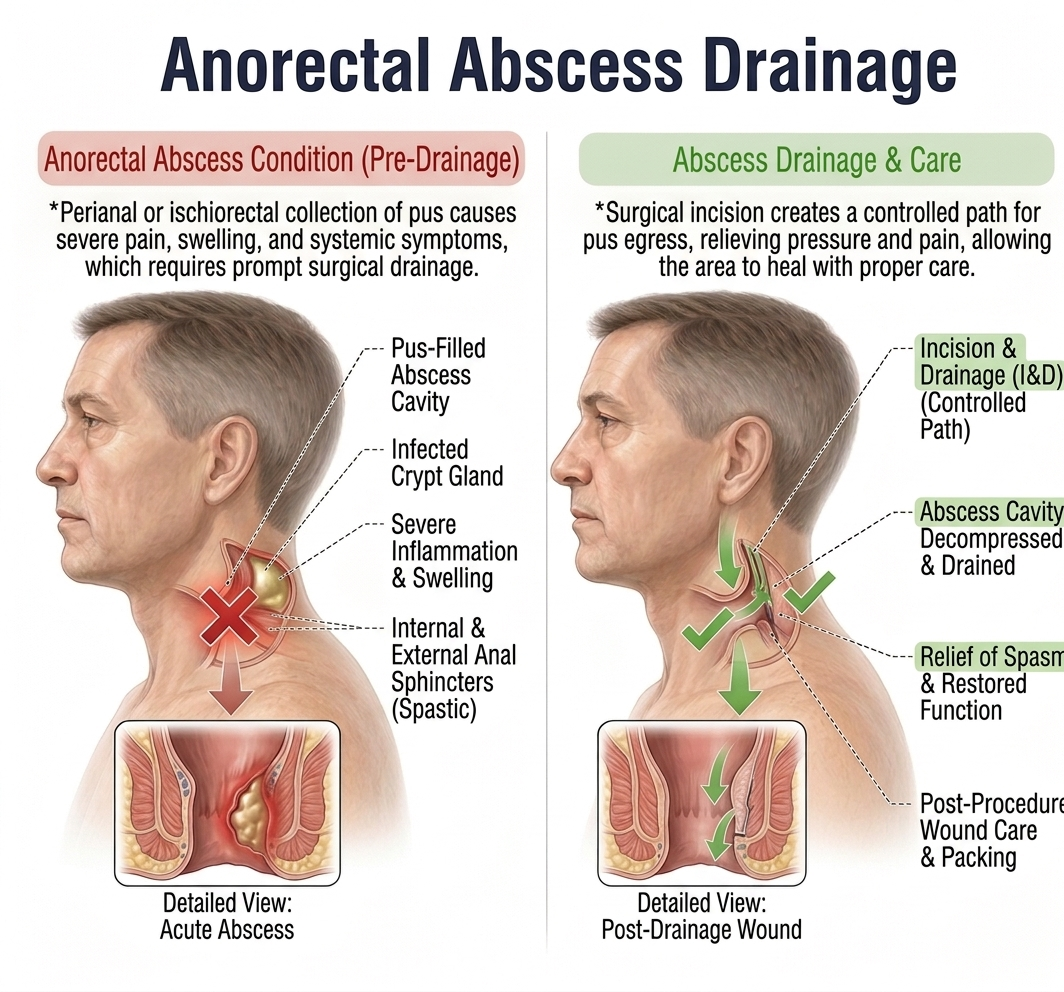
An anorectal abscess is an acute collection of pus in the tissue spaces surrounding the anus and rectum, usually arising from an infected anal crypt gland. Surgical Incision and Drainage (I&D) involves opening the abscess cavity to evacuate trapped pus, relieve intense pressure, and prevent the spread of infection into deeper pelvic tissue spaces.
Who Needs Anorectal Abscess Drainage?
Anorectal abscesses require urgent surgical drainage. Antibiotics alone cannot penetrate an undrained fluid collection.
Key clinical indicators include:
- Severe, constant throbbing pain in the perianal area that worsens with sitting, walking, or bowel movements.
- Visible, tender, red, fluctuating lump near the anal opening.
- High fever, chills, and systemic signs of infection (sepsis).
- Deep pelvic pain or urinary retention caused by an ischiorectal or supralevator abscess.
Types of Anorectal Abscesses
- Perianal Abscess: Most common (60%); superficial collection right under the perianal skin.
- Ischiorectal Abscess: Deeper abscess occupying the ischiorectal fossa; requires deeper drainage.
- Intersphincteric Abscess: Located between the internal and external anal sphincter layers.
- Supralevator Abscess: Deep pelvic abscess above the levator ani muscle; requires specialized surgical drainage.
Crucial Medical Warning: Delaying abscess drainage can lead to extensive tissue necrosis, Fournier's gangrene, or severe bloodstream infection (sepsis).
Benefits of Anorectal Abscess Drainage
- Immediate, dramatic relief from excruciating perianal pain.
- Rapid control of fever, systemic infection, and inflammatory response.
- Prevents destruction of surrounding sphincter muscles and tissue structures.
- Fast recovery with low risk of surgical complications.
What to Expect Before Surgery?
- Urgent Clinical Evaluation: Physical examination and digital rectal check (or Ultrasound/MRI for deep occult abscesses).
- Fast-Track Surgical Clearance: Emergency blood work (CBC, blood sugar, renal function) and pre-anesthetic check.
- Intravenous Antibiotics: Immediate initiation of broad-spectrum IV antibiotics.
Complete Procedure
The Incision & Drainage procedure follows these steps:
- Administration of spinal, short general, or local anesthesia with sedation.
- Patient positioned in lithotomy or jackknife position.
- Identification and palpation of the point of maximal fluctuation over the abscess.
- Making a cruciate (cross-shaped) or ellipse incision over the abscess to ensure open drainage.
- Complete evacuation of loculated pus pockets, followed by thorough saline irrigation.
- Placement of a loose wound packing, cavity drain, or seton string if an underlying fistula is identified.
- Application of a sterile, absorbent pressure dressing.
What to Expect During Surgery?
The surgical procedure takes 15 to 30 minutes. Patients wake up with immediate relief from the severe pressure pain caused by trapped pus.
In-Clinic Drainage vs OR Surgical Drainage
| Feature | Bedside Local Drainage | OR Surgical Drainage (Recommended) |
|---|---|---|
| Pain Control | Incomplete local numbing | 100% painless under spinal/general anesthesia |
| Exploration | Cannot break deep septa | Thorough evacuation of all pus loculations |
| Fistula Identification | Difficult | High accuracy in evaluating primary crypt gland |
| Recurrence Risk | Higher due to incomplete drainage | Significantly lower recurrence rate |
Success Rate and Safety
Urgent surgical drainage successfully resolves acute infection in over 95% of cases. Approximately 30-50% of patients may subsequently develop a chronic anal fistula requiring elective secondary treatment.
Anorectal Abscess Drainage Cost Estimate
| Procedure Category | Estimated Cost Range (INR) |
|---|---|
| Simple Perianal Abscess Drainage (Day Care) | ₹25,000 - ₹45,000 |
| Deep Ischiorectal / Supralevator Drainage | ₹45,000 - ₹85,000 |
Disclaimer: Final costs depend on emergency OR admission, overnight ICU stay requirement for septic patients, and diabetes/co-morbidity management.
Recovery Guide & Post-Operative Care
Recovery Timeline
- Day 0-1: Discharge home once fully awake and able to pass urine naturally.
- Days 2-3: Removal of initial wound packing; initiation of sitz baths.
- Week 1-2: Wound cavity begins Granulation (healing from the inside out); drainage decreases.
- Week 3-4: Complete skin closure of the drained cavity.
Post-Op Precautions & Care
- Daily Warm Sitz Baths: Take 15-minute sitz baths 3 times daily to keep the open wound cavity clean.
- Absorbent Dressings: Keep clean cotton pads over the area to absorb ongoing tissue drainage.
- Complete Antibiotic Course: Finish all prescribed oral antibiotics strictly.
- Monitor for Fistula: Report any persistent thin watery drainage lasting longer than 6 weeks for fistula evaluation.
Frequently Asked Questions
Can an anorectal abscess be treated with antibiotics without surgery?⌄
No. Antibiotics cannot clear a closed pus collection. Emergency surgical incision and drainage is mandatory to prevent severe infection spread.
Will an abscess turn into an anal fistula?⌄
Approximately 30% to 50% of patients with an anorectal abscess develop an anal fistula later because the original infected anal gland remains connected to the skin.
Why is the drainage wound left open instead of stitched closed?⌄
Leaving the incision open allows continuous drainage of residual fluid, allowing the cavity to heal safely from the inside out and preventing pus from re-accumulating.
How long will the wound discharge pus or fluid after drainage?⌄
Minor clear or pinkish drainage is normal for 1 to 2 weeks while the cavity fills with healthy tissue.
Is abscess drainage performed as a day-care procedure?⌄
Yes, simple perianal abscess drainage is usually performed as a day-care procedure, allowing patients to return home the same day.