





What is Cochlear Implant Surgery?
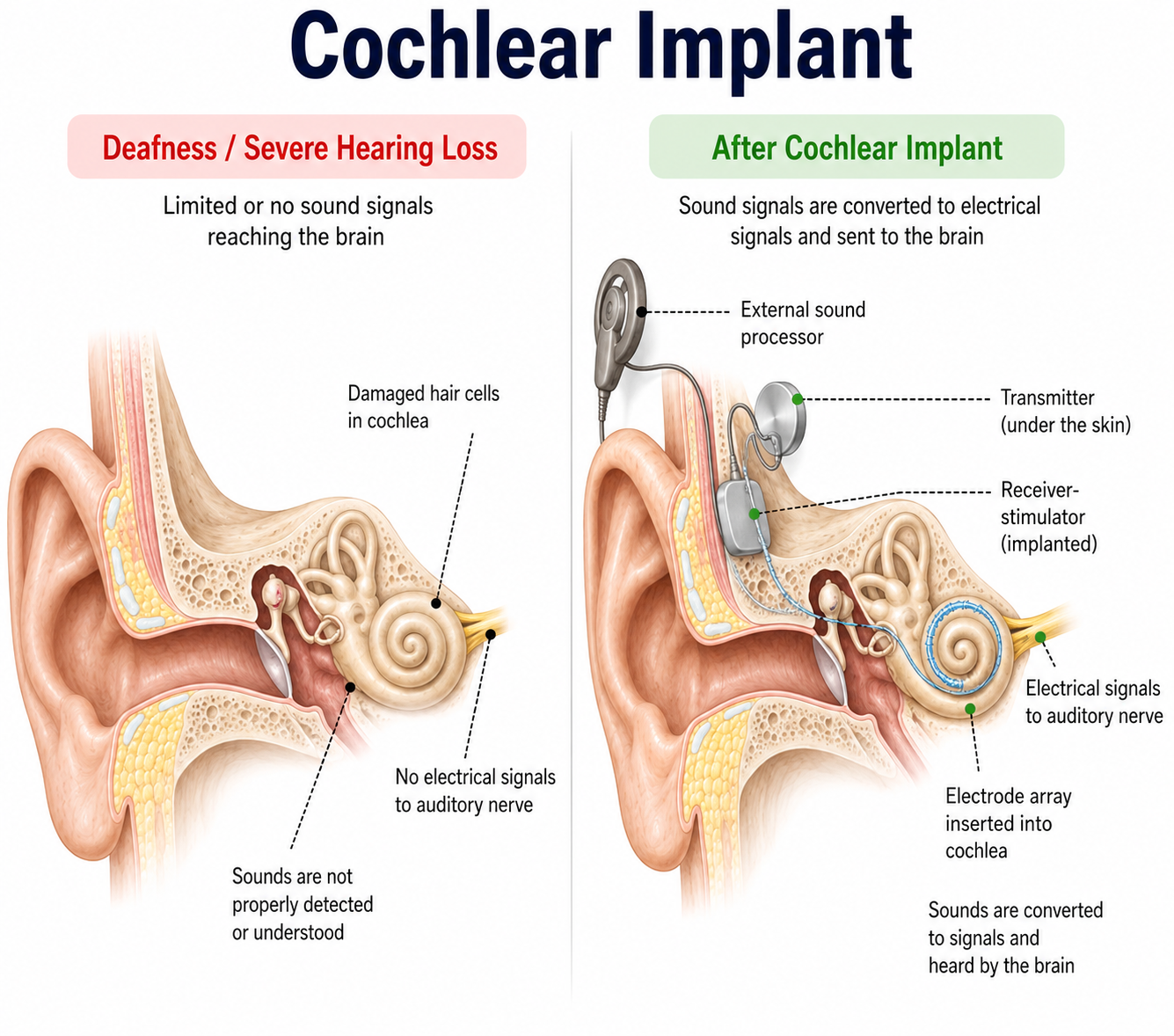
A cochlear implant is an advanced electronic medical device that bypasses damaged sensory hair cells in the cochlea (inner ear) to directly stimulate the auditory nerve. Unlike acoustic hearing aids that simply amplify sound, a cochlear implant converts sound signals into coded electrical impulses. The device consists of an internal receiver-stimulator unit surgically implanted beneath the skin behind the ear with an electrode array inserted into the cochlea, and an external sound processor worn behind the ear.
Who Needs Cochlear Implant Surgery?
Cochlear implantation is indicated for pediatric and adult candidates with severe-to-profound sensorineural hearing loss who receive limited benefit from conventional hearing aids.
Key clinical indicators include:
- Severe-to-profound bilateral sensorineural hearing loss (hearing threshold > 70-90 dB).
- Poor speech discrimination scores (<50% sentence recognition in the best-aided condition).
- Congenital deafness in infants and young children (ideally implanted between 9 months and 2 years of age for optimal language acquisition).
- Sudden or progressive adult-onset post-lingual deafness.
- Normal auditory nerve presence documented on high-resolution MRI.
Types & Surgical Options
- Unilateral Cochlear Implantation: Implantation in one ear (often the ear with worse hearing or shorter duration of deafness).
- Bilateral Simultaneous Implantation: Implantation in both ears during a single surgical session (ideal for young children).
- Bilateral Sequential Implantation: Second ear implanted in a subsequent surgical procedure.
- Electro-Acoustic Stimulation (EAS) / Hybrid Implant: Combines acoustic amplification for residual low-frequency hearing with electrical stimulation for high frequencies.
Benefits of Cochlear Implant Surgery
- Ability to perceive environmental sounds, speech, and auditory warning signals.
- Development of age-appropriate spoken language skills in congenitally deaf children.
- Dramatic improvement in speech understanding in adult-onset deafness without lip-reading.
- Enhanced quality of life, educational outcomes, and vocational opportunities.
What to Expect Before Surgery?
Comprehensive multi-disciplinary evaluation is required prior to candidacy approval:
- Audiological Battery: Pure-tone audiometry, Auditory Brainstem Response (ABR/BERA), Otoacoustic Emissions (OAE), and hearing aid trial verification.
- Radiological Imaging: High-resolution CT scan of temporal bone and inner ear MRI to confirm cochlear patency and auditory nerve structure.
- Vaccination Protocol: Mandatory Pneumococcal and Meningococcal vaccination at least 2 weeks prior to surgery to prevent meningitis.
- Speech-Language & Psychological Assessment: Evaluation of child development and family commitment to post-operative auditory-verbal therapy.
Complete Procedure
The surgical procedure is performed under general anesthesia and takes approximately 2 to 3 hours per ear:
- Administration of general anesthesia and intraoperative facial nerve monitoring setup.
- Making a post-auricular incision behind the ear and creating a scalp pocket for the receiver unit.
- Cortical mastoidectomy and posterior tympanotomy to access the middle ear space and round window.
- Opening the round window membrane or performing a cochleostomy into the scala tympani of the cochlea.
- Precise insertion of the flexible electrode array into the cochlea.
- Intraoperative electrophysiological testing (Telemetry/NRT) to confirm electrode function and auditory nerve response.
- Layered closure of incision and application of a sterile head bandage.
What to Expect During Surgery?
The surgery is performed under high-power microscope magnification. Continuous facial nerve monitoring protects the facial nerve throughout. Intraoperative telemetry verifies device functionality before skin closure.
Hearing Aids vs Cochlear Implants
| Feature | Conventional Hearing Aid | Cochlear Implant |
|---|---|---|
| Mechanism | Amplifies acoustic sound waves. | Converts sound to electrical signals stimulating the nerve. |
| Indication | Mild to severe hearing loss. | Severe to profound sensorineural deafness. |
| Target Organ | Relies on functioning cochlear hair cells. | Bypasses damaged hair cells completely. |
| Therapy Requirement | Basic fitting adjustments. | Intensive auditory-verbal rehabilitation required. |
Success Rate and Safety
Cochlear implantation is a safe and standardized procedure with a success rate exceeding 98% regarding surgical device placement and electronic activation. Complications such as flap infection or facial nerve weakness occur in <1-2% of cases.
Cochlear Implant Surgery Cost Estimate
| Implantation Modality | Indian / Regional Device System (INR) | Advanced Imported Device System (INR) |
|---|---|---|
| Unilateral Cochlear Implant | ₹6,00,000 - ₹9,50,000 | ₹10,00,000 - ₹16,00,000+ |
| Bilateral Simultaneous Implants | ₹11,00,000 - ₹17,00,000 | ₹18,00,000 - ₹28,00,000+ |
Disclaimer: Total cost includes the internal implant & external processor hardware, surgery, hospital stay, and initial programming.
Recovery Guide & Post-Operative Care
Recovery Timeline
- Day 1-3: Inpatient observation; head bandage removed; mild dizziness or balance unsteadiness subsides.
- Week 1-2: Suture removal or absorbable stitch check; surgical wound healing behind ear.
- Week 3-4 (Switch-On Day): External sound processor fitting, initial mapping, and device activation.
- Month 2-12: Regular mapping sessions (re-tuning) and intensive Auditory-Verbal Therapy (AVT).
Post-Op Precautions & Care
- Keep Wound Dry: Avoid getting the surgical site wet until fully healed and cleared by your surgeon.
- Avoid Pressure Changes: Refrain from air travel, deep swimming, or heavy straining for 4 weeks post-surgery.
- Auditory Rehabilitation: Strict attendance at post-implantation speech and listening therapy sessions is vital for hearing development.
- Vaccination Compliance: Keep all recommended pneumococcal booster vaccinations up to date.
Frequently Asked Questions
When is the device turned on after surgery?⌄
Device activation (the 'Switch-On') typically occurs 3 to 4 weeks after surgery, allowing sufficient time for surgical incision healing.
Can adults benefit from a cochlear implant?⌄
Yes. Adults with post-lingual deafness (who previously had hearing and speech) adapt quickly and achieve high levels of speech understanding.
Is auditory-verbal therapy required after surgery?⌄
Yes. Speech and auditory-verbal therapy (AVT) is crucial, especially for young children, to teach the brain how to interpret new electrical auditory signals.
Can a person with a cochlear implant undergo an MRI in the future?⌄
Modern cochlear implants feature rotatable internal magnets that allow safe MRI scans up to 1.5T or 3.0T under specific manufacturer guidelines.
How long does the internal implant last?⌄
The internal implant is engineered to last a lifetime. External sound processors are updated every 5 to 7 years as technology advances.