


What is ACL Reconstruction Surgery?
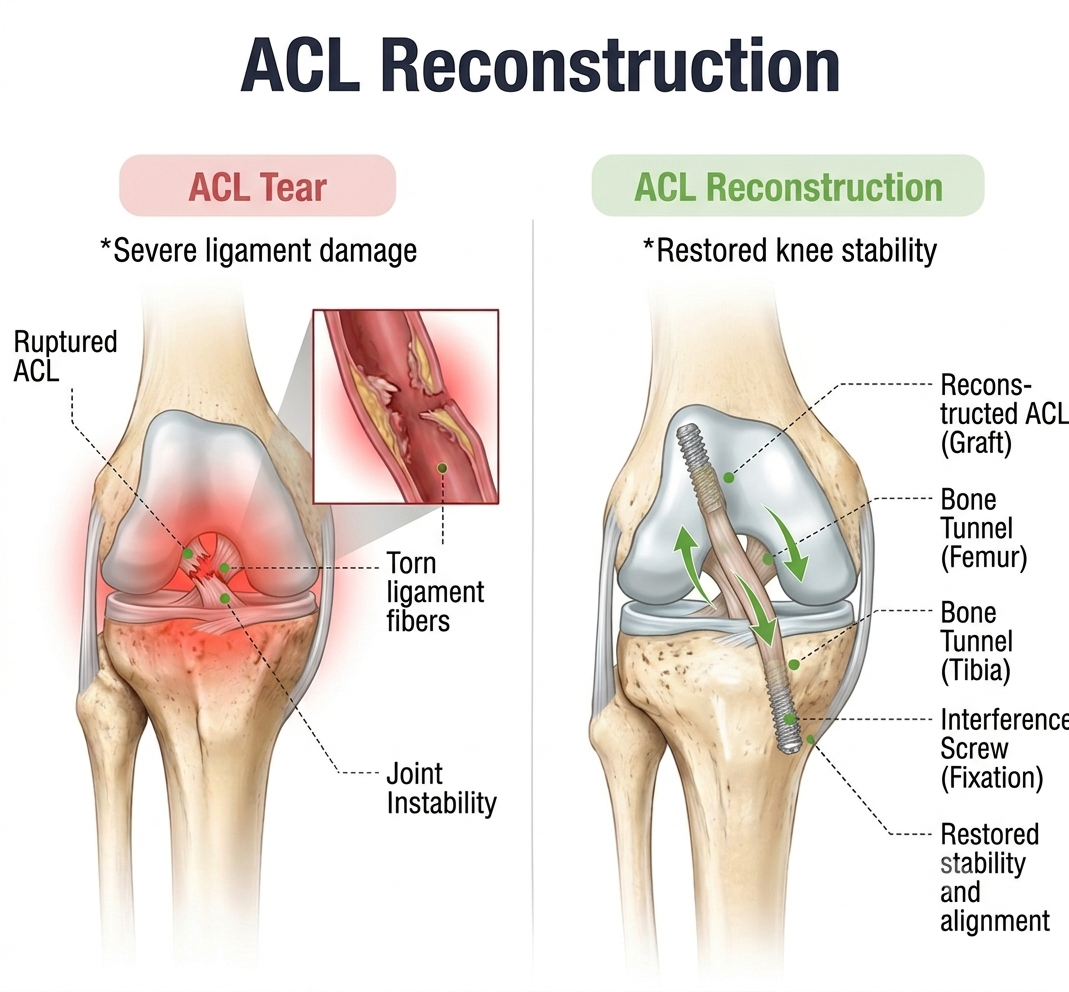
Anterior Cruciate Ligament (ACL) reconstruction is an arthroscopic surgical repair performed to replace a completely torn ACL in the knee joint. Because a torn ACL cannot heal on its own, surgeons replace the damaged ligament with a tendon graft harvested from the patient's body (autograft) or a donor (allograft).
Who Needs ACL Reconstruction Surgery?
Surgery is indicated for active individuals and athletes who experience knee instability or wish to return to high-demand sports involving pivoting, jumping, and cutting motions.
Key clinical indicators include:
- Knee giving way or buckling during routine movements or sports.
- A popping sound or sensation at the time of injury accompanied by immediate swelling.
- Associated meniscus tears or cartilage damage requiring repair.
- Chronic instability affecting daily activities.
- High functional demands in young or athletic individuals.
Types of ACL Reconstruction Grafts
- Hamstring Tendon Autograft: Popular option using the semitendinosus/gracilis tendons; offers high tensile strength and minimal incision marks.
- Bone-Patellar Tendon-Bone (BTB) Autograft: Uses the central third of the patellar tendon with bone blocks; considered the gold standard for high-performance athletes.
- Quadriceps Tendon Autograft: Excellent option offering high tissue volume and strong fixation.
- Allograft (Donor Tissue): Uses donor tendon tissue; eliminates graft harvest site pain, often used in revision ACL cases.
Benefits of ACL Reconstruction Surgery
- Restores rotational and anterior knee joint stability.
- Prevents recurrent buckling and secondary meniscus or cartilage damage.
- Enables return to competitive sports and physical activities.
- Minimally invasive arthroscopic technique reduces scarring and pain.
What to Expect Before Surgery?
- Pre-habilitation (Pre-Op PT): Reducing knee swelling and restoring full knee extension prior to surgery significantly improves post-op outcomes.
- Diagnostic MRI: Detailed imaging to confirm graft planning and check for accompanying meniscus or ligament injuries.
- Surgical Consultation: Deciding on graft type and reviewing the post-op bracing plan.
Complete Procedure
- Administration of general or spinal anesthesia.
- Graft harvesting and preparation (if using autograft).
- Creation of tiny keyhole incisions around the knee joint.
- Insertion of an arthroscope (camera) and miniature instruments.
- Removal of the damaged ACL tissue remnants.
- Drilling of precise bone tunnels in the tibia (shin bone) and femur (thigh bone).
- Threading the new graft through the tunnels and securing it with medical screws, buttons, or anchors.
- Testing graft tension, knee range of motion, and closing incisions.
What to Expect During Surgery?
The procedure takes about 60 to 90 minutes. It is usually performed as a day-care or short overnight stay procedure. You will wake up with a knee brace and crutches.
Autograft vs Allograft
| Feature | Autograft (Own Tissue) | Allograft (Donor Tissue) |
|---|---|---|
| Tissue Source | Patient's own hamstring, patellar, or quad tendon. | Donated tissue from a certified tissue bank. |
| Harvest Site Pain | Minor donor site soreness. | No donor site pain. |
| Incorporation | Faster biological integration. | Slightly slower integration rate. |
| Re-tear Risk in Young Athletes | Lower re-tear rate. | Slightly higher re-tear rate in young patients (<20 yrs). |
Success Rate and Safety
ACL reconstruction has an overall success rate of 85-95% in restoring joint stability and allowing patients to return to daily and athletic activities without knee giving way.
ACL Reconstruction Surgery Cost Estimate
| Type of Procedure | Standard Arthroscopic Surgery (INR) | Advanced / Revision ACL (INR) |
|---|---|---|
| Single ACL Reconstruction (Hamstring/Patellar) | ₹1,20,000 - ₹2,50,000 | ₹2,20,000 - ₹3,80,000 |
| ACL + Meniscus Repair | ₹1,60,000 - ₹3,00,000 | ₹2,80,000 - ₹4,50,000 |
| Bilateral or Revision ACL Reconstruction | ₹2,50,000 - ₹4,20,000 | ₹3,50,000 - ₹5,50,000 |
Disclaimer: Estimates vary based on graft choice, implant hardware (fiber tape, tightropes, bio-screws), and hospital room category.
Recovery Guide & Post-Operative Care
Recovery Timeline
- Week 1-2: Crutch walking; focus on active quad activation, reducing swelling, and achieving full knee extension.
- Week 3-6: Weaning off crutches; bending knee to 120+ degrees; stationary cycling.
- Month 2-4: Progressive leg strengthening, balance training, and straight-line jogging.
- Month 6-9: Agility drills, sport-specific training, and return-to-sport clearance test.
Post-Op Precautions & Care
- Brace Compliance: Wear the post-operative knee brace locked in extension during early walking as instructed.
- Ice and Elevation: Regularly apply ice packs to keep knee swelling low.
- Dedicated Physical Therapy: Strict compliance with a 6-to-9-month rehab protocol is mandatory for long-term success.
Frequently Asked Questions
When can I return to playing sports after ACL reconstruction?⌄
Return to pivoting sports usually takes 6 to 9 months of structured physical therapy, pending functional testing and surgeon clearance.
Which graft is best for ACL reconstruction?⌄
Hamstring autograft and bone-patellar tendon-bone (BTB) autograft are both excellent options. Your surgeon will recommend the best graft based on your age, sports requirements, and joint flexibility.
Will I need crutches after ACL surgery?⌄
Yes, crutches are typically used for 1 to 3 weeks to protect the knee and promote proper gait mechanics.
Can a torn ACL heal without surgery?⌄
Complete ACL tears do not heal on their own due to lack of blood supply. Non-surgical management is only suitable for low-demand, inactive individuals with no knee instability.
Is ACL surgery performed through keyholes?⌄
Yes, modern ACL reconstruction is performed arthroscopically through small keyhole incisions, minimizing scarring and tissue damage.