




What is Epilepsy Surgery?
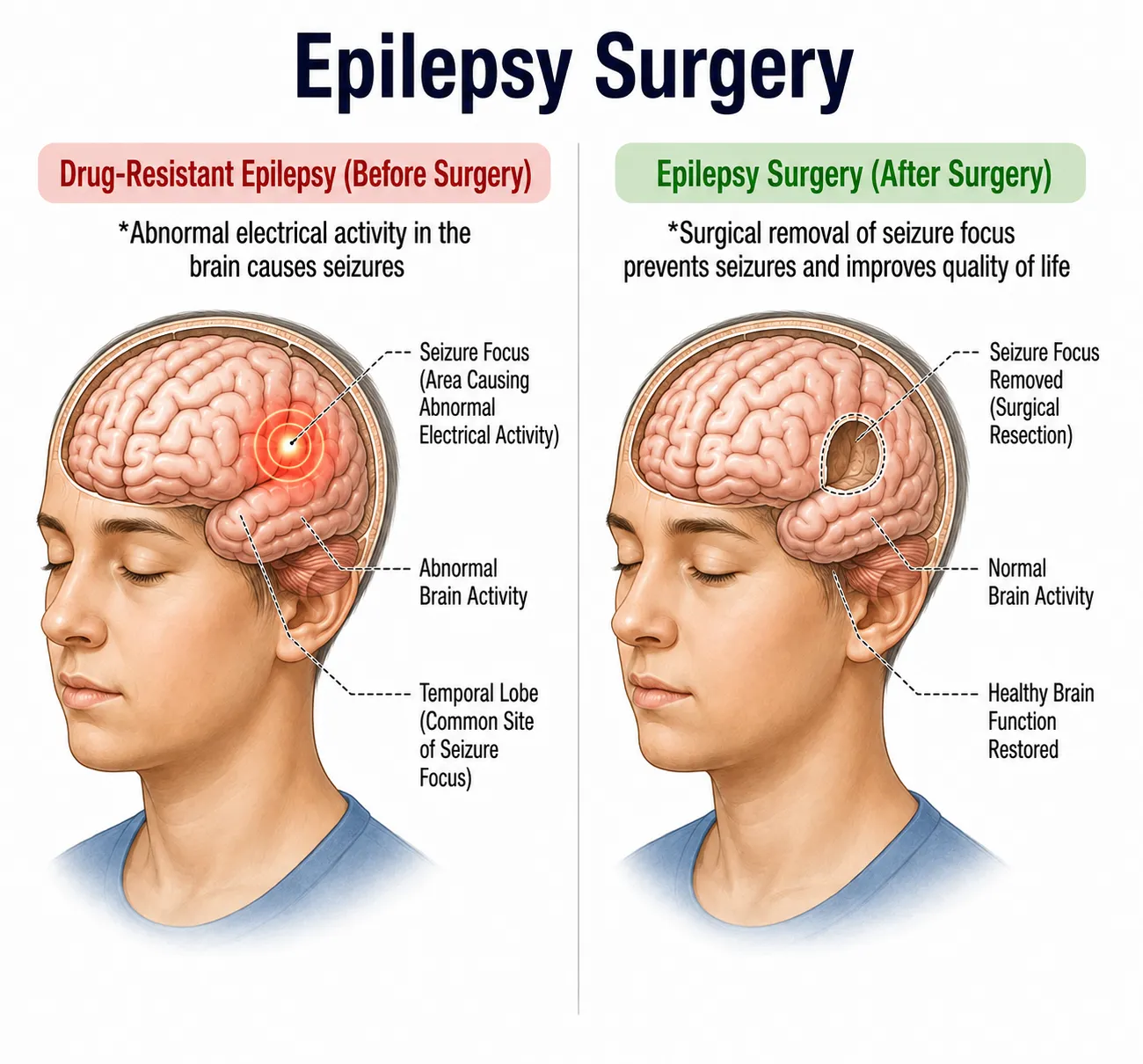
Epilepsy surgery encompasses specialized neurosurgical techniques used to resect, alter, or disconnect specific brain areas where epileptic seizures originate (the epileptogenic zone). It is a life-changing option for patients whose seizures cannot be controlled by anti-seizure medications, offering a pathway toward complete seizure freedom or a dramatic reduction in seizure frequency and severity.
Who Needs Epilepsy Surgery?
Surgery is evaluated when a patient meets the definition of Drug-Resistant (Refractory) Epilepsy—failing to achieve sustained seizure freedom after adequate trials of two tolerated and appropriately chosen anti-seizure drugs.
Key clinical indicators include:
- Continued disabling seizures despite compliance with multiple anti-seizure medications.
- Clear focal seizure origin identified on video-EEG monitoring and neuroimaging.
- Presence of resectable structural lesions like Mesial Temporal Sclerosis (MTS), focal cortical dysplasia, cavernomas, or low-grade tumours.
- High risk of seizure-related injury or cognitive decline from persistent uncontrolled activity.
Types of Epilepsy Surgery
- Resective Surgery (Anteromedial Temporal Lobectomy / Lesionectomy): Surgical removal of the specific structural lesion or brain tissue generating seizures.
- Laser Interstitial Thermal Therapy (LITT): Minimally invasive thermal ablation of deep seizure foci using a laser probe under real-time MRI guidance.
- Disconnective Procedures (Corpus Callosotomy / Hemispherotomy): Severing nerve pathways that allow seizures to spread across brain hemispheres.
- Neuromodulation (Vagus Nerve Stimulation / RNS): Implanting devices to deliver electrical pulses that disrupt seizure signals when resection is not feasible.
Benefits of Epilepsy Surgery
- Potential for complete seizure freedom (up to 70-80% in temporal lobe epilepsy).
- Reduction in anti-seizure drug reliance and medication side effects.
- Decreased long-term risk of Sudden Unexpected Death in Epilepsy (SUDEP).
- Improved educational, employment, and social independence.
What to Expect Before Surgery?
Pre-surgical evaluation (Phase I and Phase II presurgical workup) is exhaustive:
- Long-Term Video-EEG Monitoring: Inpatient admission to record clinical seizures and electrical spikes simultaneously.
- High-Resolution Epilepsy Protocol MRI: 3T MRI scanning to identify subtle structural brain abnormalities.
- Functional Mapping (PET, SPECT, fMRI, & MEG): Functional imaging to confirm metabolic activity and locate language and motor zones.
- Invasive Stereo-EEG (sEEG): (If needed) Robotic insertion of depth electrodes into the brain to pinpoint exact seizure origins before resection.
Complete Procedure
The surgical steps for a typical focal resection include:
- General anesthesia induction and head placement in a rigid stabilization frame.
- Craniotomy designed directly over the pre-mapped epileptogenic zone.
- Intraoperative electrocorticography (ECoG) to record brain activity directly from the surface and confirm boundaries.
- Micro-resection of the epileptogenic brain focus using micro-instruments and ultrasonic aspirators, preserving critical surrounding vessels and functional tissue.
- Final ECoG check to ensure spike-generating margins are clear.
- Bone flap closure and scalp reconstruction.
What to Expect During Surgery?
Operating duration ranges from 3 to 6 hours depending on whether intraoperative mapping or sEEG is utilized.
Resective Surgery vs Neuromodulation
| Feature | Resective Surgery | Neuromodulation (VNS / RNS) |
|---|---|---|
| Primary Goal | Complete seizure freedom (cure). | Reduction in seizure frequency/severity (palliative). |
| Brain Tissue Alteration | Permanent removal of focus tissue. | No brain tissue removal; electrical stimulation. |
| Ideal Candidate | Single, well-defined non-eloquent seizure focus. | Multiple foci or focus located in critical functional areas. |
| Seizure Freedom Rate | 60% - 80% (Temporal Lobe). | 10% - 20% complete freedom; 50-70% frequency reduction. |
Success Rate and Safety
Temporal lobe resective surgery achieves complete freedom from disabling seizures in 60-80% of well-selected patients. Complication rates in specialized comprehensive epilepsy centers are under 2-3%.
Epilepsy Surgery Cost Estimate
| Procedure Type | Standard Lesionectomy (INR) | Complex Resection / sEEG Guided (INR) |
|---|---|---|
| Temporal Lobectomy / Focal Resection | ₹3,50,000 - ₹5,50,000 | ₹5,00,000 - ₹7,50,000 |
| Stereo-EEG Mapping + Resection | ₹5,50,000 - ₹7,50,000 | ₹7,00,000 - ₹8,50,000+ |
Disclaimer: Extensive pre-surgical video-EEG and PET/SPECT diagnostic workups are billed separately prior to the main procedure.
Recovery Guide & Post-Operative Care
Recovery Timeline
- Day 0-2: Neuro-ICU monitoring; routine post-op CT scan and neurological assessments.
- Day 3-6: Transfer to ward; gradual physical therapy and cognitive assessment.
- Week 2-4: Scalp suture removal; gradual return to light home activities.
- Month 3-12: Neuro-epileptology follow-up; anti-seizure medications are maintained for at least 1-2 years post-op before gradual tapering.
Post-Op Precautions & Care
- Medication Compliance: Never stop anti-seizure medications immediately after surgery, even if completely seizure-free.
- Sleep & Stress Hygiene: Maintain regular sleep cycles and avoid known seizure triggers during brain healing.
- Incision Care: Keep scalp wounds dry and observe for signs of CSF leakage or inflammation.
- Driving Restrictions: Maintain driving restrictions per local medical guidelines until cleared by your epileptologist.
Frequently Asked Questions
Can I stop my seizure medications immediately after epilepsy surgery?⌄
No, anti-seizure medications must be continued for at least 1 to 2 years after surgery. If you remain completely seizure-free, your epileptologist may gradually taper doses.
What is the success rate of temporal lobe epilepsy surgery?⌄
Temporal lobe resection is highly effective, achieving complete seizure freedom in 60% to 80% of appropriately selected candidates.
How do doctors know which part of the brain to operate on?⌄
Specialists use a combination of long-term video-EEG monitoring, 3T MRI, PET scans, MEG, and sometimes stereo-EEG (sEEG) depth electrodes to pinpoint the exact seizure origin.
Will epilepsy surgery change my memory or personality?⌄
Comprehensive neuropsychological evaluations are conducted before surgery to predict and minimize memory or language risks. Most patients experience stable or improved cognitive function once seizures stop.
How long is the hospital stay for epilepsy surgery?⌄
Patients typically stay 4 to 8 days in the hospital following resective epilepsy surgery.