








What is Robotic Prostatectomy?
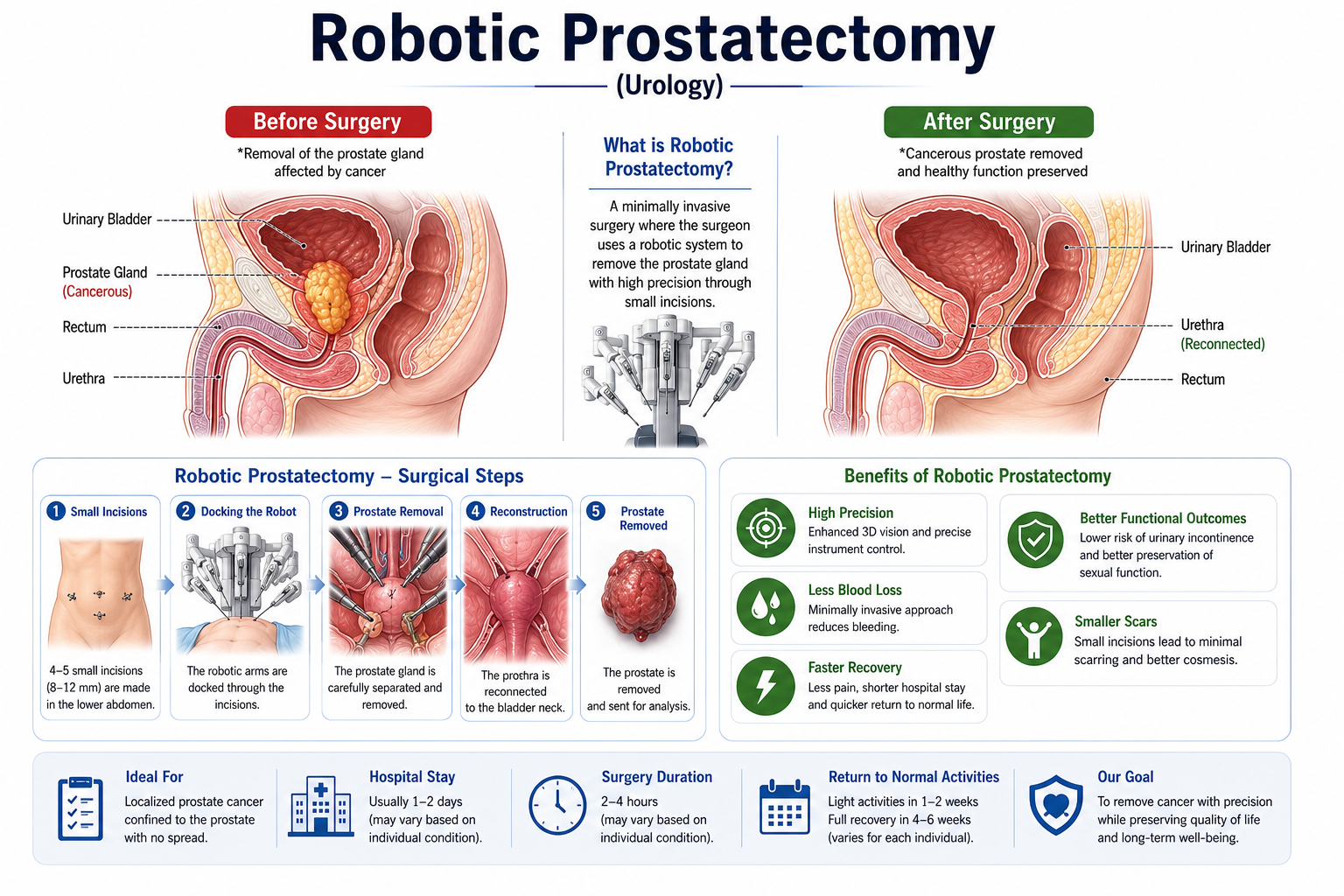
Robotic prostatectomy, technically known as Robotic-Assisted Laparoscopic Radical Prostatectomy (RALRP), is a minimally invasive surgical procedure used to treat localized prostate cancer. Utilizing advanced robotic surgical platforms, such as the da Vinci Surgical System, the operating surgeon controls high-precision robotic arms equipped with miniaturized surgical instruments through a 3D high-definition console.
During the procedure, the entire prostate gland, along with the attached seminal vesicles and surrounding tissue, is dissected and removed. The bladder neck is then reconnected directly to the urethra in a reconstruction termed vesicourethral anastomosis. The robotic system translates hand movements in real-time into micro-movements inside the abdomen, minimizing trauma to adjacent delicate nerves and blood vessels responsible for urinary continence and erectile function.
Who Needs Robotic Prostatectomy?
Robotic prostatectomy is primarily recommended for men diagnosed with localized prostate cancer where surgical intervention offers the highest likelihood of cure.
Key clinical indicators include:
- Clinically localized prostate cancer (staged T1 to T3a) confined within or just adjacent to the prostate gland.
- Elevated PSA levels and biopsy-confirmed adenocarcinoma.
- Intermediate to high-risk disease where Gleason score and clinical staging warrant curative therapy.
- Patients seeking long-term oncological control with maximum preservation of urinary continence and erectile function.
- Select localized recurrence cases after primary radiation therapy.
Types of Prostatectomy
- Nerve-Sparing Robotic Radical Prostatectomy: Designed to preserve the delicate cavernous nerve bundles running along the sides of the prostate to maintain post-surgical erectile function while achieving clear surgical margins.
- Non-Nerve-Sparing Robotic Radical Prostatectomy: Indicated when cancer has extended close to or into the nerve bundles, necessitating complete removal to ensure full cancer excision.
- Standard Open Radical Prostatectomy: Traditional open abdominal surgery (retropubic or perineal) requiring a larger incision and longer recovery.
- Simple Prostatectomy vs Radical Prostatectomy: A simple prostatectomy removes only the obstructive inner adenoma for non-cancerous BPH, whereas radical prostatectomy removes the entire prostate gland, seminal vesicles, and surrounding tissue for cancer.
Benefits of Robotic Prostatectomy
- 10x magnified, 3D high-definition visualization with 7 degrees of freedom in instrument motion.
- Minimal blood loss and lower blood transfusion rates.
- Smaller keyhole incisions resulting in reduced post-operative pain and minimal scarring.
- Shorter hospital stay and faster return to daily activities.
- Accelerated recovery of urinary continence due to high-precision vesicourethral reconstruction.
- Optimized preservation of neurovascular bundles responsible for potency.
What to Expect Before Surgery?
Preparation involves several key steps to ensure patient safety and surgical success:
- Medical Optimization: Comprehensive blood work, cardiac clearance, urine tests, and review of mpMRI or PSMA PET scans.
- Medication Management: Discontinuing blood thinners and anti-inflammatory drugs 7 to 10 days prior under medical guidance.
- Pre-Operative Fasting: Adhering to strict fasting protocols after midnight prior to the procedure.
- Pelvic Floor Exercises: Initiating Kegel exercises several weeks before surgery to enhance post-operative urinary control.
Complete Procedure
The surgical process generally follows these steps:
- Administration of general anesthesia and positioning the patient in a steep Trendelenburg position.
- Creating 5 to 6 small abdominal keyhole incisions and docking the robotic arms.
- Mobilizing the bladder to access the pelvic space.
- Separating the prostate neck from the bladder and dividing the vas deferens and seminal vesicles.
- Carefully dissecting neurovascular bundles away from the prostate (if nerve-sparing).
- Transecting the urethra at the apex of the prostate and removing regional pelvic lymph nodes if indicated.
- Sewing the bladder neck directly back to the urethral stump over a silicone Foley catheter.
- Extracting the specimen in a protective bag and closing keyhole incisions.
What to Expect During Surgery?
The surgical time is usually 2 to 4 hours under general anesthesia. Vitals, oxygenation, and fluid balance are continuously monitored by the anesthesia team. Post-procedure, the patient is monitored in the recovery area before transfer to the room or ICU.
Robotic vs Traditional Open Prostatectomy
| Feature | Traditional Open Surgery | Robotic-Assisted Surgery |
|---|---|---|
| Incision Size | Single 10-15 cm lower abdominal incision | 5-6 small keyhole incisions (0.5-1 cm) |
| Surgical Blood Loss | Moderate to High (500 - 1500 mL) | Minimal (< 100 - 200 mL) |
| Visual Magnification | Direct line of sight (1x, 2D) | 3D High-Definition (10x magnification) |
| Hospital Stay | 3 - 7 Days | 2 - 4 Days |
| Catheter Duration | 2 - 3 Weeks | 7 - 10 Days |
| Recovery Time | 6 - 8 Weeks | 2 - 4 Weeks |
Success Rate and Safety
Robotic prostatectomy offers established oncological and functional outcomes, with 5-year disease-free survival rates exceeding 95% for localized prostate cancer. Approximately 85% to 95% of patients regain complete urinary control within 6 to 12 months.
Robotic Prostatectomy Cost Estimate
| Type of Procedure | Conventional Open Surgery (INR) | Robotic-Assisted Surgery (INR) |
|---|---|---|
| Standard Radical Prostatectomy | ₹2,00,000 - ₹3,50,000 | ₹2,50,000 - ₹4,50,000 |
| Nerve-Sparing Radical Prostatectomy | ₹2,50,000 - ₹4,00,000 | ₹3,50,000 - ₹5,50,000 |
| Radical Prostatectomy + Pelvic Lymph Node Dissection | ₹3,00,000 - ₹5,00,000 | ₹4,50,000 - ₹7,50,000 |
Disclaimer: These are broad estimates. Final costs depend on room category, ICU stay requirements, and specific hospital technology fees.
Recovery Guide & Post-Operative Care
Recovery Timeline
- Day 0-3: Early mobilization; liquid to soft diet transition; Foley catheter care.
- Week 1-2: Discharge home with urinary catheter; catheter removal around Day 7-10.
- Week 3-6: Gradual increase in walking distance; pelvic floor exercises; return to desk work.
- Month 3-6: Resumption of full physical activities, driving, and exercise upon surgeon clearance.
Post-Op Precautions & Care
- Urinary Catheter Hygiene: Keep drainage bag below bladder level and clean catheter site daily.
- Pelvic Floor (Kegel) Exercises: Strict adherence to Kegel routines to regain full continence.
- Activity Restrictions: Avoid heavy lifting (> 5 kg) or strenuous exercise for 6 weeks.
- Hydration: Drink 2 to 3 liters of water daily to flush the urinary tract.
Frequently Asked Questions
How long will I need a urinary catheter after robotic prostatectomy?⌄
Most patients require a Foley urinary catheter for about 7 to 10 days following robotic prostatectomy to allow the connection between the bladder and urethra to heal securely.
Will I experience urinary incontinence after surgery?⌄
Temporary urinary leakage is common immediately after catheter removal. With pelvic floor (Kegel) exercises, 85% to 95% of patients regain complete bladder control within 3 to 12 months.
How does robotic prostatectomy affect erectile function?⌄
Erectile recovery depends on age, pre-surgery function, and whether a nerve-sparing procedure was feasible. Nerve recovery takes 12 to 24 months, often supported by penile rehabilitation therapy.
What are the cancer cure rates following robotic radical prostatectomy?⌄
For localized prostate cancer, 5-year disease-free survival exceeds 95%. Routine follow-up PSA tests confirm complete cancer removal.
When can I return to work and normal physical activities?⌄
Light duties and desk jobs can be resumed in 2 to 3 weeks, while heavy lifting (> 5 kg) and vigorous exercise should be avoided for at least 6 weeks.