






What is Breast Cancer Surgery?
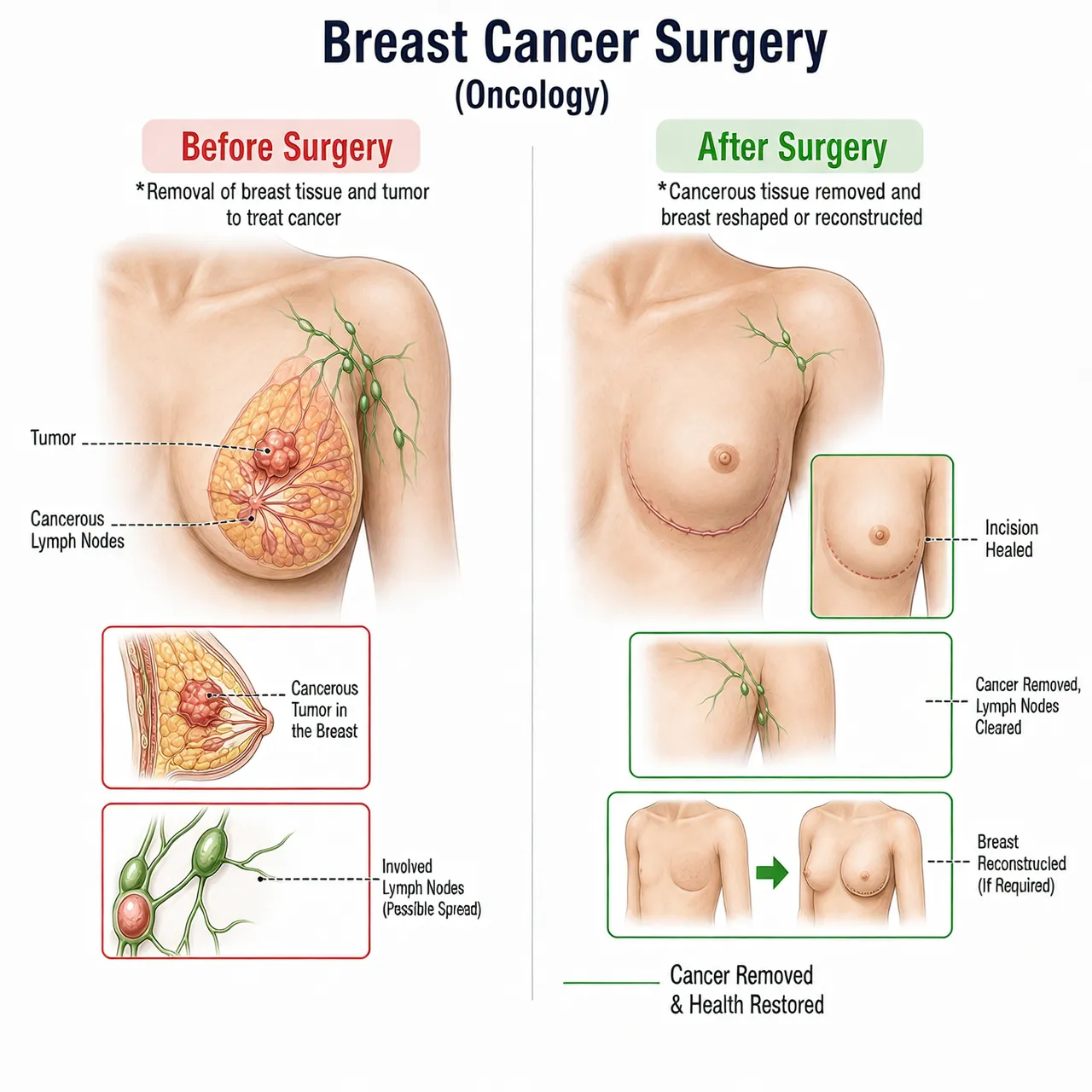
Breast Cancer Surgery is a primary treatment modality aimed at removing localized malignant tumors from the breast tissue. Depending on the stage, tumor location, and patient preference, surgery may conserve most of the healthy breast (lumpectomy) or require complete removal of the breast tissue (mastectomy). In many cases, evaluation of axillary lymph nodes (sentinel node biopsy or axillary dissection) is performed concurrently to guide staging and subsequent systemic treatment.
Who Needs Breast Cancer Surgery?
Surgery is indicated for most individuals diagnosed with non-metastatic breast cancer (Stages 0–III) and occasionally for local control in selected Stage IV cases.
Key clinical indicators include:
- Biopsy-confirmed invasive ductal/lobular carcinoma or Ductal Carcinoma In Situ (DCIS).
- Persistent or suspicious breast mass resistant to initial neo-adjuvant systemic therapy.
- Genetic predisposition (e.g., BRCA1/BRCA2 mutation) seeking prophylactic bilateral mastectomy.
- Need for definitive histological staging and margin clearance.
Types of Breast Cancer Surgery
- Lumpectomy (Breast-Conserving Surgery): Removal of the tumor along with a rim of healthy surrounding tissue, preserving the majority of the breast.
- Simple / Total Mastectomy: Removal of the entire breast tissue, including the nipple-areolar complex, without removing axillary lymph nodes.
- Modified Radical Mastectomy: Removal of the entire breast tissue along with axillary (underarm) lymph nodes.
- Oncoplastic & Reconstructive Surgery: Combining tumor resection with plastic surgery techniques, using implants or autologous tissue flaps (DIEP/TRAM) to restore breast shape.
Note on Lymph Node Surgery: Sentinel Lymph Node Biopsy (SLNB) tests the first few nodes to check for cancer spread, avoiding full axillary clearance when nodes are negative.
Benefits of Breast Cancer Surgery
- Complete physical removal of the primary malignant tumor.
- Accurate disease staging and biomarker re-evaluation to tailor chemotherapy or radiation.
- High rates of local disease control and long-term survival in early-stage disease.
- Opportunity for immediate aesthetic restoration via oncoplastic reconstruction.
What to Expect Before Surgery?
- Diagnostic Mapping: Pre-operative mammography, breast MRI, or ultrasound localization (wire/seed placement for non-palpable lesions).
- Multidisciplinary Tumor Board Review: Coordination among surgical oncologists, medical oncologists, and reconstructive surgeons.
- Pre-Anesthesia Clearance: Cardiac and pulmonary evaluations, complete blood count, and coagulation panels.
- Surgical Choice Consultation: Detailed discussion regarding lumpectomy vs. mastectomy and reconstruction timing.
Complete Procedure
- Administration of general anesthesia.
- Localization and skin incision over the tumor site or planned mastectomy boundaries.
- Resection of the tumor mass with adequate clear surgical margins.
- Sentinel lymph node identification (using radioactive tracer or dye) and excision for frozen section evaluation.
- Immediate reconstruction (if planned), placing a tissue expander, implant, or flap.
- Insertion of surgical drains (Jackson-Pratt) to prevent fluid collection (seroma).
- Closure of incisions using subcuticular sutures and application of surgical dressings or supportive brassiere.
What to Expect During Surgery?
The procedure typically takes 1.5 to 3 hours, or up to 6 hours if immediate flap reconstruction is performed. Vital signs and tissue perfusion are continuously monitored.
Minimally Invasive / Oncoplastic vs Traditional
| Feature | Traditional Mastectomy | Oncoplastic / Breast-Conserving |
|---|---|---|
| Cosmetic Outcome | Significant change in breast contour; loss of breast profile. | Preserves natural shape and symmetry using localized tissue rearrangement. |
| Incision Size | Long scar across the chest wall. | Concealed periareolar or inframammary incisions. |
| Recovery Time | 3 - 6 weeks. | 1 - 3 weeks for lumpectomy without flap. |
| Radiation Need | Required in high-risk features. | Almost always required following lumpectomy. |
Success Rate and Safety
Breast cancer surgery carries a high local control rate, with 5-year survival rates exceeding 90% for localized early-stage disease. Modern surgical techniques prioritize both oncologic safety and aesthetic outcome.
Breast Cancer Surgery Cost Estimate
| Type of Procedure | Standard Hospital Stay (INR) | Premium / Deluxe Ward (INR) |
|---|---|---|
| Lumpectomy + SLNB | ₹1,50,000 - ₹3,00,000 | ₹2,50,000 - ₹4,50,000 |
| Total / Modified Radical Mastectomy | ₹2,20,000 - ₹4,00,000 | ₹3,50,000 - ₹5,50,000 |
| Mastectomy + Immediate Reconstruction | ₹3,50,000 - ₹6,00,000 | ₹5,00,000 - ₹8,50,000+ |
Disclaimer: Final costs vary based on implant choice, flap complexity, and length of ICU/ward stay.
Recovery Guide & Post-Operative Care
Recovery Timeline
- Day 0-1: Recovery in ward; management of post-operative pain and initial drain care education.
- Week 1-2: Drain removal once output drops below 30 mL/day; gentle arm range-of-motion exercises.
- Week 3-4: Pathology review to determine adjuvant therapies (chemotherapy, radiation, hormone therapy).
- Month 2-3: Full resumption of normal daily activities and progressive strength training.
Post-Op Precautions & Care
- Arm Care: Avoid blood pressure checks, injections, or heavy lifting on the side where axillary lymph nodes were removed to minimize lymphedema risk.
- Surgical Drain Hygiene: Record daily output and maintain strict clean technique around drain entry sites.
- Wound Care: Keep dressing dry until cleared by surgeon; wear a supportive, non-wired post-surgical bra.
Frequently Asked Questions
Is a lumpectomy as effective as a mastectomy?⌄
Yes. Clinical studies show that for early-stage breast cancer, lumpectomy combined with radiation therapy offers survival rates equivalent to a total mastectomy.
When will my surgical drains be removed?⌄
Surgical drains are usually removed 1 to 2 weeks post-surgery when the daily fluid collection drops below 30 milliliters for two consecutive days.
Can I have breast reconstruction at the same time as tumor removal?⌄
In many cases, yes. Immediate reconstruction can be performed in the same operative session, provided it does not compromise oncologic safety or delay necessary adjuvant treatments.
How can I prevent arm swelling (lymphedema) after node removal?⌄
Practice gentle arm exercises as prescribed, protect the arm on the affected side from cuts, burns, or needle sticks, and avoid tight clothing or blood pressure cuffs on that arm.
When can I resume normal activities and work?⌄
Most patients who undergo lumpectomy return to work within 1 to 2 weeks. Mastectomy or reconstruction patients may require 4 to 6 weeks for full recovery.