

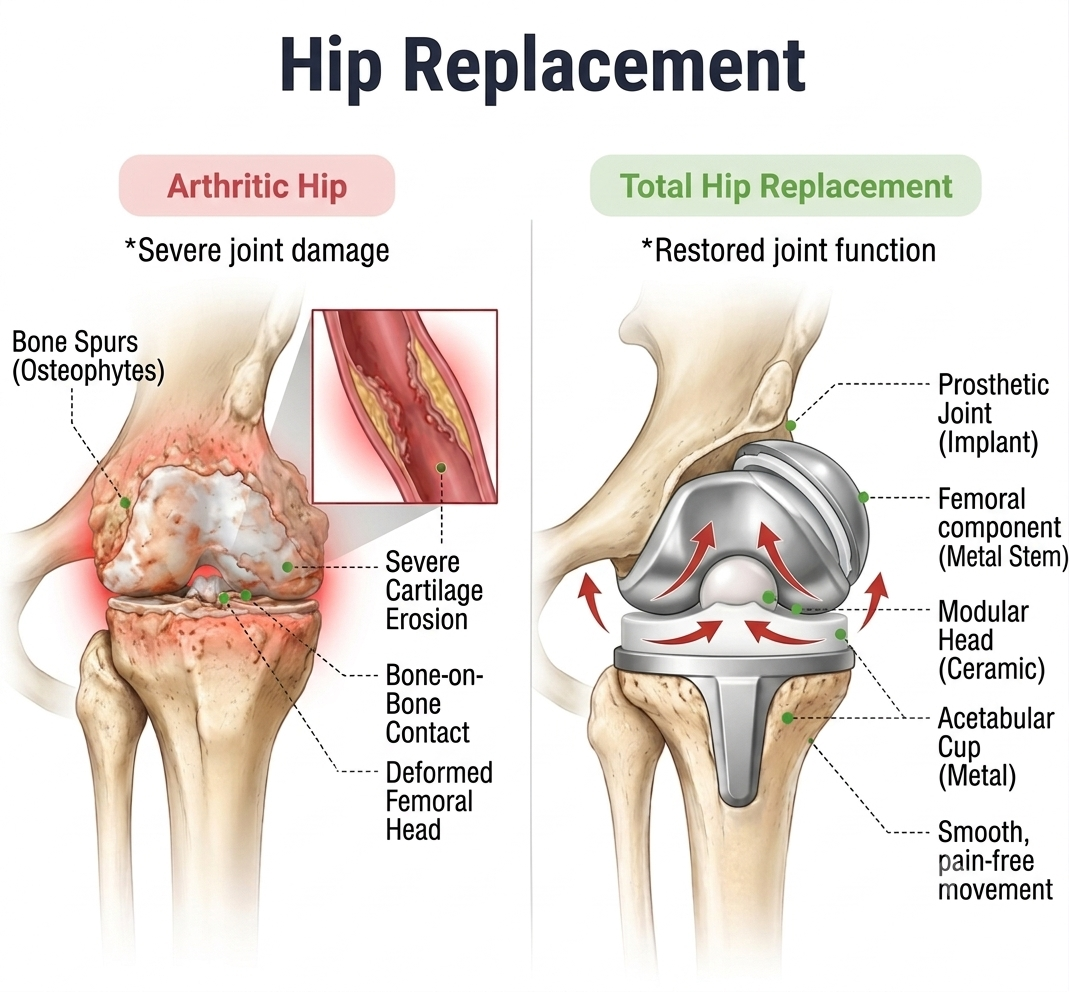










What is Total Hip Replacement Surgery?
Total Hip Arthroplasty is a surgical procedure where the diseased bone and cartilage of the ball-and-socket hip joint are removed and replaced with prosthetic components. The worn femoral head (ball) is replaced with a metal or ceramic stem and ball, and the damaged acetabulum (socket) is fitted with a durable metal cup lined with medical-grade plastic, ceramic, or metal.
Who Needs Total Hip Replacement Surgery?
Surgery is indicated when non-surgical treatments—such as medications, physical therapy, and lifestyle adjustments—no longer relieve debilitating hip pain or stiffness.
Key clinical indicators include:
- Severe hip or groin pain that limits everyday activities like walking, bending, or putting on shoes.
- Pain that persists during rest or interferes with sleep.
- Stiffness in the hip that restricts leg movement and rotation.
- Radiographic evidence of severe osteoarthritis, rheumatoid arthritis, avascular necrosis, or hip fractures.
- Ineffective pain relief from anti-inflammatory drugs or steroid injections.
Types of Total Hip Replacement Surgery
- Standard Total Hip Replacement: Conventional replacement using a posterior or anterolateral incision.
- Direct Anterior Approach Hip Replacement: A muscle-sparing technique where the surgeon accesses the hip joint from the front, minimizing muscle cutting.
- Partial Hip Replacement (Hemiarthroplasty): Replaces only the femoral head, commonly indicated for certain hip fractures in elderly patients.
- Revision Hip Replacement: Surgical repair or replacement of an existing artificial hip joint that has worn out, loosened, or infected over time.
Note on Modality: Robotic-Assisted Hip Replacement utilizes pre-operative 3D CT mapping to ensure sub-millimeter precision in cup positioning and leg-length restoration.
Benefits of Total Hip Replacement Surgery
- Significant relief or complete elimination of severe hip joint pain.
- Improved leg mobility, flexibility, and overall range of motion.
- Restoration of leg-length equality and functional alignment.
- Long implant survival rates exceeding 15 to 20 years.
What to Expect Before Surgery?
- Medical Optimization: Full cardiovascular and blood work clearance prior to anesthesia.
- Pre-Op Imaging: X-rays or CT scans for anatomical templating and sizing.
- Home Preparation: Removing rug hazards, installing grab bars, and arranging a raised toilet seat.
- Medication Adjustments: Discontinuing blood thinners and specific supplements under surgeon guidance.
Complete Procedure
- Administration of regional (spinal/epidural) or general anesthesia.
- Surgical incision made over the side, back, or front of the hip joint.
- Removal of the damaged femoral head and reaming of the acetabulum (socket).
- Placement and press-fitting (or cementing) of the metal acetabular cup.
- Insertion of the femoral stem into the hollow center of the femur.
- Attachment of the ceramic or metal ball head onto the stem and placement of the liner.
- Testing the new joint for stability, leg length, and range of motion.
- Incision closure with surgical sutures/staples and sterile dressing.
What to Expect During Surgery?
The procedure typically takes 60 to 90 minutes. Vital signs are continuously monitored. Following surgery, you will spend 1-2 hours in the post-anesthesia care unit (PACU) before transfer to your hospital room.
Robotic vs Traditional
| Feature | Traditional Surgery | Robotic-Assisted Surgery |
|---|---|---|
| Precision | Relies on manual alignment jigs and surgeon experience. | 3D CT-based sub-millimeter positioning. |
| Leg-Length Accuracy | Good manual estimation. | Precise real-time tracking during surgery. |
| Disruption | Standard soft tissue handling. | Minimized tissue trauma and optimized cup placement. |
| Cost | Baseline cost. | Higher due to technology and software licensing. |
Success Rate and Safety
Hip replacement is considered one of the most successful interventions in modern orthopedic surgery, with satisfaction rates above 90-95%. Modern ceramic and cross-linked polyethylene materials are engineered for 20+ years of durability.
Total Hip Replacement Cost Estimate
| Type of Procedure | Conventional Surgery (INR) | Robotic / Minimally Invasive (INR) |
|---|---|---|
| Single (Unilateral) Hip Replacement | ₹1,80,000 - ₹4,50,000 | ₹3,00,000 - ₹6,50,000 |
| Both Hips (Bilateral) Replacement | ₹3,50,000 - ₹7,50,000 | ₹5,50,000 - ₹10,00,000 |
| Revision Hip Replacement | ₹2,50,000 - ₹5,50,000 | ₹4,00,000 - ₹8,00,000 |
Disclaimer: Estimated range. Final costs vary based on implant choice (imported vs domestic), hospital selection, and length of stay.
Recovery Guide & Post-Operative Care
Recovery Timeline
- Day 0-1: Assisted standing and walking with a walker on the same day or next day.
- Week 1-2: Transitioning to a cane; wound care and targeted physical therapy exercises.
- Week 3-6: Resuming light daily activities and driving (if off narcotic medications).
- Month 3-6: Complete return to normal walking, swimming, and low-impact activities.
Post-Op Precautions & Care
- Hip Dislocation Precautions: Avoid bending the hip past 90 degrees or crossing legs (if advised by your surgical team).
- Physical Therapy: Diligent rehabilitation is essential to rebuild gluteal and hip muscle strength.
- Infection Prevention: Keep the incision clean and dry; report any signs of drainage or fever immediately.
Frequently Asked Questions
How long does a total hip replacement implant last?⌄
Modern hip implants are highly durable, with current studies showing that over 80-90% of hip replacements last 20 years or more.
When can I walk after hip replacement surgery?⌄
Most patients start walking with the help of a physical therapist and a walker on the same day as surgery or the morning after.
What precautions should I take after hip replacement?⌄
For the first few weeks, avoid crossing your legs, bending your hip past a 90-degree angle, or extreme twisting of the leg.
Is anterior hip replacement better than posterior?⌄
The anterior approach is muscle-sparing and can lead to a slightly faster initial recovery with fewer dislocation precautions, though long-term outcomes for both approaches are equally excellent.
Will my leg lengths be equal after surgery?⌄
Surgeons carefully measure and template leg lengths during procedure planning. Advanced techniques and robotic navigation minimize leg-length discrepancies.