











What is Knee Replacement Surgery?
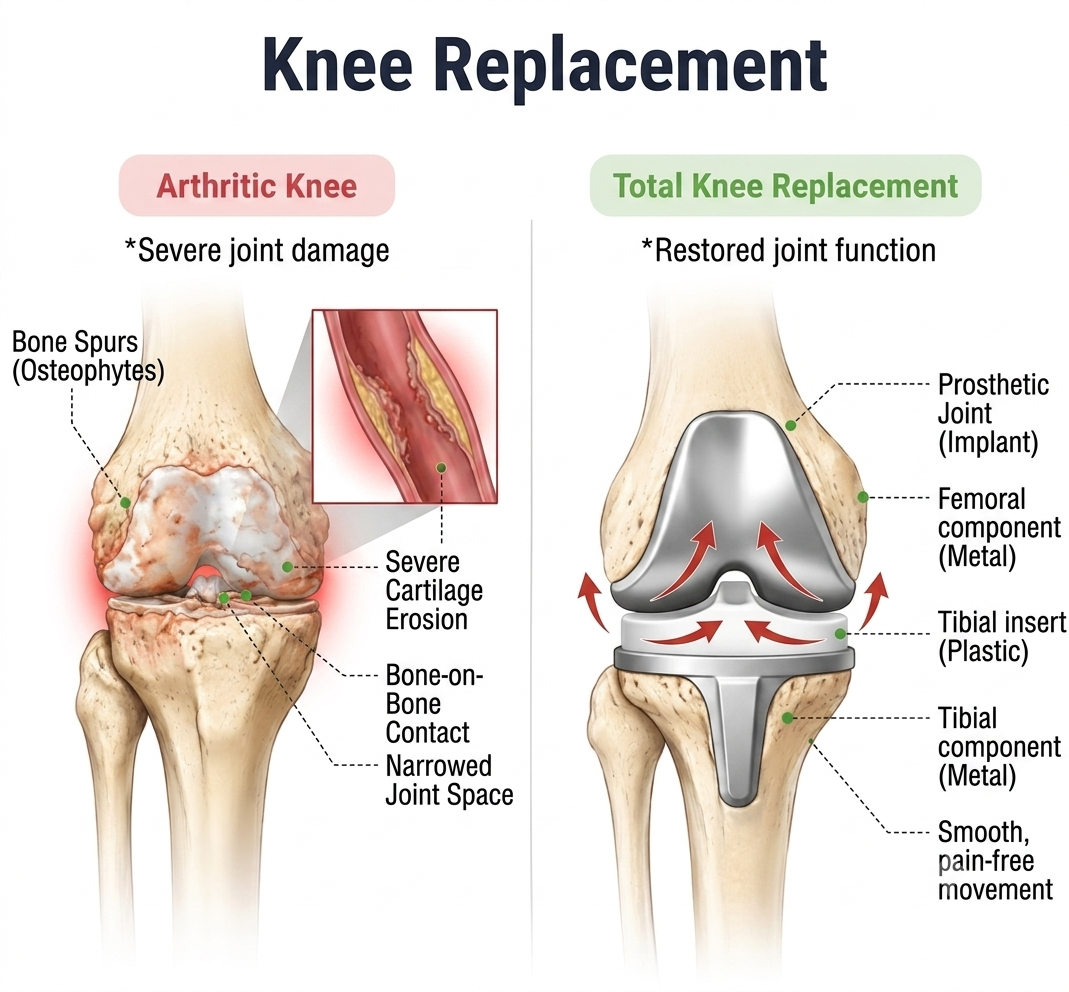
Knee Arthroplasty is a surgical procedure to resurface a knee joint damaged by articular cartilage loss. Whether caused by osteoarthritis, rheumatoid arthritis, post-traumatic injury, or avascular necrosis, the goal remains the same: the worn-out cartilage and bone are replaced with metal and high-density polyethylene components to restore alignment, eliminate bone-on-bone friction, and restore pain-free function.
Who Needs Knee Replacement Surgery?
While often discussed in the context of the 50-80 age bracket, the necessity for surgery is dictated by physiological damage and quality of life, not a birth date. Surgery is indicated when non-surgical treatments such as physical therapy, weight management, and activity modification fail to manage symptoms.
Key clinical indicators include:
- Severe joint pain that limits daily activities (walking, climbing stairs).
- Visible joint deformity (bowlegs or knock-knees).
- Radiographic evidence of significant cartilage loss or bone-on-bone contact.
- Chronic inflammation and swelling that persists despite rest.
- Pain that occurs even while resting or at night.
Types of Knee Replacement Surgery
- Total Knee Replacement (TKR): Replacement of all three compartments of the knee joint (medial, lateral, and patellofemoral).
- Partial Knee Replacement (PKR): Replacement of only the damaged compartment (medial or lateral) to preserve healthy ligaments and bone.
- Bilateral Knee Replacement: Simultaneous replacement of both knees in one operative session.
- Revision Knee Replacement: A procedure required to replace components that have worn, loosened, or become infected over time.
Note on Modality: Robotic-Assisted Surgery is a specialized modality that can be applied to TKR or PKR, using advanced 3D mapping for superior precision.
Benefits of Knee Replacement Surgery
- Substantial reduction or elimination of chronic pain.
- Correction of mechanical deformities (e.g., bowlegs or knock-knees).
- Improved independence and return to activities of daily living.
- High survivorship of modern, highly cross-linked polyethylene implants.
What to Expect Before Surgery?
Preparation involves several key steps to ensure patient safety and surgical success:
- Medical Optimization: Comprehensive clearance for anesthesia, including cardiac evaluation.
- Lifestyle Optimization: Smoking cessation is non-negotiable to reduce infection risk and improve bone healing. Achieving a healthy weight reduces the load on the new implant.
- Home Preparation: Ensuring the environment is clear of tripping hazards and setting up a recovery station.
- Medication Management: Ceasing blood thinners or herbal supplements as directed by your surgeon to prevent excessive bleeding.
Complete Procedure
The surgical process generally follows these steps:
- Administration of anesthesia (general or spinal/epidural).
- Making an incision over the front of the knee.
- Moving the kneecap aside and removing damaged bone and cartilage from the femur (thigh bone) and tibia (shin bone).
- Preparing the bone surfaces to precisely fit the artificial implants.
- Positioning and securing the new metal components (often using special bone cement).
- Inserting a medical-grade plastic spacer between the metal components to create a smooth gliding surface.
- Closing the incision with stitches or surgical staples and applying a sterile dressing.
What to Expect During Surgery?
The surgical time is usually 60-90 minutes, though total time in the operating room encompasses anesthesia induction and positioning. Vitals are monitored continuously. Post-procedure, you are monitored in the recovery area before being transferred to the ward.
Robotic vs Traditional
| Feature | Traditional Surgery | Robotic-Assisted Surgery |
|---|---|---|
| Precision | Relies on surgeon's manual skill and physical jigs. | Sub-millimeter accuracy using 3D bone mapping. |
| Tissue Disruption | Standard soft tissue handling. | Often allows for minimized soft tissue trauma. |
| Outcome | Highly successful in skilled hands. | Potential for improved alignment and balanced ligament tension. |
| Cost | Baseline cost. | Premium cost due to technology licensing/disposables. |
Success Rate and Safety
TKR is one of the most successful interventions in modern medicine, with >90% patient satisfaction regarding pain relief. Modern implants are engineered for 15-20+ years of survival, provided the patient follows long-term maintenance guidelines.
Knee Replacement Surgery Cost Estimate
| Type of Procedure | Conventional Surgery (INR) | Robotic-Assisted Surgery (INR) |
|---|---|---|
| Unilateral (Single) Total Knee Replacement | ₹2,50,000 - ₹5,00,000 | ₹3,50,000 - ₹6,50,000+ |
| Bilateral (Both Knees) Total Knee Replacement | ₹4,50,000 - ₹8,50,000 | ₹5,50,000 - ₹10,00,000+ |
| Partial Knee Replacement | ₹1,50,000 - ₹3,50,000 | ₹2,50,000 - ₹4,50,000 |
Disclaimer: These are broad estimates. Final costs depend on room category, ICU stay requirements, and specific implant manufacturers (e.g., US/European vs. Indian/Chinese imports).
Recovery Guide & Post-Operative Care
Recovery Timeline
- Day 0-1: Early mobilization; standing and taking steps with assistance.
- Week 1-2: Transition to home; focus on wound healing and basic PT exercises.
- Week 3-6: Gradual increase in walking distance; most patients resume driving if they have regained sufficient muscle control and are off narcotic pain meds.
- Month 3-6: Return to low-impact sports and full daily activities.
Post-Op Precautions & Care
- Physical Therapy (PT): Strict adherence to PT is the single most important factor for a successful outcome.
- Antibiotic Prophylaxis: You must inform future healthcare providers (including dentists) about your implant, as you may need antibiotics before certain procedures to prevent infection.
- Wound Monitoring: Watch for signs of infection like redness, warmth, or persistent drainage.
- Blood Clot Prevention: Follow all instructions regarding compression stockings and blood-thinning medications.
Frequently Asked Questions
How long does it take to recover from a total knee replacement?⌄
Most patients can return to light daily activities within 3 to 6 weeks. Full recovery, including returning to more strenuous activities, typically takes 6 to 12 months depending on individual progress and physical therapy.
When can I start walking after the surgery?⌄
With modern techniques like robotic-assisted surgery, many patients are encouraged to stand and take a few steps with assistance on the same day or the day after surgery.
What is the success rate of total knee replacement?⌄
Total knee replacement is highly successful, with over 90% of patients experiencing significant pain relief and improved mobility. Modern implants are designed to last 15-20 years or more.
Is robotic-assisted knee replacement better?⌄
Robotic assistance allows for sub-millimeter precision in implant alignment. This can lead to a more natural-feeling knee, potentially faster recovery, and improved longevity of the prosthetic joint.
Will I need physical therapy after surgery?⌄
Yes, physical therapy is a crucial part of recovery. It helps strengthen the muscles around the new joint and ensures you regain a full range of motion safely.