





What is Aortic Aneurysm Repair?
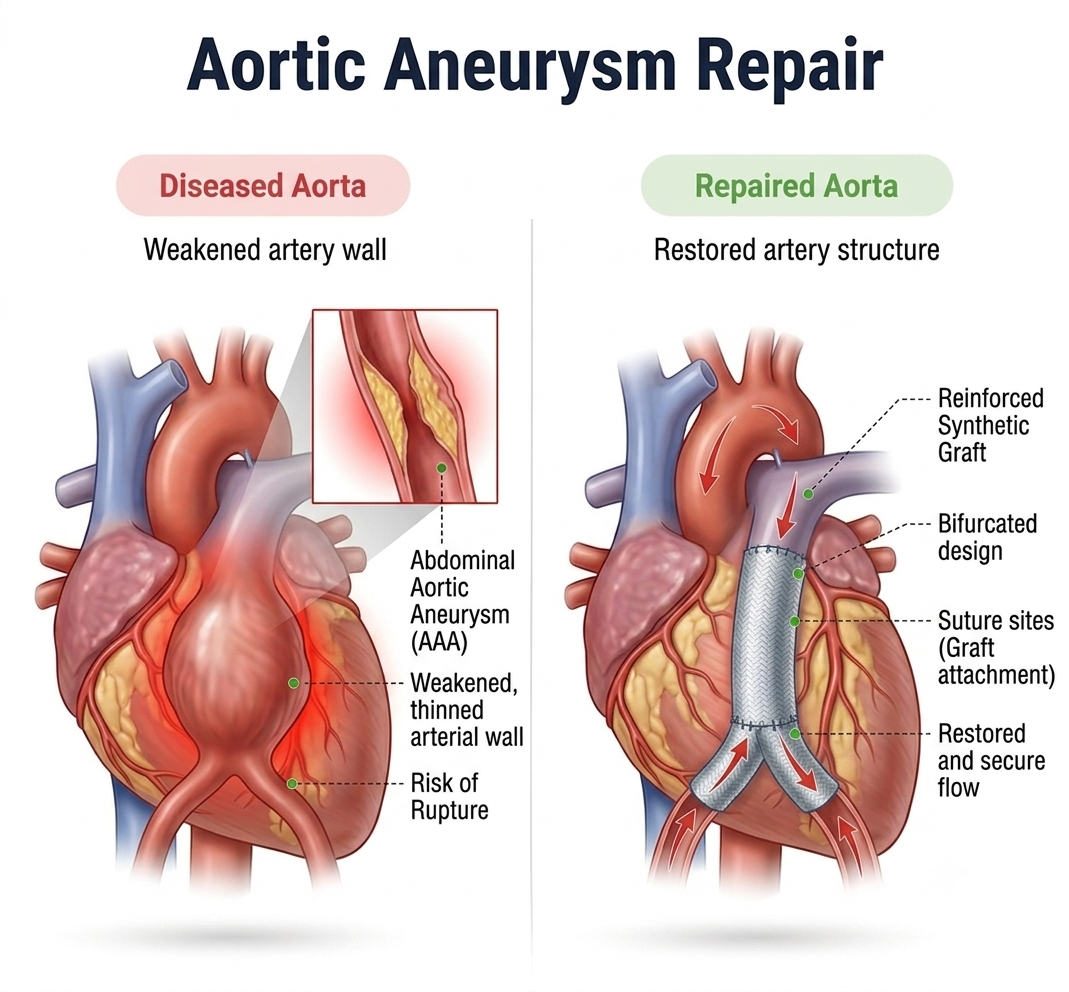
An aortic aneurysm is a weakened, bulging section in the aorta—the primary blood vessel conveying oxygenated blood from the heart to the rest of the body. Aneurysms can occur in the chest (Thoracic Aortic Aneurysm - TAA) or abdomen (Abdominal Aortic Aneurysm - AAA). If left untreated, progressive enlargement can cause sudden rupture, resulting in massive internal hemorrhage. Surgical repair replaces or reinforces the weakened arterial wall using a durable synthetic graft.
Who Needs Aortic Aneurysm Repair?
Repair is strongly recommended when aneurysm size or growth rate exceeds safe thresholds.
Key clinical indicators include:
- Abdominal Aortic Aneurysm (AAA) diameter measuring ≥ 5.5 cm in men or ≥ 5.0 cm in women.
- Thoracic Aortic Aneurysm (TAA) diameter measuring ≥ 5.5 cm (or ≥ 4.5-5.0 cm in connective tissue disorders like Marfan syndrome).
- Rapid aneurysm growth rate (>0.5 cm in 6 months or >1 cm in a year).
- Symptomatic aneurysms causing persistent severe back, flank, chest, or abdominal pain.
- Acute aortic dissection or impending rupture (emergency surgical indication).
Types of Repair Techniques
- Open Surgical Repair: The traditional approach involving a large abdominal or chest incision to open the bulging aorta directly and sew a Dacron or PTFE synthetic graft inside.
- EVAR (Endovascular Aneurysm Repair): A minimally invasive approach for abdominal aneurysms where a stent-graft is guided through femoral leg arteries and expanded inside the aneurysm.
- TEVAR (Thoracic Endovascular Aneurysm Repair): Endovascular stent-graft placement specifically tailored for thoracic aortic aneurysms or dissections.
- Complex Fenestrated / Branched EVAR (FEVAR): Custom-designed stent-grafts with tailored openings for renal and visceral branch arteries in complex neck anatomies.
Benefits of Aortic Aneurysm Repair
- Elimination of the risk of sudden, fatal aortic rupture.
- Complete resolution of back, flank, and abdominal discomfort caused by aneurysm expansion pressure.
- Minimally invasive options (EVAR/TEVAR) offer short recovery times for high-risk patients.
- Long-term durability and structural protection of the body's primary arterial trunk.
What to Expect Before Surgery?
Rigorous vascular mapping and anatomical planning are mandatory:
- Triple-Phase CT Angiography: Millimeter-thin slice scan to measure aneurysm neck length, angle, wall calcification, and access vessel diameter.
- Cardiopulmonary Assessment: Stress testing, echocardiogram, and pulmonary function tests to gauge anesthesia safety.
- Renal Protection Protocol: Pre-procedural hydration to mitigate contrast-induced nephropathy.
- Blood Cross-Matching: Ensuring immediate availability of matched blood products for emergency open surgery.
Complete Procedure
The surgical steps depend on the selected modality:
Open Surgical Repair:
- General anesthesia and midline abdominal or left thoracoabdominal incision.
- Cross-clamping the aorta above and below the aneurysm segment.
- Incising the aneurysm sac and clearing internal thrombus/clots.
- Sewing a synthetic tubular or bifurcated graft onto healthy native aortic walls.
- Re-establishing blood flow, verifying arterial pulses in legs, and wrapping the aneurysm sac over the graft.
EVAR / TEVAR Procedure:
- Local or regional anesthesia with small groin incisions over femoral arteries.
- Threading delivery catheters containing collapsed stent-grafts under fluoroscopic X-ray.
- Precisely positioning and deploying the main body and limb components inside the aneurysm sac.
- Inflating molding balloons to seal graft edges against healthy vessel walls, excluding the aneurysm sac from pressurized blood flow.
What to Expect During Surgery?
EVAR/TEVAR takes approximately 1.5 to 3 hours, whereas Open Surgical Repair takes 3.5 to 6 hours. Intensive monitoring of spinal cord perfusion, renal blood flow, and blood pressure is maintained throughout.
Open Surgical Repair vs EVAR / TEVAR
| Feature | Open Surgical Repair | EVAR / TEVAR (Endovascular) |
|---|---|---|
| Incision | Large abdominal or chest incision. | Small puncture/incision in both groins. |
| Hospital Stay | 7 to 10 Days (including ICU). | 2 to 3 Days. |
| Recovery Time | 6 to 12 Weeks. | 1 to 2 Weeks. |
| Long-Term Monitoring | Routine clinical checks. | Mandatory lifetime annual CT scans to monitor for endoleaks. |
Success Rate and Safety
Elective aneurysm repair carries a success rate exceeding 95-98%. Endovascular repair (EVAR) offers a 30-day procedural mortality rate under 1-2% in suitable candidates.
Aortic Aneurysm Repair Cost Estimate
| Procedure Type | Open Surgical Repair (INR) | EVAR / TEVAR (INR) |
|---|---|---|
| Abdominal Aortic Aneurysm (AAA) Repair | ₹4,00,000 - ₹6,50,000 | ₹6,50,000 - ₹10,50,000 |
| Thoracic Aortic Aneurysm (TAA / TEVAR) | ₹5,00,000 - ₹7,50,000 | ₹7,50,000 - ₹12,50,000 |
| Complex Fenestrated EVAR (FEVAR) | N/A | ₹12,00,000 - ₹18,00,000+ |
Disclaimer: Endovascular stent-grafts (GORE, Medtronic, Cook) represent a significant portion of procedural costs.
Recovery Guide & Post-Operative Care
Recovery Timeline
- Day 0-2: Intensive Care monitoring; blood pressure control and hourly limb pulse checks.
- Day 3-5: Ward mobilization; transition from IV to oral pain medications (EVAR patients discharged by Day 3).
- Week 2-4: Home rest; avoiding heavy lifting or straining.
- Week 6-8: Open surgical wound healed; return to light work routines.
- Month 1 & 12: Post-EVAR CT Angiography scan to check graft placement and rule out endoleaks.
Post-Op Precautions & Care
- Strict Lifting Restrictions: Do not lift objects weighing >5 kg for 6 to 8 weeks post-open surgery to prevent incisional hernia formation.
- Blood Pressure Management: Keep systolic blood pressure under strict target limits to minimize graft stress.
- Lifelong Surveillance (EVAR/TEVAR): Mandatory annual CT angiograms or contrast ultrasound checks to ensure no blood leaks back into the excluded aneurysm sac (endoleak).
- Smoking Cessation: Smoking accelerates arterial wall degradation and must be stopped completely.
Frequently Asked Questions
What happens if an aortic aneurysm ruptures?⌄
A ruptured aortic aneurysm causes sudden, severe internal bleeding and severe back/abdominal pain. It is an extreme medical emergency requiring immediate surgical treatment.
How do I know if I have an aortic aneurysm?⌄
Most unruptured aneurysms cause no symptoms and are discovered incidentally during routine abdominal ultrasound or chest CT scans.
Am I a candidate for EVAR instead of open surgery?⌄
Eligibility for EVAR depends on your aorta's anatomy, specifically having an adequate 'neck' length and un-tortuous leg access arteries as seen on CT angiography.
What is an endoleak after EVAR?⌄
An endoleak occurs when blood continues to seep into the aneurysm sac around the stent-graft. Most endoleaks can be monitored or treated with minor catheter interventions.
Can I exercise after aortic aneurysm repair?⌄
Walking and light aerobic exercise are encouraged after recovery, but heavy weightlifting or isometric straining should be permanently modified to protect the aorta.