




What is Angioplasty & Stenting?
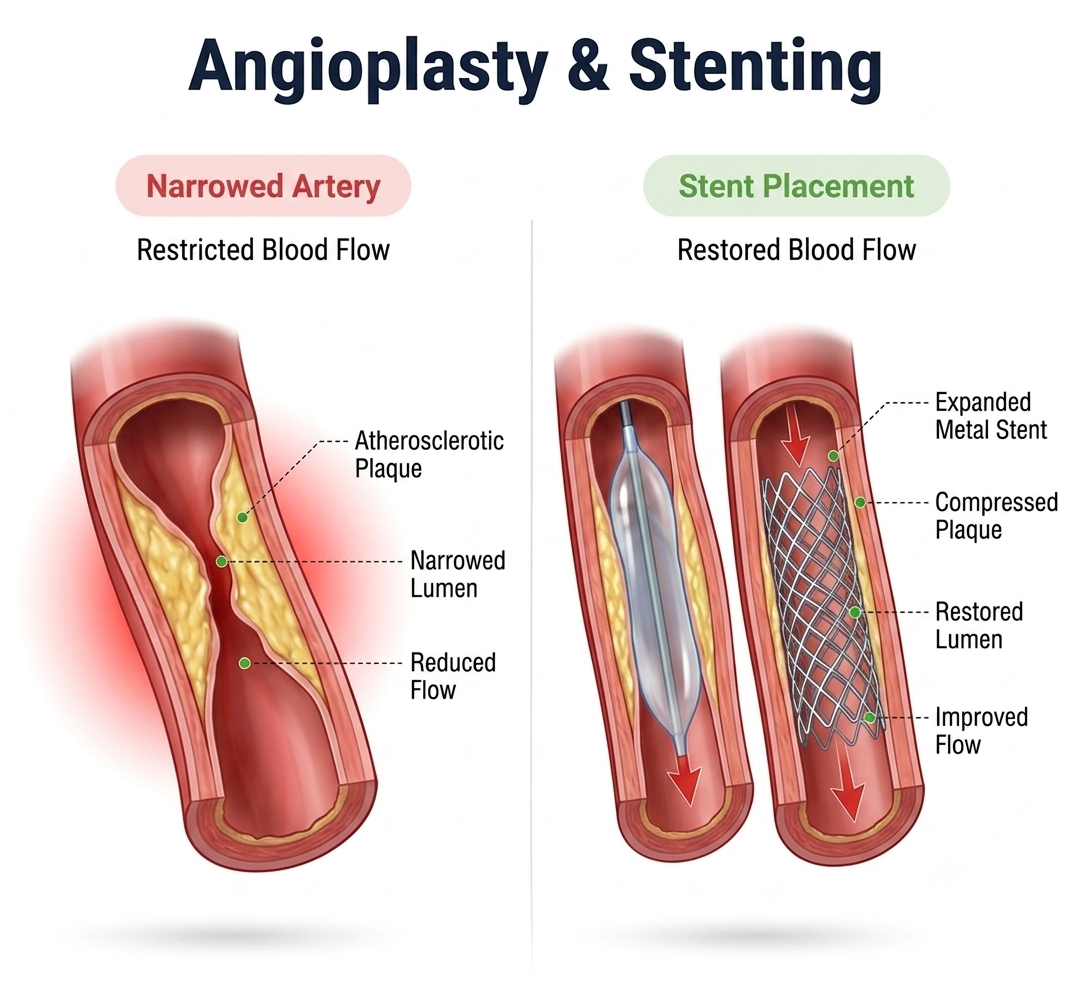
Coronary Angioplasty (PCI) is a non-surgical catheter-based procedure performed to reopen narrowed or blocked coronary arteries caused by atherosclerosis. A thin flexible tube (catheter) with a miniature balloon at its tip is guided through a peripheral artery (radial or femoral) into the blocked heart vessel. Inflating the balloon compresses fatty plaque against the arterial wall, and a expandable metal mesh tube (stent) is permanently deployed to hold the artery open.
Who Needs Angioplasty?
Angioplasty is performed as an emergency life-saving procedure during acute heart attacks or as an elective treatment for severe coronary blockages.
Key clinical indicators include:
- Acute ST-Elevation Myocardial Infarction (STEMI) or Non-STEMI heart attack.
- Severe stable or unstable angina that persists despite maximum medical therapy.
- Single or double vessel coronary artery disease identified on coronary angiography.
- High-risk ischemia demonstrated on treadmill stress testing or myocardial perfusion imaging.
Types of Angioplasty & Stent Technologies
- Drug-Eluting Stents (DES): Modern metallic stents coated with medication that gradually releases over time to prevent tissue regrowth and re-blockage (restenosis).
- Bare-Metal Stents (BMS): Uncoated metal mesh stents used rarely today or in patients who cannot tolerate long-term dual antiplatelet therapy.
- Bioresorbable Vascular Scaffolds (BVS): Naturally dissolving stents that provide temporary arterial support and disappear over 2-3 years.
- Complex PCI (CTO / Bifurcation): Advanced techniques using intravascular ultrasound (IVUS), fractional flow reserve (FFR), or rotational atherectomy (Rotablator) for heavily calcified or total blockages.
Benefits of Angioplasty & Stenting
- Rapid restoration of blood flow during an emergency heart attack, minimizing muscle damage.
- Immediate relief from crippling chest pain and shortness of breath.
- Minimally invasive procedure requiring no open surgical chest incisions.
- Short hospital stay and quick return to regular working life.
What to Expect Before Surgery?
Preparation involves safety protocols to ensure kidney protection and bleeding control:
- Diagnostic Angiogram: Visualizing the precise location, severity, and morphology of arterial blockages.
- Renal Function Testing: Checking blood urea and creatinine levels to safely handle contrast dye.
- Hydration Protocol: Intravenous fluids before and after the procedure to protect kidney function.
- Loading Antiplatelet Medications: Doses of aspirin and second-generation blood thinners (ticagrelor/prasugrel/clopidogrel).
Complete Procedure
The catheterization laboratory procedure follows these steps:
- Local anesthesia administered at the access site (wrist radial artery or groin femoral artery).
- Insertion of a small sheath followed by a long, narrow guiding catheter up to the heart.
- Injecting radiopaque dye and viewing arterial structure under real-time fluoroscopic X-ray.
- Threading a micro-guidewire across the blocked segment of the coronary artery.
- Advancing a balloon catheter over the wire and inflating it to dilate the narrowed vessel segment.
- Position-verifying and expanding a Drug-Eluting Stent (DES) to lock the vessel open.
- Confirming ideal stent expansion using IVUS/OCT imaging, removing catheters, and closing the access site.
What to Expect During Surgery?
The procedure takes approximately 30 to 60 minutes for straightforward cases (longer for complex multi-stent interventions). The patient remains awake under light sedation. You may feel a temporary warm flush when contrast dye is injected or mild chest tightness during balloon inflation.
Drug-Eluting Stents (DES) vs Bare-Metal Stents (BMS)
| Feature | Drug-Eluting Stents (DES) | Bare-Metal Stents (BMS) |
|---|---|---|
| Restenosis Rate | Exceptionally low (<5%). | Moderate (15-30%). |
| Medication Coating | Anti-proliferative drugs (e.g., Everolimus, Zotarolimus). | None. |
| Blood Thinner Duration | 6 to 12 months Dual Antiplatelet Therapy (DAPT). | 1 to 3 months DAPT. |
| Clinical Standard | Current global primary standard of care (>95% of cases). | Reserved for select high bleeding-risk patients. |
Success Rate and Safety
Angioplasty boasts a procedural success rate over 98%. Modern third-generation Drug-Eluting Stents have reduced long-term stent re-blockage (restenosis) rates to under 3-5%.
Angioplasty Cost Estimate
| Procedure Type | Single Stent (INR) | Double / Triple Stent (INR) |
|---|---|---|
| Elective PCI with Drug-Eluting Stent (DES) | ₹1,20,000 - ₹2,20,000 | ₹2,20,000 - ₹3,80,000 |
| Emergency PCI (Primary Angioplasty in Heart Attack) | ₹1,60,000 - ₹2,60,000 | ₹2,80,000 - ₹4,20,000 |
| Complex PCI (with IVUS / FFR / Rotablation) | ₹2,50,000 - ₹3,50,000 | ₹3,80,000 - ₹5,50,000+ |
Disclaimer: Total cost depends on stent brand (US-FDA approved vs domestic), usage of advanced guidance imaging (IVUS/OCT/FFR), and room category.
Recovery Guide & Post-Operative Care
Recovery Timeline
- Hour 0-6: Sheath removal and bed rest (6 hours for groin access, 2 hours for wrist access).
- Day 1: Discharge from hospital if vitals and puncture site remain stable.
- Day 2-5: Light home activities; avoiding heavy lifting or strenuous arm/leg movements.
- Week 1-2: Normal work routine resumed for most non-strenuous occupations.
- Month 1: Follow-up visit with cardiologist for medication optimization.
Post-Op Precautions & Care
- Strict Medication Adherence: Never skip dual antiplatelet drugs (Aspirin + Ticagrelor/Clopidogrel) to prevent life-threatening stent thrombosis.
- Hydration: Drink plenty of water for 48 hours post-procedure to flush out radiopaque contrast dye.
- Access Site Monitoring: Check wrist or groin for lump formation, swelling, or severe bruising.
- Lifestyle & Exercise: Begin progressive walking, adopt a heart-healthy diet, and eliminate tobacco exposure completely.
Frequently Asked Questions
Is angioplasty a major surgery?⌄
No, angioplasty is a minimally invasive percutaneous procedure performed under local anesthesia. It does not require opening the chest or a heart-lung machine.
How long does a coronary stent stay in the body?⌄
Coronary stents are permanent metallic structures that integrate safely into the artery wall over time and do not need to be removed.
What is the difference between angiography and angioplasty?⌄
Angiography is purely a diagnostic test to map arterial blockages, whereas angioplasty is the actual therapeutic treatment to open the blockage with a balloon and stent.
Can a stented artery block again?⌄
While modern Drug-Eluting Stents keep re-blockage rates under 5%, new blockages can form in untreated segments if blood pressure, cholesterol, and lifestyle factors are unmanaged.
How soon can I walk or travel after angioplasty?⌄
You can walk short distances the day after the procedure. Air travel or long road travel is generally safe within 1 to 2 weeks after an elective, uncomplicated angioplasty.