









What is Kidney Transplant Surgery?
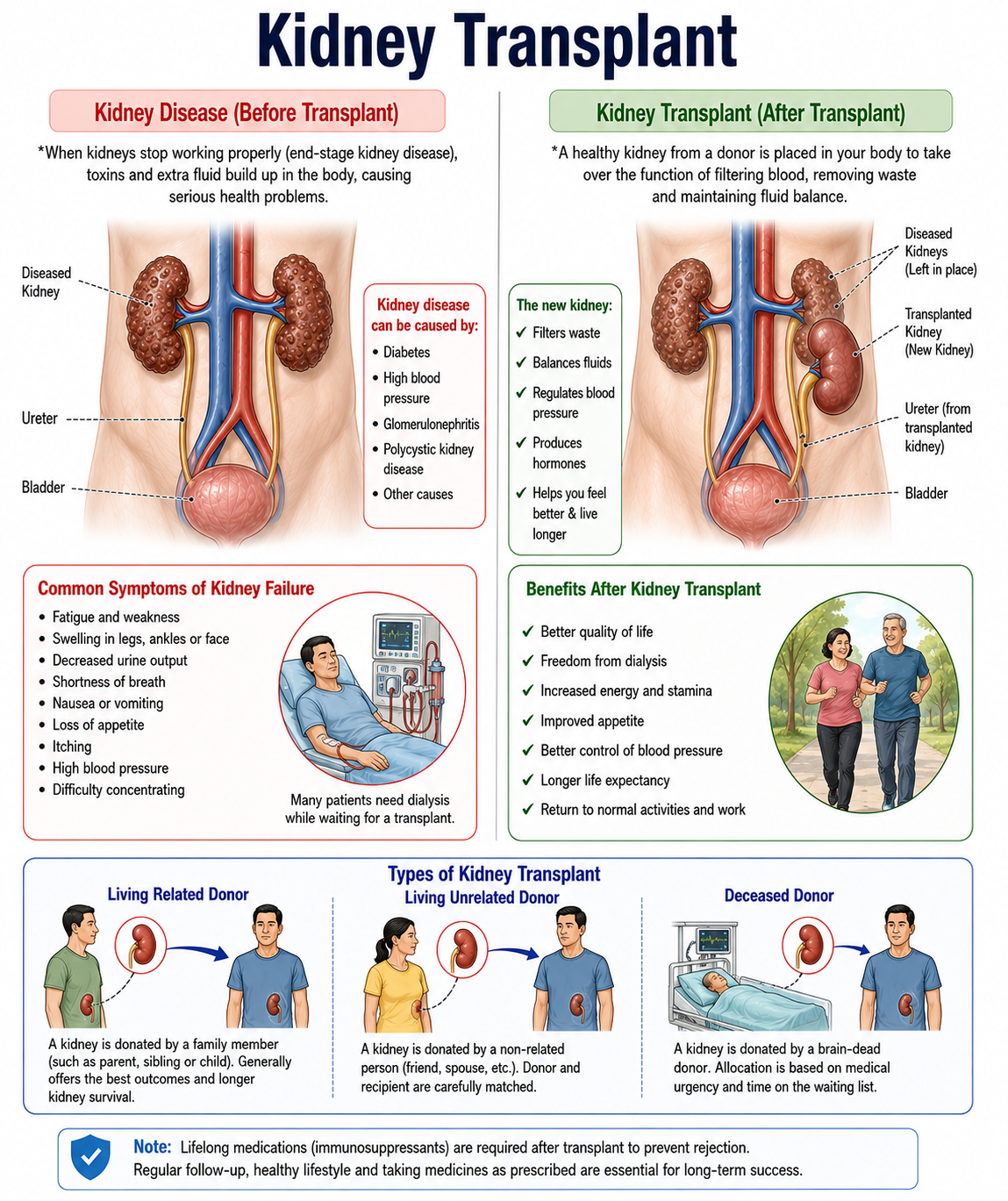
Kidney transplantation is a major vascular and urological procedure where a healthy donor kidney is transplanted into a recipient suffering from irreversible kidney failure (End-Stage Renal Disease - ESRD).
The transplanted kidney assumes full metabolic roles including filtration, fluid balance, and hormone production. The new kidney is positioned in the lower abdomen (iliac fossa), while native non-functioning kidneys are generally left in place.
Who Needs a Kidney Transplant?
Transplantation is required for patients with Stage 5 Chronic Kidney Disease (eGFR < 15 mL/min/1.73m²).
Key clinical indicators include:
- End-stage renal disease secondary to diabetic nephropathy or hypertension.
- Glomerulonephritis, polycystic kidney disease, or severe congenital anomalies.
- Long-term dependence on hemodialysis or peritoneal dialysis.
- Declining quality of life on maintenance dialysis.
Types of Kidney Transplant
- Living Donor Transplant: A healthy donor (family member or compatible donor) donates a kidney, offering high graft survival and quick scheduling.
- Deceased Donor Transplant: A kidney retrieved from a deceased organ donor allocated via national waitlists.
- ABO-Incompatible / Paired Exchange: Special desensitization or donor-swapping programs for blood-type or tissue-incompatible pairs.
Benefits of Kidney Transplant
- Significantly increased life expectancy compared to long-term dialysis.
- Complete freedom from multi-weekly dialysis sessions.
- Enhanced quality of life, energy levels, and fluid/dietary freedom.
- Reduced risk of cardiovascular complications associated with chronic renal failure.
- Restored fertility and improved general health.
What to Expect Before Surgery?
- Medical & Cardiac Screening: Thorough health evaluation for donor and recipient.
- Tissue & Crossmatch Testing: HLA tissue typing and crossmatching to ensure compatibility.
- Immunosuppression Prep: Preparing the immune system with anti-rejection medications.
- Pre-Op Dialysis: Dialysis optimization shortly before surgery.
Complete Procedure
The surgical process generally follows these steps:
- Administration of general anesthesia and central line placement.
- Making a curvilinear incision in the lower abdomen (iliac fossa).
- Connecting the donor renal artery and vein to the recipient's external iliac vessels.
- Removing vascular clamps to verify immediate blood flow and urine production.
- Connecting the donor ureter to the recipient's bladder over a temporary DJ stent.
- Placing a surgical drain and meticulously closing the incision.
What to Expect During Surgery?
Surgery lasts 3 to 5 hours under general anesthesia. Vitals, fluid balance, and graft perfusion are continuously monitored by a specialized transplant team.
Living Donor vs Deceased Donor Transplant
| Feature | Living Donor Transplant | Deceased Donor Transplant |
|---|---|---|
| Wait Time | Weeks to months (Elective) | Years (Waitlist dependent) |
| Average Graft Lifespan | 15 to 20+ Years | 10 to 15 Years |
| Immediate Graft Function | Typical (Minimal cold ischemia) | Delayed function risk present |
Success Rate and Safety
One-year graft survival rates for living donor transplants exceed 95%, and 90% to 95% for deceased donor transplants.
Kidney Transplant Cost Estimate
| Component | Estimated Cost Range (INR) |
|---|---|
| Pre-Transplant Workup & Crossmatching | ₹1,00,000 - ₹2,00,000 |
| Recipient Surgery & Hospital Stay | ₹4,50,000 - ₹10,00,000 |
| Donor Surgery & Care | ₹1,50,000 - ₹3,00,000 |
| Initial Year Anti-Rejection Medications | ₹1,50,000 - ₹3,00,000 |
| Total Estimated Cost Range | ₹6,50,000 - ₹16,00,000 |
Disclaimer: Costs vary based on hospital, donor type, ICU stay, and desensitization needs.
Recovery Guide & Post-Operative Care
Recovery Timeline
- Days 1-3 (ICU): Graft function monitoring, fluid management, immunosuppressant dosing.
- Days 7-14: Discharge home; drain and urinary catheter removal.
- Weeks 2-6: Outpatient visits, frequent blood tests (creatinine, drug levels).
- Months 3-6: Return to work and full normal daily activities.
Post-Op Precautions & Care
- Strict Medication Adherence: Take anti-rejection drugs on a strict schedule without missing doses.
- Infection Prevention: Practice good hand hygiene, wear masks in crowds, avoid sick individuals.
- Fluid Intake: Drink 2.5 to 3 liters of fluid daily to maintain graft blood flow.
Frequently Asked Questions
What happens to the old non-functioning kidneys?⌄
Native failed kidneys are usually left in place unless they cause severe hypertension, infection, or massive enlargement.
Are anti-rejection medications required for life?⌄
Yes, immunosuppressant medications must be taken daily for as long as the transplanted kidney functions to prevent organ rejection.
How long does a transplanted kidney last?⌄
A living donor kidney lasts 15 to 20+ years on average, while a deceased donor kidney lasts 10 to 15 years.
How long does a living donor take to recover?⌄
Living donors stay in the hospital for 3 to 5 days and return to full normal activities within 4 to 6 weeks.
When can a recipient return to work?⌄
Recipients can usually return to light work within 6 to 8 weeks, with full activity resumption in 3 to 6 months.