




What is Atrial Fibrillation Surgery?
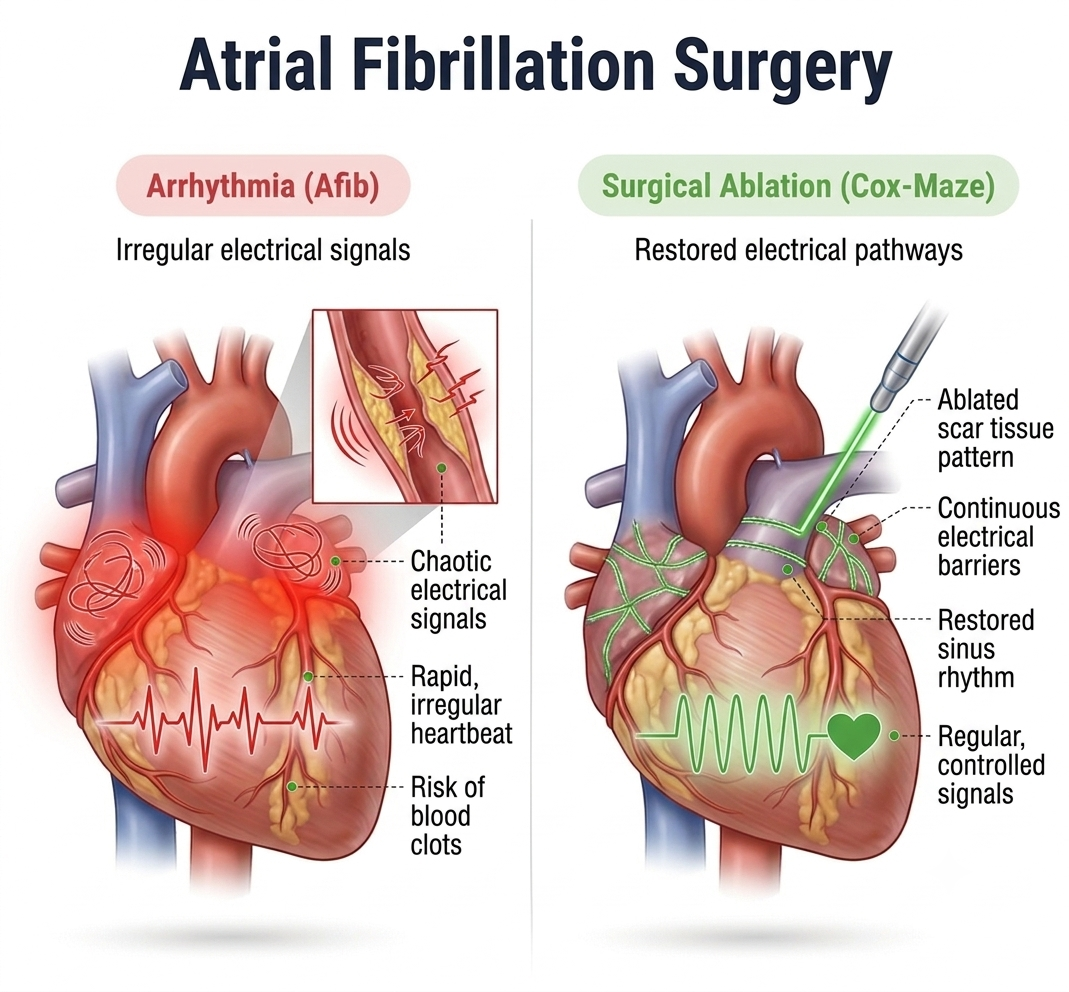
Atrial Fibrillation (AFib) is the most common cardiac arrhythmia, characterized by rapid, disorganized electrical quivering in the upper heart chambers (atria). This reduces heart pumping efficiency and drastically raises stroke risk due to blood pooling in the Left Atrial Appendage (LAA). AFib surgery or ablation creates strategic scar tissue lines (pulmonary vein isolation or the Cox-Maze pattern) that block rogue electrical impulses and restore a synchronized rhythm.
Who Needs AFib Surgery or Ablation?
Intervention is considered when medications fail to control rhythm or symptoms impair quality of life.
Key clinical indicators include:
- Symptomatic Paroxysmal or Persistent AFib refractory to anti-arrhythmic drugs (AADs).
- AFib-induced tachycardia-mediated cardiomyopathy (weakening heart muscle function).
- Patient intolerance or high bleeding risks associated with long-term blood thinner medications.
- Patients undergoing concomitant cardiac surgery (such as mitral valve repair or CABG) who also have AFib.
Types of AFib Procedures
- Catheter Radiofrequency / Cryoablation: A catheter is inserted through a leg vein into the heart to deliver extreme heat (RF) or extreme cold (Cryo balloon) to isolate the pulmonary veins.
- Surgical Cox-Maze IV Procedure: The gold-standard open or thoracoscopic surgical technique using bipolar radiofrequency and cryo probes to create a complete "maze" of conduction-blocking scar lines.
- Hybrid AFib Ablation: A combined procedure uniting minimally invasive epicardial surgical ablation with endocardial catheter mapping.
- Left Atrial Appendage Closure (LAAO / WATCHMAN): Mechanically sealing or clipping off the LAA pocket where 90% of stroke-causing clots originate.
Benefits of AFib Surgery
- High rate of permanent freedom from rapid, irregular heart palpitations and flutter.
- Significant reduction in long-term ischemic stroke risk.
- Elimination of chronic fatigue, dizziness, and exercise intolerance caused by arrhythmia.
- Potential discontinuation of long-term anti-arrhythmic and blood thinner drugs after successful blanking period.
What to Expect Before Surgery?
Pre-procedural mapping ensures safety and precise targeted ablation:
- Transesophageal Echocardiogram (TEE): Checking for pre-existing blood clots in the Left Atrial Appendage immediately prior to ablation.
- 3D Electro-Anatomical Mapping (CARTO / EnSite): Creating a detailed 3D color voltage map of atrial electrical conduction.
- CT / MRI Pulmonary Vein Anatomy: Mapping spatial entry points of pulmonary veins into the left atrium.
- Anticoagulation Continuity: Continuing or bridging blood thinners as instructed by the electrophysiologist to maintain anti-clotting protection.
Complete Procedure
The Catheter Ablation and Surgical Maze steps involve:
Catheter Ablation Protocol:
- Sedation or general anesthesia in the EP laboratory.
- Accessing the femoral vein in the groin and performing a transseptal puncture into the left atrium.
- Reconstructing 3D atrial geometry using high-density mapping catheters.
- Delivering radiofrequency heat or cryo-cooling around all four pulmonary vein ostia (Pulmonary Vein Isolation - PVI).
- Testing for complete electrical entrance and exit block across created scar lines.
Surgical Cox-Maze IV Protocol:
- Open chest access or right mini-thoracotomy port creation.
- Applying specialized energy clamps across precise atrial locations to block electrical loops.
- Exposing and surgical excising or stapling closed the Left Atrial Appendage (LAA).
What to Expect During Surgery?
Catheter ablation takes approximately 2 to 4 hours. Surgical Maze combined with open valve surgery adds about 30 to 45 minutes to the operative duration. Continuous esophageal temperature monitoring is maintained to prevent thermal injury.
Catheter Ablation vs Surgical Cox-Maze Procedure
| Feature | Catheter Ablation (PVI) | Surgical Cox-Maze IV |
|---|---|---|
| Approach | Minimally invasive groin puncture. | Thoracoscopic ports or open surgical access. |
| Success in Paroxysmal AFib | 70 - 85% freedom from AFib. | 85 - 95% freedom from AFib. |
| Success in Long-Standing Persistent AFib | 50 - 65% (may need 2nd session). | 75 - 85% single-procedure success. |
| LAA Closure | Requires separate WATCHMAN device. | Direct surgical excision or clipping included. |
Success Rate and Safety
In paroxysmal AFib, catheter ablation achieves an 80-85% success rate. The surgical Cox-Maze IV procedure remains the gold standard, demonstrating up to 90% long-term freedom from arrhythmia.
Atrial Fibrillation Surgery Cost Estimate
| Procedure Type | Catheter Ablation (INR) | Surgical / Hybrid Maze (INR) |
|---|---|---|
| Radiofrequency / Cryoballoon Ablation | ₹2,50,000 - ₹4,50,000 | N/A |
| Standalone Minimally Invasive Surgical Maze | N/A | ₹4,50,000 - ₹6,50,000 |
| Concomitant Cox-Maze IV (added to Valve/CABG) | N/A | ₹1,20,000 - ₹2,00,000 (Add-on) |
| WATCHMAN / LAA Closure Device | ₹4,50,000 - ₹6,50,000 | Included in surgery |
Disclaimer: Advanced 3D mapping catheters and cryo balloons represent specialized single-use consumable costs.
Recovery Guide & Post-Operative Care
Recovery Timeline
- Day 0-1: Groin pressure dressing management, overnight stay in step-down cardiac unit.
- Day 2: Discharge home following catheter ablation; light walking permitted.
- Week 1-3: "Blanking Period"—occasional benign palpitations can occur while scar tissue matures.
- Month 3: Repeat 24-hour Holter monitoring and electrophysiology evaluation.
- Month 6: Anticoagulant cessation consideration based on CHA2DS2-VASc score and ablation success.
Post-Op Precautions & Care
- Understanding the 3-Month "Blanking Period": Irregular heartbeats in the first 90 days post-ablation are common due to local tissue inflammation and do not mean procedure failure.
- Groin Site Care: Avoid heavy lifting (>5 kg) or squatting for 1 week to prevent femoral hematoma formation.
- Continued Anticoagulation: Never stop blood thinners prematurely until explicit electrophysiologist clearance is granted.
- Trigger Avoidance: Eliminate alcohol, excessive caffeine, sleep deprivation, and high stress.
Frequently Asked Questions
What is the 'blanking period' after AFib ablation?⌄
The 3 months immediately following ablation are known as the blanking period. Temporary arrhythmias during this time are common due to cardiac inflammation and are managed with temporary medications.
Will I still need blood thinners after successful AFib ablation?⌄
Blood thinners are continued for at least 3 to 6 months post-procedure. Long-term continuation depends on your baseline stroke risk score (CHA2DS2-VASc score) rather than symptom status alone.
How does AFib cause a stroke?⌄
When the atria quiver chaotically, blood can pool in the Left Atrial Appendage (LAA), forming blood clots. If a clot dislodges and travels to the brain, it triggers an ischemic stroke.
What is the difference between Radiofrequency and Cryoablation?⌄
Radiofrequency uses thermal heat energy point-by-point to create scar lines, while Cryoablation uses a cold-refrigerated balloon to freeze tissue in a single step around the pulmonary veins.
Can AFib come back after ablation?⌄
Yes, AFib can recur if new electrical pathways develop over time. A second touch-up catheter ablation session can successfully isolate recurrent conduction gaps.