



What is Breast Reconstruction?
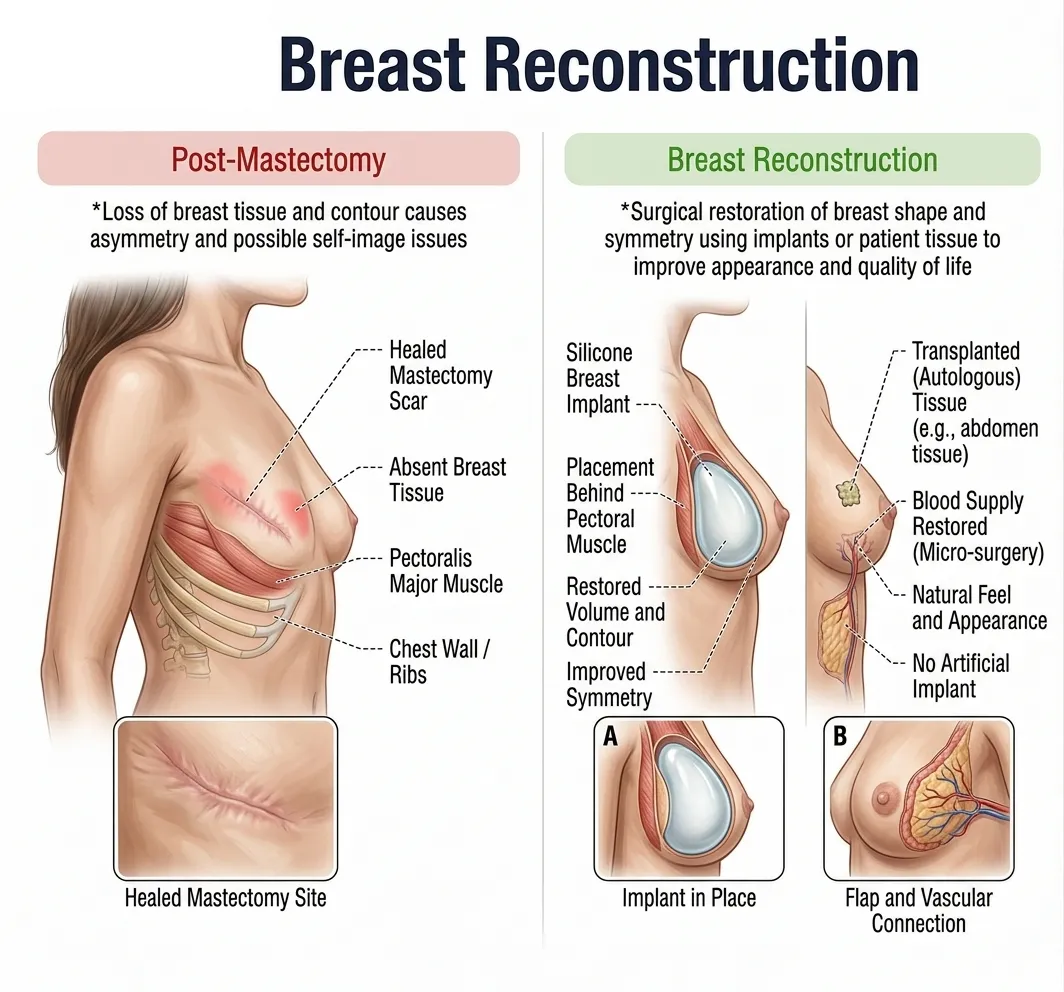
Breast reconstruction restores one or both breasts after oncologic surgery. Utilizing tissue expansion, silicone prostheses, or autologous tissue flaps (transferred from the abdomen, back, or thigh), plastic surgeons recreate a natural breast mound tailored to match the patient's chest anatomy.
Who Needs Breast Reconstruction?
Women who have undergone mastectomy or breast-conserving surgery (lumpectomy) for breast cancer or high-risk genetic mutations (BRCA1/2).
Key clinical indicators include:
- Unilateral or bilateral post-mastectomy tissue deficit.
- Severe chest wall contour asymmetry following oncologic surgery.
- Patient desire for body wholeness and elimination of external prostheses.
Types of Breast Reconstruction
- Implant-Based Reconstruction: Use of a temporary tissue expander followed by a permanent silicone or saline implant.
- Autologous DIEP Flap: Deep Inferior Epigastric Perforator flap using lower abdominal skin/fat while sparing abdominal muscle.
- Autologous TRAM Flap: Transverse Rectus Abdominis Myocutaneous flap utilizing abdominal muscle and tissue.
- Latissimus Dorsi Flap: Tissue transferred from the upper back, frequently combined with an implant.
Benefits of Breast Reconstruction
- Permanent restoration of body contour and physical symmetry.
- Eliminates dependence on external, removable breast forms.
- Positive psychological impact on self-esteem and post-cancer healing.
- Coordinated surgical timing during primary mastectomy (immediate reconstruction).
What to Expect Before Surgery?
- Multidisciplinary Tumor Board Consultation: Coordination between surgical oncologist, medical oncologist, radiation oncologist, and plastic surgeon.
- Donor Site Assessment: Vascular mapping via CT angiography if planning autologous flap surgery.
- Radiation Timing Planning: Evaluating whether post-mastectomy radiation therapy (PMRT) will precede or follow reconstruction.
Complete Procedure
- General anesthesia administration.
- Oncologic mastectomy completed by breast surgeon (if immediate reconstruction).
- Plastic surgery reconstruction stage:
- Implant Route: Placement of tissue expander or permanent implant under chest wall muscle.
- Flap Route: Harvesting tissue flap, microsurgical re-anastomosis of blood vessels, and shaping breast mound.
- Placement of surgical drains and meticulous skin closure.
- Subsequent 2nd-stage procedure for nipple-areolar complex reconstruction or symmetry adjustments if needed.
Implant-Based vs Autologous Flap Reconstruction
| Feature | Implant-Based | Autologous Flap (DIEP/TRAM) |
|---|---|---|
| Source | Medical-grade silicone prosthesis | Patient's own tissue (abdomen/back) |
| Surgical Complexity | Shorter operating time (2-3 hrs) | Complex microsurgery (6-8 hrs) |
| Hospital Stay | 1 - 2 days | 3 - 5 days |
| Long-Term Feel | Firm; stays consistent | Soft; behaves like natural body tissue |
Success Rate and Safety
Reconstruction has high safety profiles and excellent long-term outcomes. Microsurgical DIEP flap success rates exceed 95-98% in specialized surgical centers.
Cost Estimate
| Procedure Variation | Estimated Cost (INR) |
|---|---|
| Single Breast Implant-Based Reconstruction | ₹1,80,000 - ₹3,00,000 |
| Autologous Flap Reconstruction (DIEP/TRAM) | ₹2,80,000 - ₹4,50,000+ |
| Nipple-Areolar Reconstruction & Revision | ₹40,000 - ₹80,000 |
Disclaimer: Final costs depend on staging (immediate vs. delayed), flap complexity, ICU monitoring requirements, and hospital stay.
Recovery Guide & Post-Operative Care
Recovery Timeline
- Days 1-5: Inpatient monitoring; management of surgical drains and vascular checks for flaps.
- Weeks 2-3: Drain removal; gradual restoration of shoulder range of motion with light physical therapy.
- Weeks 4-6: Return to non-strenuous daily activities and driving.
- Month 3-6: Complete tissue settling; second-stage nipple reconstruction or symmetry adjustments considered.
Post-Op Precautions & Care
- Drain Monitoring: Measure and record daily drain fluid output accurately.
- Movement Restrictions: Avoid heavy pushing, pulling, or overhead lifting for 6 weeks.
- Compression Wear: Wear specialized supportive abdominal binder (for flap procedures) or bra as instructed.
Frequently Asked Questions
Can reconstruction be done at the same time as my mastectomy?⌄
Yes. Immediate reconstruction occurs during the same operation as your mastectomy. Delayed reconstruction can also be performed months or years later.
Does breast reconstruction increase the risk of cancer recurrence?⌄
No. Extensive medical research shows breast reconstruction does not cause breast cancer to recur nor does it delay cancer detection.
What is a DIEP flap reconstruction?⌄
A DIEP flap uses skin and fat from the lower abdomen to rebuild the breast without cutting or removing the underlying rectus abdominis muscle, preserving core strength.
How long does the reconstructed breast last?⌄
Autologous tissue flaps (DIEP/TRAM) last a lifetime as they become part of your body. Implants last many years but may need maintenance or replacement over time.
Will the reconstructed breast have normal sensation?⌄
Numbness is expected after mastectomy. While full sensation rarely returns, nerve-grafting techniques during flap procedures can help restore partial sensation over time.