

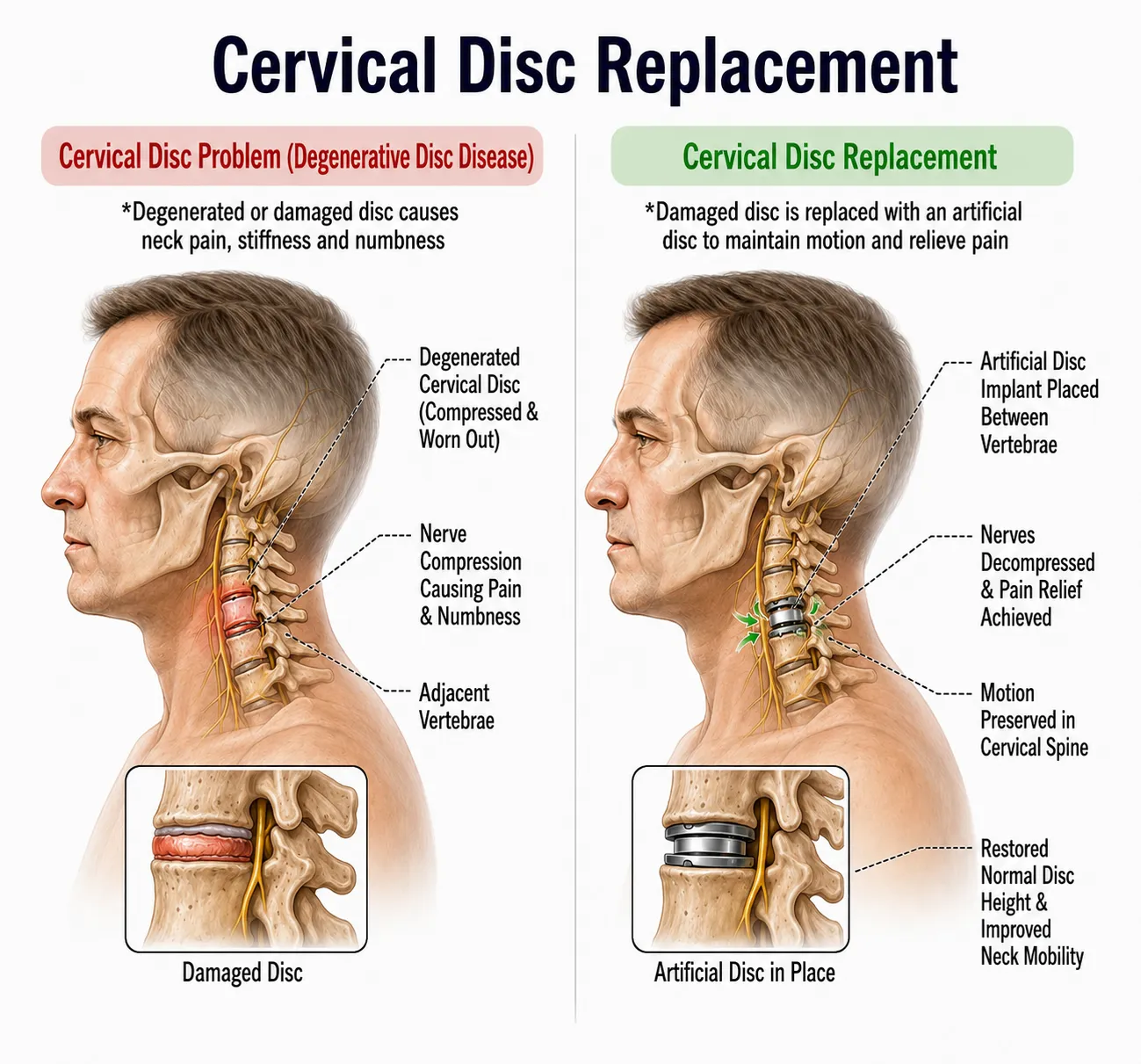










What is Cervical Disc Replacement?
Cervical Disc Replacement (also known as Cervical Disc Arthroplasty) is an advanced surgical procedure performed to treat symptomatic cervical radiculopathy (pinched nerve) or myelopathy (spinal cord compression). Unlike traditional fusion surgery, disc replacement removes the worn-out disc and inserts a medical-grade prosthetic device (titanium and ultra-high-molecular-weight polyethylene) that maintains natural neck motion and flex.
Who Needs Cervical Disc Replacement?
Surgery is indicated when cervical disc herniation or spondylosis causes persistent pain, numbness, or weakness radiating down the arm that fails to respond to conservative care.
Key clinical indicators include:
- Severe, burning neck and arm pain (cervical radiculopathy) unresponsive to 6+ weeks of physical therapy and medications.
- Numbness, tingling, or motor weakness in the shoulder, arm, or fingers.
- MRI evidence of single-level or two-level disc herniation with nerve root or spinal cord compression.
- Preserved spinal alignment without severe facet joint arthritis or spinal instability.
Types of Cervical Spine Procedures
- Cervical Disc Arthroplasty (CDR): Removal of damaged disc and placement of a motion-preserving artificial implant.
- Anterior Cervical Discectomy and Fusion (ACDF): Removal of the damaged disc with placement of a bone graft/cage and plate to fuse the adjacent vertebrae together permanently.
- Posterior Cervical Foraminotomy: Minimally invasive decompression performed from the back of the neck to relieve localized nerve pinching.
Benefits of Cervical Disc Replacement
- Preservation of natural segmental motion in the neck (flexion, extension, rotation).
- Reduced risk of Adjacent Segment Disease (ASD)—preventing premature wear on neighboring disc levels.
- Eliminates the need for bone grafting or rigid bone fusion recovery.
- Faster post-operative recovery with minimal need for rigid neck collars.
What to Expect Before Surgery?
Preparation involves precise radiological and clinical evaluations:
- Spine Imaging: High-resolution Cervical MRI, CT scan (to assess bone density and facet joint health), and dynamic flexion-extension X-rays.
- Neurological Exam: Mapping dermatomal sensory loss and muscle weakness grade.
- Pre-anesthesia Clearance: Routine blood panels, chest X-ray, and airway assessment.
Complete Procedure
The surgical steps include:
- General anesthesia and positioning on the operating table with gentle neck extension.
- Small horizontal skin incision (approx. 3-4 cm) in a natural skin crease on the front (anterior) of the neck.
- Gently moving aside esophagus, trachea, and blood vessels using natural tissue planes.
- Removing the herniated/degenerated intervertebral disc and micro-decompressing pinched nerve roots and spinal cord under an operating microscope.
- Preparing vertebral endplates with precise milling instruments.
- Inserting and anchoring the sized artificial disc device under intraoperative fluoroscopic (X-ray) guidance.
- Closing the deep tissue layers and skin with absorbable sutures.
What to Expect During Surgery?
Operating duration is typically 1.5 to 2.5 hours per disc level. Continuous intraoperative somatosensory evoked potential (SSEP) monitoring protects neurological safety.
Disc Replacement (CDR) vs Fusion (ACDF)
| Feature | Cervical Disc Replacement (CDR) | Cervical Fusion (ACDF) |
|---|---|---|
| Neck Mobility | Preserves natural segmental flexion/rotation. | Eliminates motion at the fused level. |
| Adjacent Segment Stress | Low stress on neighboring discs. | Higher mechanical stress on adjacent disc levels over time. |
| Bone Grafting | None required. | Requires bone graft or synthetic cage fusion. |
| Post-Op Collar | Soft collar for few days or none. | Rigid cervical collar often worn for 2-6 weeks. |
Success Rate and Safety
Cervical disc replacement is an FDA-approved procedure with success rates exceeding 90-95% in relieving arm pain. Clinical trials demonstrate lower re-operation rates compared to ACDF at 7-10 year follow-ups.
Cervical Disc Replacement Cost Estimate
| Procedure Type | Single-Level Replacement (INR) | Two-Level Replacement (INR) |
|---|---|---|
| Cervical Disc Arthroplasty | ₹3,00,000 - ₹5,00,000 | ₹5,50,000 - ₹7,50,000 |
Disclaimer: Implant costs (US FDA-approved motion-preserving devices like Mobi-C, Prestige, or Simplify) represent a significant portion of overall surgical fees.
Recovery Guide & Post-Operative Care
Recovery Timeline
- Day 0-1: Mobilization on the same evening or next morning; soft collar worn for comfort.
- Day 2-3: Transition to oral pain medications; hospital discharge.
- Week 1-2: Incision site healing; light walking encouraged; swallowing discomfort resolves.
- Week 4-6: Resumption of normal daily routines, office desk work, and light driving.
- Month 3: Return to full sports and active exercise after follow-up X-ray confirmation.
Post-Op Precautions & Care
- Incision Care: Keep anterior neck incision dry and clean for 7-10 days.
- Swallowing Hygiene: Eat soft or semi-solid foods for the first few days if minor throat soreness occurs.
- Neck Motion: Gentle range-of-motion exercises as instructed by physical therapy; avoid forceful hyperextension initially.
Frequently Asked Questions
Is cervical disc replacement better than spinal fusion (ACDF)?⌄
For candidates without severe arthritis or bone instability, disc replacement preserves natural neck motion and reduces stress on adjacent discs, leading to lower long-term reoperation rates.
How long does an artificial cervical disc last?⌄
Modern artificial discs are engineered using high-durability materials tested to last 40+ years without mechanical failure.
Will I need to wear a rigid neck brace after disc replacement?⌄
No, most patients only wear a soft collar for comfort for a few days, or no brace at all, as bone fusion is not required.
How soon can I return to work after cervical disc replacement?⌄
Patients with desk jobs often return to work within 2 to 3 weeks. Physical jobs may require 6 to 8 weeks.
Can cervical disc replacement be done at two levels?⌄
Yes, multi-level disc replacement at two contiguous levels is FDA-approved and widely performed with high success.