



What is Cleft Lip & Palate Repair?
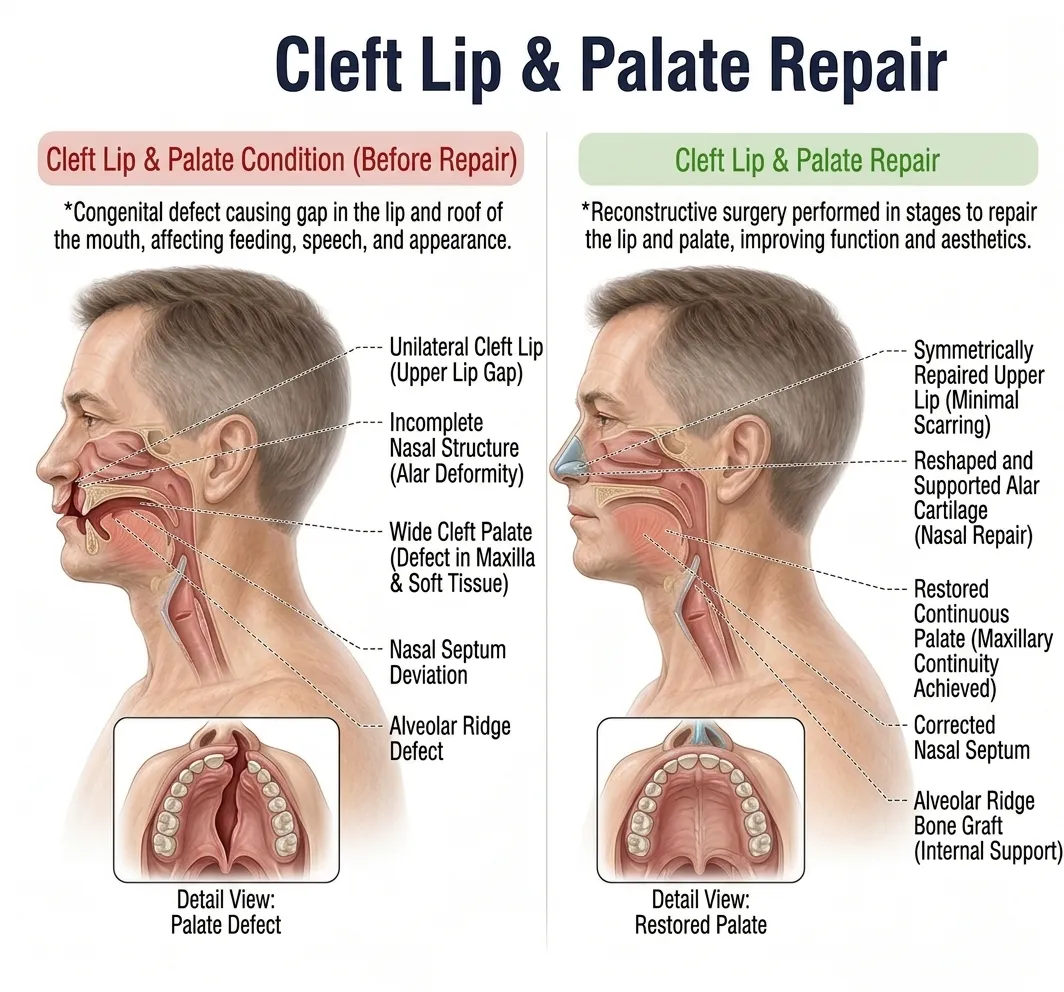
Cleft lip and cleft palate are common congenital facial differences occurring when embryonic facial structures do not fuse completely. Reconstructive plastic surgery re-aligns orbicularis oris muscle fibers, restores the oral vault, closes the palatal floor, and aligns nasal cartilages.
Who Needs Cleft Surgery?
Infants born with unilateral or bilateral cleft lip and/or cleft palate.
Key clinical indicators include:
- Visible separation of the upper lip extending toward the nose.
- Opening in the roof of the mouth (hard or soft palate).
- Difficulty feeding, nasal regurgitation of milk, or poor weight gain.
- Hypernasal speech articulation and frequent middle ear infections (otitis media).
Surgical Staging & Timeline
- Rule of 10s for Cleft Lip Repair: Surgery around 3-6 months of age (At least 10 weeks old, 10 lbs weight, 10 g/dL hemoglobin).
- Cleft Palate Repair (Palatoplasty): Performed at 9-18 months before major speech development begins.
- Alveolar Bone Grafting: Performed at 8-11 years to support permanent canine tooth eruption.
- Secondary Rhinoplasty / Orthognathic Surgery: Adolescence (15-18 years) for final cosmetic and jaw alignment.
Benefits of Cleft Repair
- Normalization of infant feeding and weight gain.
- Prevention of severe hypernasal speech impediments.
- Restoration of facial symmetry and lip muscle function.
- Reduction in chronic middle ear fluid buildup and hearing loss risk.
What to Expect Before Surgery?
- Pediatric & Anesthesia Clearance: Airway and cardiac evaluation to ensure safe general anesthesia.
- Feeding Management: Specialized Haberman feeders or squeeze bottles to maintain pre-op nutrition.
- Pre-Surgical Nasoalveolar Molding (NAM): Orthodontic appliance used in infants to narrow cleft gaps prior to surgery.
Complete Procedure
- General anesthesia with specialized endotracheal tube placement.
- Incisions made along natural lip landmarks (Millard rotation-advancement or Fisher technique).
- Dissection and realigning of split orbicularis oris lip muscle fibers into a continuous ring.
- Reconstructing palatal mucosal layers and soft palate levator muscles (for palate repair).
- Meticulous skin closure with fine sutures and protective Logan bow or steri-strips.
Primary Lip Repair vs Palate Repair
| Feature | Cleft Lip Repair | Cleft Palate Repair |
|---|---|---|
| Target Age | 3 - 6 months | 9 - 18 months |
| Primary Goal | Lip muscle continuity & nasal symmetry | Speech development & oral-nasal separation |
| Feeding Impact | Improves latching | Eliminates milk regurgitation through nose |
| Hospital Stay | 1 - 2 days | 2 - 4 days |
Success Rate and Safety
With multidisciplinary care (pediatric plastic surgeon, orthodontist, speech therapist), long-term functional and aesthetic success rates are excellent.
Cost Estimate
| Procedure Phase | Estimated Cost (INR) |
|---|---|
| Unilateral Cleft Lip Repair | ₹50,000 - ₹1,20,000 |
| Cleft Palate Repair (Palatoplasty) | ₹70,000 - ₹1,50,000 |
| Secondary Revision / Cleft Rhinoplasty | ₹60,000 - ₹1,40,000 |
Note: Many humanitarian organizations and specialized hospitals provide subsidized or free care programs for pediatric cleft surgery.
Recovery Guide & Post-Operative Care
Recovery Timeline
- Days 1-3: Liquid diet via syringe or cup; soft elbow arm immobilizers placed to prevent infant from touching mouth.
- Week 1-2: Lip sutures removed or dissolve; transition to pureed diet for palate repair.
- Month 1: Resumption of normal bottle/cup feeding; scar massaging initiated.
- Long-term: Regular follow-ups for speech therapy and orthodontic monitoring.
Post-Op Precautions & Care
- Arm Restraints: Use gentle elbow splints for 10-14 days so the child cannot insert fingers into the surgical site.
- Feeding Technique: Avoid pacifiers, straws, or hard utensils that could disrupt palatal incision lines.
- Incision Hygiene: Clean lip suture line gently with saline swabs after feedings.
Frequently Asked Questions
At what age should cleft lip surgery be performed?⌄
Cleft lip repair is typically performed between 3 and 6 months of age, following the 'Rule of 10s' (10 weeks old, 10 lbs weight, 10 g/dL hemoglobin).
Will my child be able to speak normally after cleft palate repair?⌄
When palatoplasty is performed before 18 months of age alongside speech therapy evaluation, most children develop clear, normal speech.
Are multiple surgeries required as the child grows?⌄
Comprehensive cleft care may involve staged procedures: lip repair (infancy), palate repair (1 year), alveolar bone graft (8-11 years), and optional cleft rhinoplasty (late teens).
How is feeding managed immediately after palate surgery?⌄
Infants are fed using a syringe, spoon, or specialized soft cup for 1-2 weeks. Hard nipples, straws, and pacifiers are restricted during initial healing.
Will there be visible scarring on the lip?⌄
Incision lines are placed along natural lip contours (Philtrum lines). Scars fade significantly with proper scar management and time.