






What is Colorectal Cancer Surgery?
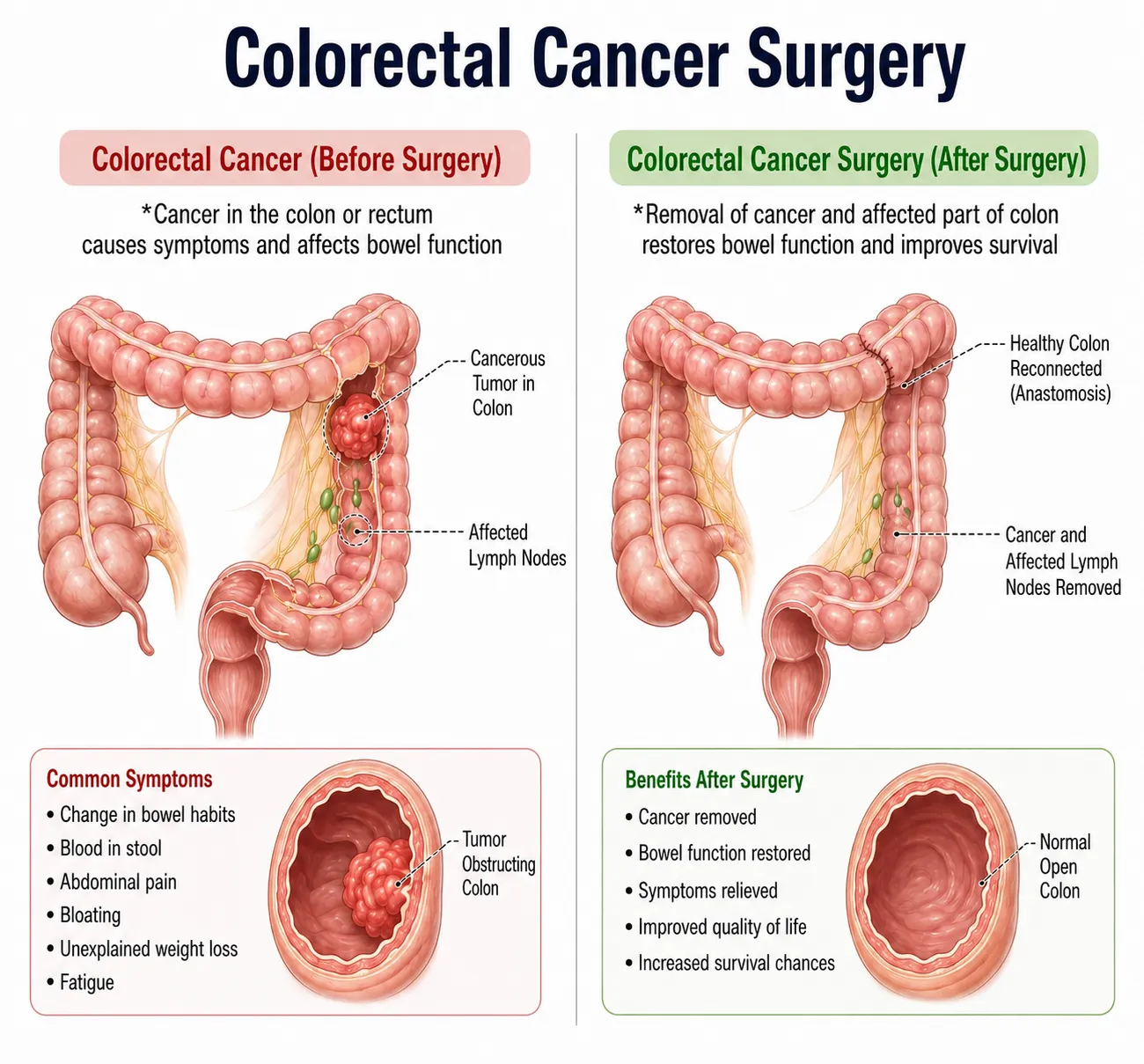
Colorectal Cancer Surgery involves the surgical removal of a segment of the large intestine (colon) or rectum affected by cancer, along with its associated blood supply and regional mesenteric lymph nodes (colectomy or total mesorectal excision). Continuity of the bowel is typically re-established by joining healthy ends together (anastomosis). Laparoscopic and robotic-assisted techniques are widely utilized to shorten recovery times.
Who Needs Colorectal Cancer Surgery?
Surgery is indicated for most localized malignant adenocarcinomas of the colon or rectum (Stages I–III) and selected Stage IV cases with resectable metastases.
Key clinical indicators include:
- Colonoscopy-confirmed adenocarcinoma of the cecum, colon, or rectum.
- Large polyps containing invasive cancer unusable for endoscopic mucosal resection.
- Bowel obstruction, bleeding, or perforation caused by a colorectal mass.
- Familial adenomatous polyposis (FAP) or Lynch syndrome requiring prophylactic colectomy.
Types of Colorectal Cancer Surgery
- Right / Left Hemicolectomy: Resection of the right or left portion of the colon and reconnection of healthy ends.
- Sigmoid Colectomy: Removal of the sigmoid colon for tumors located in the distal colon.
- Low Anterior Resection (LAR): Removal of upper/middle rectal tumors with sphincter preservation.
- Abdominoperineal Resection (APR): Complete removal of the anus, rectum, and sigmoid colon for low rectal tumors, creating a permanent colostomy.
- Total Mesorectal Excision (TME): Precise anatomical dissection of the rectal envelope to minimize local recurrence.
Benefits of Colorectal Cancer Surgery
- Complete surgical removal of primary malignant bowel tumors.
- Preserves natural bowel continence in the majority of colon and mid/upper rectal cancers.
- Systemic lymph node clearance guides accurate TNM staging.
- Minimal invasive approaches allow rapid return of bowel motility (peristalsis).
What to Expect Before Surgery?
- Mechanical Bowel Preparation: Clear liquid diet and oral laxative solutions prior to surgery to cleanse the bowel.
- Stoma Marking: Consultation with a wound ostomy nurse to mark a suitable skin site if a temporary or permanent stoma is possible.
- Enhanced Recovery After Surgery (ERAS) Protocol: Pre-operative carbohydrate loading and avoidance of prolonged fasting.
- Antibiotic Prophylaxis: Oral and intravenous antibiotics to reduce surgical site infection risks.
Complete Procedure
- Administration of general anesthesia.
- Laparoscopic keyhole access or midline abdominal incision.
- Mobilization of the diseased bowel segment and high ligation of supplying vascular trunks.
- Resection of the tumor-bearing bowel with mesenteric lymph node dissection.
- Rejoining healthy bowel ends (stapled or hand-sewn anastomosis) or creation of a stoma (ileostomy/colostomy).
- Intraoperative leak test of the anastomosis.
- Closure of abdominal incisions and dressing application.
What to Expect During Surgery?
Surgery typically lasts between 2.5 and 5 hours depending on tumor site, surgical approach (laparoscopic, robotic, open), and whether stoma creation is required.
Laparoscopic / Robotic vs Open Surgery
| Feature | Open Colectomy | Laparoscopic / Robotic |
|---|---|---|
| Incision | Large vertical abdominal scar. | 3 - 5 small keyhole incisions (0.5 - 1.5 cm). |
| Bowel Function Return | 4 - 6 Days (higher ileus rate). | 1 - 3 Days. |
| Hospital Stay | 6 - 10 Days. | 3 - 5 Days. |
| Post-Op Pain | Moderate to High. | Low to Moderate. |
Success Rate and Safety
Five-year survival rates for Stage I colon cancer exceed 90%, and Stage II ranges from 70% to 80%. TME surgery has dramatically decreased local recurrence rates in rectal cancer to under 5-10%.
Colorectal Cancer Surgery Cost Estimate
| Procedure Type | Open Surgery (INR) | Laparoscopic / Robotic (INR) |
|---|---|---|
| Segmental Colectomy | ₹2,00,000 - ₹3,80,000 | ₹3,00,000 - ₹5,50,000 |
| Low Anterior Resection (LAR) | ₹2,80,000 - ₹4,50,000 | ₹4,00,000 - ₹7,00,000 |
| Abdominoperineal Resection (APR) | ₹3,20,000 - ₹5,00,000 | ₹4,50,000 - ₹7,50,000+ |
Disclaimer: Final cost varies based on stapler reloader usage, stoma supplies, and ward stay.
Recovery Guide & Post-Operative Care
Recovery Timeline
- Day 0-1: ERAS early mobilization; sipping clear fluids as bowel sounds return.
- Day 2-3: Transition to soft low-residue diet as gas/stool passes; stoma care training if applicable.
- Day 4-6: Discharge home once tolerating solid food and bowel function is regular.
- Week 3-6: Gradual return to light daily tasks; pathology review for adjuvant chemotherapy decisions.
Post-Op Precautions & Care
- Dietary Progression: Eat small, frequent low-fiber meals initially to avoid bowel overdistension.
- Stoma Management: If fitted with a stoma, inspect stoma color (should be pink/red) and ensure proper pouch seal.
- Wound Care: Monitor incisions for signs of infection or unusual swelling; avoid heavy lifting (>5 kg) for 6 weeks.
Frequently Asked Questions
Will I always need a permanent colostomy bag after colorectal surgery?⌄
No. Most colon cancer surgeries and upper/mid-rectal cancer surgeries allow immediate reconnection of the bowel without a permanent bag. Permanent stomas are mainly needed for low rectal cancers close to the anal sphincter.
What is a temporary diverting stoma?⌄
A temporary ileostomy or colostomy diverts stool away from a newly created rectal anastomosis to allow it to heal safely. It is typically closed in a minor second surgery 8 to 12 weeks later.
How soon after surgery will my bowel function return?⌄
With minimally invasive laparoscopic or robotic techniques and ERAS protocols, bowel motility (passing gas or stool) usually returns within 1 to 3 days.
What diet should I follow after colon surgery?⌄
Start with a soft, low-residue diet that is easy to digest. Slowly reintroduce fiber-rich foods over several weeks as advised by your surgical team.
Is laparoscopic colectomy as thorough for cancer removal as open surgery?⌄
Yes. Clinical trials confirm that laparoscopic and robotic colectomy achieve identical oncologic clearance and lymph node yields as open surgery, with faster recovery.