









What is Gynaecological Cancer Surgery?
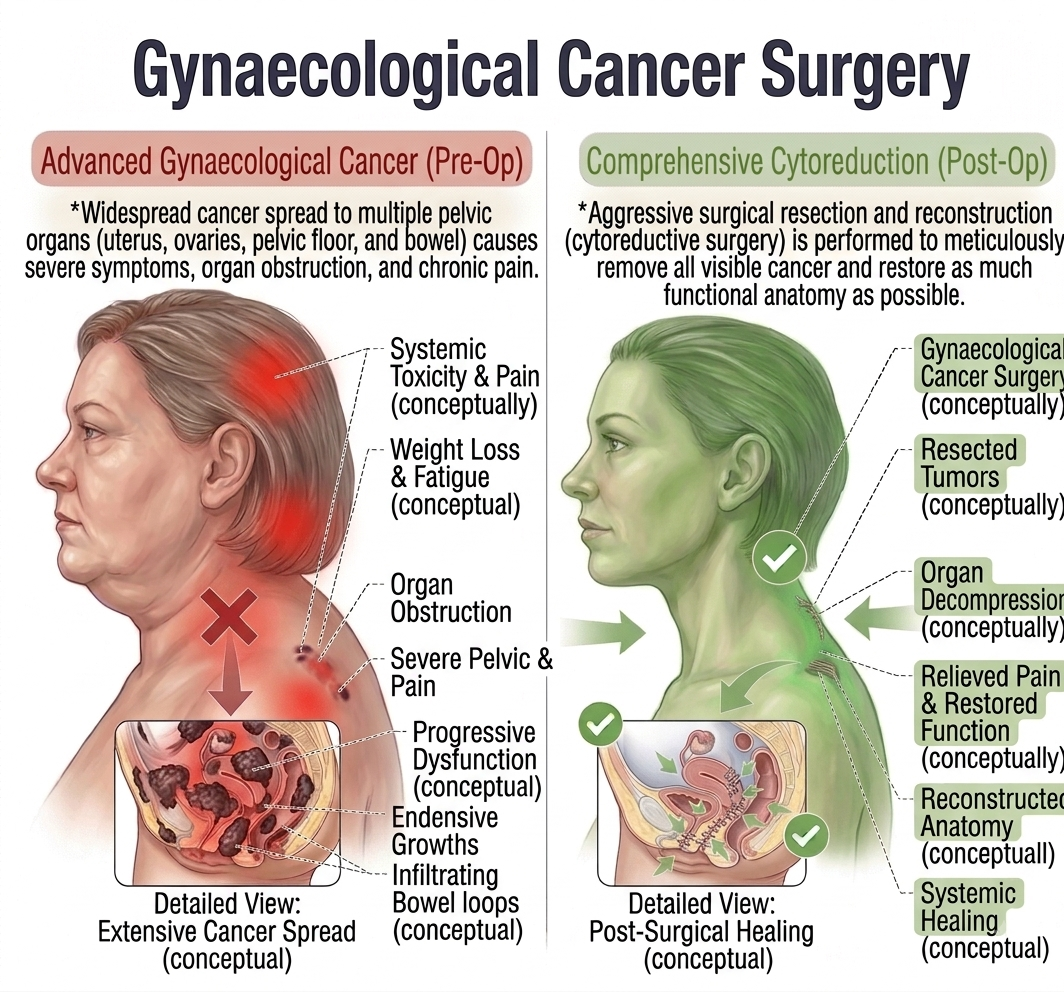
Gynaecological Cancer Surgery includes specialized surgical operations performed by trained gynaecologic oncologists to treat cancers of the female reproductive system (cervical, endometrial/uterine, ovarian, vaginal, and vulvar cancers). Surgical intervention aims to achieve complete tumor resection (R0 resection), accurate cancer staging, and debulking to maximize survival outcomes.
Who Needs Gynaecological Cancer Surgery?
Surgery is a primary treatment modality for early and locally advanced gynaecological malignancies, or as part of multimodality care alongside chemotherapy and radiation.
Key clinical indicators include:
- Biopsy-confirmed endometrial, cervical, or ovarian carcinoma.
- Complex pelvic masses with elevated tumor markers (CA-125, HE4, CEA) suspicious for malignancy.
- Pre-cancerous lesions (severe cervical dysplasia / CIN 3, atypical endometrial hyperplasia).
- Cytoreductive debulking for advanced stage ovarian cancer.
Types of Gynaecological Cancer Surgery
- Radical Hysterectomy: Extensive removal of uterus, cervix, parametrii (tissue next to cervix), and upper vaginal cuff (for Cervical / Uterine Cancer).
- Staging & Cytoreductive Debulking: Surgical removal of all visible tumor masses, omentum (omentechomy), pelvic lymph nodes, and peritoneal implants (for Ovarian Cancer).
- Pelvic & Para-Aortic Lymphadenectomy: Dissection of regional lymph nodes to check for microscopic cancer spread.
- Sentinel Lymph Node (SLN) Biopsy: High-precision dye mapping (ICG fluorescent imaging) to remove only key sentinel nodes, reducing lymphedema risks.
- Fertility-Sparing Surgery: Radical trachelectomy or unilateral oophorectomy in young patients with early-stage disease desiring pregnancy.
Benefits of Gynaecological Cancer Surgery
- Complete removal of primary tumor mass and localized cancer spread.
- Precise pathological staging to guide decisions regarding adjuvant chemotherapy/radiation.
- Significant prolonging of overall survival and disease-free progression.
- Symptom control (relief from tumor pressure, bleeding, and ascites).
What to Expect Before Surgery?
Comprehensive staging and medical optimization prior to surgery:
- PET-CT / MRI Staging: Whole-body imaging to evaluate primary tumor extent and rule out distant metastases.
- Tumor Markers & Biopsies: Baseline marker levels (CA-125, HE4, CEA, CEA-19.9).
- Cardiopulmonary & Anesthesia Clearance: Full evaluation of heart and lung health for major surgery.
- Nutritional & Bowel Prep: High-protein pre-hab diet and bowel clearing protocol prior to extensive abdominal surgery.
Complete Procedure
For a comprehensive staging / radical oncological resection:
- Administration of general anesthesia with epidural pain catheter management.
- Surgical access via open vertical midline laparotomy or advanced robotic keyholes.
- Systematic exploration and washings collected for cytological fluid testing.
- Radical excision of the primary organ/tumor with clear tissue margins.
- Bilateral pelvic and para-aortic lymph node dissection or sentinel node mapping.
- In ovarian cancer: Omentectomy, peritoneal biopsies, and debulking of tumor deposits.
- Meticulous reconstruction, placement of abdominal surgical drains, and layer-by-layer incision closure.
What to Expect During Surgery?
Surgical duration varies from 3 to 6 hours depending on cancer complexity and debulking needs. Patients are closely monitored in an Intensive Care Unit (ICU) or High Dependency Unit (HDU) immediately post-surgery.
Open vs Robotic Cancer Surgery
| Feature | Open Midline Laparotomy | Robotic-Assisted Surgery |
|---|---|---|
| Indication | Large ovarian masses, extensive debulking, advanced stage. | Early-stage endometrial & cervical cancers, sentinel node mapping. |
| Precision | Direct tactile manipulation. | 3D HD 10x magnified vision, dexterity. |
| Hospital Stay | 5 to 7 Days. | 2 to 3 Days. |
| Recovery | 6 to 8 Weeks. | 2 to 3 Weeks. |
Success Rate and Safety
When performed by sub-specialized Gynaecologic Oncologists, 5-year survival rates for early-stage endometrial and cervical cancers exceed 85–90%. Surgical debulking significantly enhances long-term response to chemotherapy.
Gynaecological Cancer Surgery Cost Estimate
| Procedure Scope | Estimated Cost Range (INR) |
|---|---|
| Laparoscopic / Robotic Staging (Endometrial / Cervical) | ₹2,50,000 - ₹4,50,000 |
| Open Radical Hysterectomy + Lymphadenectomy | ₹2,20,000 - ₹4,00,000 |
| Complex Ovarian Cancer Cytoreductive Debulking | ₹4,00,000 - ₹8,00,000+ |
Disclaimer: Costs depend on ICU stay, drain management, intraoperative frozen section pathology, and requirement for robotic tech.
Recovery Guide & Post-Operative Care
Recovery Timeline
- Day 1-2: ICU/HDU monitoring; pain control via epidural; gentle bedside sitting.
- Day 3-5: Removal of surgical drains and urinary catheter; transition to oral diet; walking down hallways.
- Week 2-3: Recovery at home; wound care; review of final histopathology staging report.
- Week 4-6: Tumor board evaluation for adjuvant therapy (Chemotherapy or Radiation) if indicated; gradual return to daily routine.
Post-Op Precautions & Care
- Lymphedema Prevention: Perform recommended leg exercises to prevent lymphatic swelling.
- DVT Prevention: Wear compression stockings and take prescribed blood-thinning injections.
- Regular Surveillance: Adhere strictly to follow-up pelvic exams and tumor marker checks every 3 months for the first 2 years.
Frequently Asked Questions
Will I need chemotherapy or radiation after cancer surgery?⌄
This depends entirely on the final histopathology staging report. Early-stage cancers may only require surgery, whereas higher-stage or high-grade tumors may need adjuvant chemotherapy or radiation.
Is it possible to preserve fertility if I have gynaecological cancer?⌄
In very early-stage cancers (e.g., early cervical or early ovarian cancer in young patients), fertility-sparing operations like radical trachelectomy or single ovary preservation can be considered.
What is the role of robotic surgery in cancer treatment?⌄
Robotic surgery provides magnified 3D visualization and precise instrument control, making it ideal for delicate lymph node dissections and radical hysterectomies with smaller incisions and faster recovery.
How long is the hospital stay after cancer surgery?⌄
Hospital stay ranges from 2 to 3 days for robotic early-stage procedures, up to 5 to 7 days for open radical debulking operations.