








What is Head & Neck Cancer Surgery?
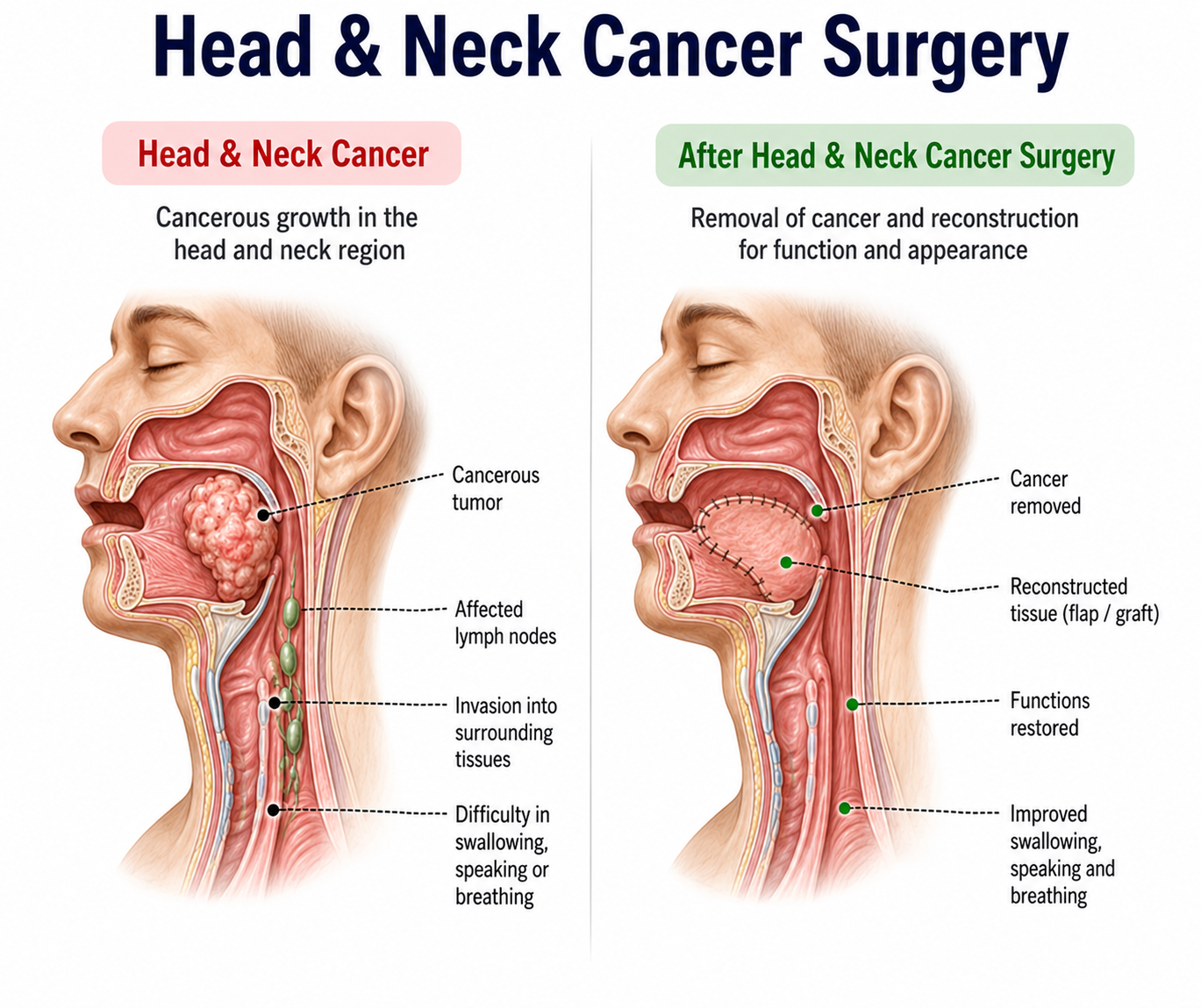
Head and neck cancer surgery encompasses surgical resections performed to excise malignant tumors arising in the oral cavity (tongue, cheek, jawbone), larynx (voice box), pharynx (throat), thyroid, or salivary glands. Because these anatomical regions govern vital functions—including speech, swallowing, breathing, and facial appearance—oncological surgery emphasizes achieving clear, negative tumor margins while simultaneously performing neck lymph node dissections and microvascular tissue flap reconstructions to restore function and form.
Who Needs Head & Neck Cancer Surgery?
Surgery is a primary curative treatment modality for resectable head and neck squamous cell carcinomas (HNSCC) and glandular malignancies.
Key clinical indicators include:
- Biopsy-confirmed oral cavity carcinoma (non-healing tongue ulcers, buccal mucosa growth).
- Laryngeal or hypopharyngeal cancer threatening airway or speech.
- Malignant tumors of the parotid or submandibular salivary glands.
- Metastatic cervical lymphadenopathy requiring neck dissection.
- Recurrent cancer following definitive radiation or chemoradiotherapy.
Types & Surgical Spectrum
- Wide Local Excision: Removal of the primary tumor with a 1 to 1.5 cm clear surgical margin.
- Neck Dissection (Selective / Modified Radical / Radical): Removal of cervical lymph nodes to eliminate or prevent regional cancer spread.
- Composite Resection (Commando Surgery): Resection of oral tumor along with jawbone (mandibula) segment and neck nodes.
- Laryngectomy (Partial / Total): Partial or complete removal of the voice box for advanced laryngeal cancer.
- Microvascular Free Flap Reconstruction: Transfer of autologous tissue (radial forearm, fibula, or ALT flap) with blood vessel re-anastomosis under a microscope.
Benefits of Head & Neck Cancer Surgery
- Complete removal of primary malignant disease with clear histopathological margins.
- Removal of regional lymph node metastases to prevent systemic disease spread.
- Functional reconstruction of jaw, tongue, or throat defects using advanced free tissue transfer.
- Definitive staging of cancer to guide adjuvant radiation or chemotherapy decisions.
What to Expect Before Surgery?
Extensive pre-operative staging and multi-disciplinary tumor board evaluation are mandatory:
- Staging Investigations: Contrast-enhanced CT scan, MRI, or PET-CT scan to determine exact tumor dimensions and distance spread.
- Endoscopic Evaluation: Panendoscopy (laryngoscopy, esophagoscopy, bronchoscopy) under anesthesia to rule out second primary tumors.
- Cardiopulmonary Clearance: Comprehensive medical fitness evaluation for extended anesthesia duration (6 to 12 hours).
- Nutritional & Speech Consultation: Placement of Ryle's tube or PEG tube prep and pre-operative speech assessment.
Complete Procedure
Surgery is performed under general anesthesia by a specialized surgical oncology team, taking 4 to 10 hours depending on reconstruction:
- Administration of general anesthesia (often via tracheostomy or nasal intubation).
- Radical excision of the primary tumor with intraoperative frozen section margin confirmation.
- Cervical neck dissection to systematically harvest regional lymph node levels.
- Harvesting of a microvascular free flap (e.g., fibula bone flap for jaw reconstruction or thigh skin flap for tongue).
- Microvascular anastomosis joining flap arteries and veins to neck vessels under an operating microscope.
- Layered defect closure, placement of closed suction drains, and tracheostomy securement.
What to Expect During Surgery?
The surgical execution is lengthy and meticulous. Patient vital parameters, urine output, and body temperature are closely monitored. ICU bed reservation is standard for post-operative monitoring.
Open Resection vs Transoral Robotic Surgery (TORS)
| Feature | Open Surgical Resection | Transoral Robotic Surgery (TORS) |
|---|---|---|
| Access | Requires external jaw-splitting or neck incisions. | Access through the open mouth using robotic arms. |
| Indication | Large tumors, bone involvement, free flap needs. | Early-stage tonsil, base of tongue, or laryngeal cancers. |
| Tissue Trauma | Significant tissue disruption and reconstruction. | Minimal tissue disruption; no external facial scar. |
| Tracheostomy Need | Frequently required temporarily. | Rarely required. |
Success Rate and Safety
Five-year overall survival rates for early-stage head and neck cancers (Stage I & II) treated surgically range from 70% to 90%. Advanced cases (Stage III & IV) achieve cure rates of 40% to 65% when combined with multimodality adjuvant therapy.
Head & Neck Cancer Surgery Cost Estimate
| Case Complexity | Standard Surgical Resection (INR) | Resection + Microvascular Free Flap (INR) |
|---|---|---|
| Early Oral / Laryngeal Resection | ₹2,50,000 - ₹4,00,000 | ₹4,00,000 - ₹6,00,000 |
| Advanced Resection + Neck Dissection | ₹3,50,000 - ₹5,50,000 | ₹5,50,000 - ₹8,50,000 |
| Complex Commando + Free Flap Reconstruction | ₹5,00,000 - ₹7,50,000 | ₹7,00,000 - ₹11,00,000+ |
Disclaimer: Final cost depends on ICU stay length, pathology frozen sections, microvascular surgical team fees, and post-op rehabilitation.
Recovery Guide & Post-Operative Care
Recovery Timeline
- Day 1-3: ICU monitoring; tracheostomy air care; enteral feeding via nasogastric tube; flap doppler monitoring.
- Day 4-7: Step-down to room ward; drain removal as output decreases; initiation of mobilization.
- Week 2-3: Suture/staple removal; tracheostomy decannulation if airway is clear; speech and swallowing therapy.
- Month 1-2: Histopathology review and initiation of adjuvant radiotherapy or chemoradiotherapy if indicated.
Post-Op Precautions & Care
- Flap Care: Protect reconstructed free flap from external compression, tight ties, or extreme temperatures.
- Tracheostomy Care: Maintain humidification, suctioning, and stoma hygiene until decannulation.
- Swallowing Rehabilitation: Work closely with speech-language pathologists on chin-tuck maneuvers and gradual oral food reintroduction.
- Oral Hygiene: Perform frequent gentle oral cavity rinses with prescribed antiseptic solutions.
Frequently Asked Questions
Will I lose my voice after head and neck cancer surgery?⌄
Voice preservation depends on the tumor location. For tongue or mouth cancers, voice is preserved. In total laryngectomy, voice box is removed, but voice restoration is achieved via a tracheoesophageal prosthesis (TEP).
What is a microvascular free flap reconstruction?⌄
It is a procedure where living skin, muscle, or bone from another body part (e.g., forearm, leg) is transplanted to rebuild the mouth or jaw, rejoining blood vessels under a microscope.
Will I need a temporary tracheostomy (breathing tube)?⌄
Temporary tracheostomy is frequently performed during major oral or jaw surgeries to ensure a secure, safe airway while post-operative facial swelling subsides.
How long will I need a feeding tube?⌄
A nasogastric tube is kept for 7 to 14 days until swallowing safety is re-established. Swallowing therapy helps transition patients back to oral soft foods.
Will I need radiation therapy after surgery?⌄
Adjuvant radiation or chemoradiotherapy is recommended if histopathology reveals close/positive margins, multiple lymph node metastases, or perineural invasion.