






What is Heart Transplant Surgery?
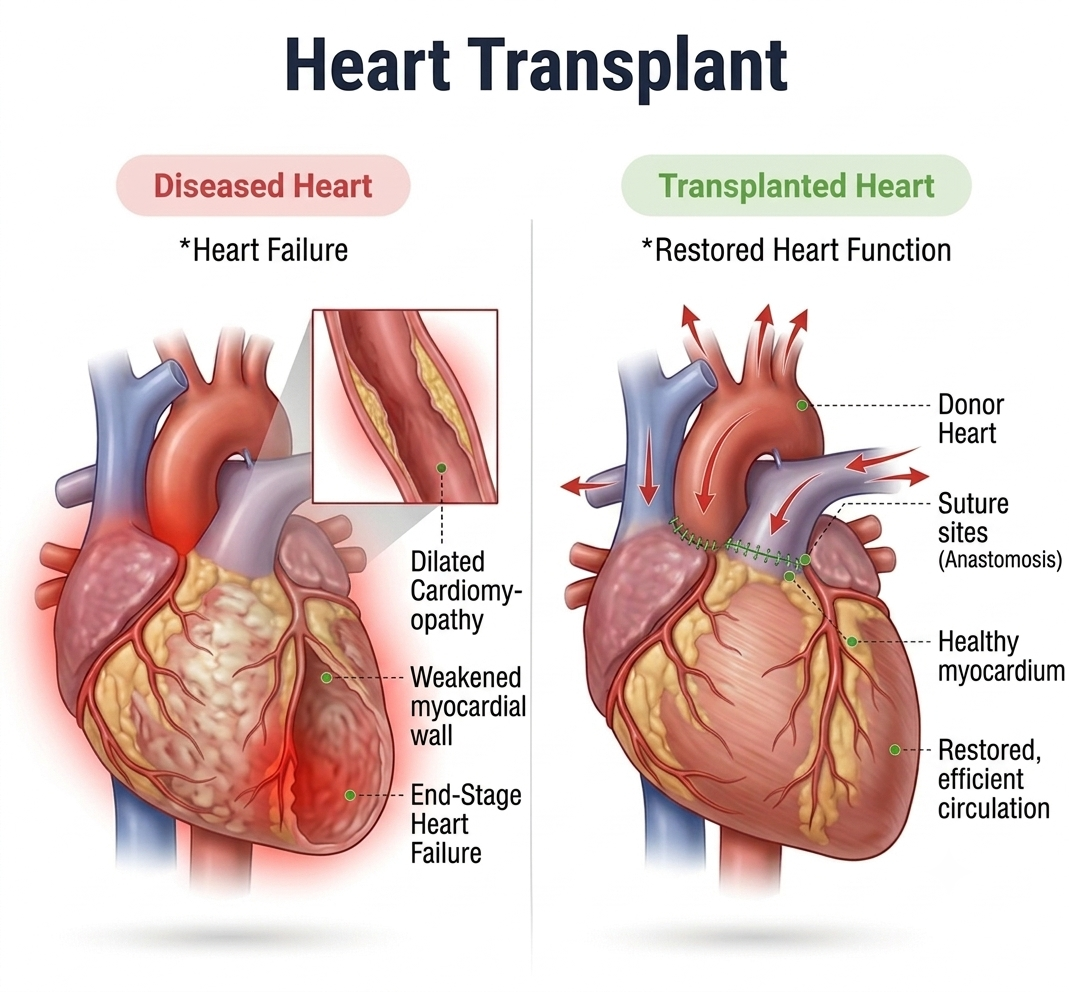
Heart Transplantation is the definitive gold-standard treatment for end-stage heart failure when medical therapy, surgical interventions, and device therapies are no longer effective. The patient's diseased heart is excised and replaced with a functionally compatible donor heart obtained from a brain-dead donor. The procedure restores normal hemodynamic circulation, enabling patients with terminal heart failure to regain mobility and quality of life.
Who Needs a Heart Transplant?
Transplantation is reserved for individuals with end-stage heart disease facing severe mortality risk despite optimal medical therapy.
Key clinical indicators include:
- End-Stage Heart Failure (NYHA Class IV) with Left Ventricular Ejection Fraction (LVEF < 20%).
- Dependence on continuous intravenous inotropic medication or mechanical circulatory support (Impella / IABP / ECMO).
- Severe, non-revascularizable Coronary Artery Disease with refractory ischemic heart failure.
- Advanced Dilated Cardiomyopathy, Hypertrophic Cardiomyopathy, or intractable congenital heart defects.
- Severe intractable cardiac arrhythmias unresponsive to ablation, surgery, or device therapy.
Types of Transplant & Mechanical Bridge Options
- Orthotopic Heart Transplantation: The standard technique where the patient's diseased heart is completely removed, and the donor heart is sewn into the anatomical thoracic cavity.
- LVAD (Left Ventricular Assist Device) Bridge-to-Transplant: Implanting a mechanical blood pump (e.g., HeartMate 3) to keep the patient alive and stable while waiting for a matching donor heart.
- LVAD Destination Therapy: Permanent mechanical pump implantation for patients who are ineligible for organ transplantation due to age or co-morbidities.
Benefits of Heart Transplant Surgery
- Complete cure for end-stage terminal heart failure.
- Dramatic improvement in functional survival, independence, and stamina.
- Ability to return to everyday physical activities, work, and social life.
- Long-term median survival exceeding 10 to 12 years with modern immunosuppressive medications.
What to Expect Before Surgery?
The pre-transplant journey involves waiting-list registration and rapid donor matching:
- Comprehensive Evaluation: Panel Reactive Antibody (PRA) testing, HLA tissue typing, pulmonary vascular resistance (PVR) checks, and psychological evaluation.
- National Organ Registry Listing: Placement on official national organ allocation registries (e.g., NOTTO in India).
- On-Call Readiness: Patients must be ready to reach the transplant center within 1 to 2 hours of a donor organ match call.
- Donor-Recipient Matching: Matching blood group, body size/weight, geographic transport timing, and viral screening.
Complete Procedure
The complex donor procurement and surgical replacement steps include:
- Rapid harvesting of the donor heart, preservation in cold cardioplegic solution, and transport in under 4 hours.
- Patient preparation under general anesthesia with full invasive hemodynamic monitoring lines.
- Median sternotomy, initiation of cardiopulmonary bypass, and cross-clamping the native aorta.
- Explanting the native failing heart while preserving posterior atrial walls and great vessel stumps.
- Surgical anastomoses: Precision suturing of donor left atrium, right atrium, pulmonary artery, and aorta.
- Re-warming blood, de-airing heart chambers, removing cross-clamps, and initiating donor heart beating (often with temporary pacing).
- Placing chest drains, closing sternal wires, and transferring the patient to a specialized isolation ICU.
What to Expect During Surgery?
The recipient operation takes approximately 4 to 8 hours, running concurrently with the donor harvest and transport logistics. Because cold ischemia time must be kept strictly under 4 hours, team coordination is critical.
Heart Transplant vs LVAD Therapy
| Feature | Heart Transplant | Left Ventricular Assist Device (LVAD) |
|---|---|---|
| Source | Human donor organ (requires waiting list). | Man-made mechanical electric pump. |
| Immune Suppression | Lifelong immunosuppressive drugs required to prevent rejection. | No immunosuppression needed (requires antiplatelets/anticoagulation). |
| Driveline/Equipment | Completely internal; no external cables. | Requires external cable (driveline) connected to battery pack. |
| Availability | Restricted by scarcity of donor organs. | Off-the-shelf availability without waiting for a donor. |
Success Rate and Safety
Heart transplantation carries a 1-year survival rate of approximately 85-90%, and a 5-year survival rate exceeding 70-75%. With disciplined immunosuppressive care, many recipients live 20 to 30+ vibrant years.
Heart Transplant Cost Estimate
| Component / Phase | Estimated Cost Range (INR) |
|---|---|
| Pre-Transplant Workup & Registry Evaluation | ₹1,50,000 - ₹3,00,000 |
| Transplant Surgery & ICU Isolation Stay (14-21 Days) | ₹15,00,000 - ₹25,00,000 |
| Donor Harvesting, Organ Retrieval & Green Corridor Air Logistics | ₹3,00,000 - ₹6,00,000 |
| Annual Post-Transplant Medications & Endomyocardial Biopsies | ₹2,50,000 - ₹4,00,000 / year |
Disclaimer: Total financial requirements depend on organ air-transport distance, ICU duration, treating acute rejection episodes, and long-term immunosuppression.
Recovery Guide & Post-Operative Care
Recovery Timeline
- Day 0-5: Positive-pressure isolation ICU care; extubation; careful titration of immunosuppressive drugs.
- Day 6-14: Step-down isolation room; regular endomyocardial biopsies to monitor for early organ rejection.
- Month 1-3: Frequent outpatient clinic visits, routine blood level checks for Tacrolimus/Cyclosporine.
- Month 6: Gradual return to community activities with protective face masking in crowds.
- Year 1 Onward: Annual comprehensive coronary angiogram and biopsy surveillance.
Post-Op Precautions & Care
- Strict Immunosuppressive Compliance: Never miss doses of antirejection medications (Tacrolimus, Mycophenolate, Steroids) to avoid organ rejection.
- Infection Protection: Strict hygiene, avoiding raw/unpasteurized foods, and wearing masks in public spaces due to suppressed immunity.
- Endomyocardial Biopsy Surveillance: Routine catheter biopsies performed via the neck vein to detect asymptomatic cellular rejection early.
- Denervated Heart Considerations: The transplanted heart lacks neural connections; heart rate increases gradually during exercise, making structured warm-ups essential.
Frequently Asked Questions
How long is the waiting list for a heart transplant?⌄
Waiting times vary from a few weeks to several months depending on your blood group, body size, urgent status, and donor availability through national registries.
What is organ rejection and how is it detected?⌄
Organ rejection happens when the immune system recognizes the donor heart as foreign tissue. It is detected early through routine microscopic tissue biopsies (endomyocardial biopsy) and treated with adjusted immunosuppressant medications.
How long can a person live with a transplanted heart?⌄
The average median survival is 10 to 12 years, but many recipients live healthy, active lives for 20 to 30+ years with proper medical compliance.
What lifestyle changes are mandatory after a heart transplant?⌄
Strict lifelong adherence to immunosuppressant drugs, meticulous food hygiene, hand washing, protection against infections, avoiding tobacco, and regular cardiovascular exercise.
What is a 'Green Corridor' for heart transport?⌄
A Green Corridor is a specialized traffic-cleared route organized by police and transport authorities to move a donor heart rapidly from the donor hospital to the recipient airport or hospital without traffic delays.