







What is Hypospadias Repair?
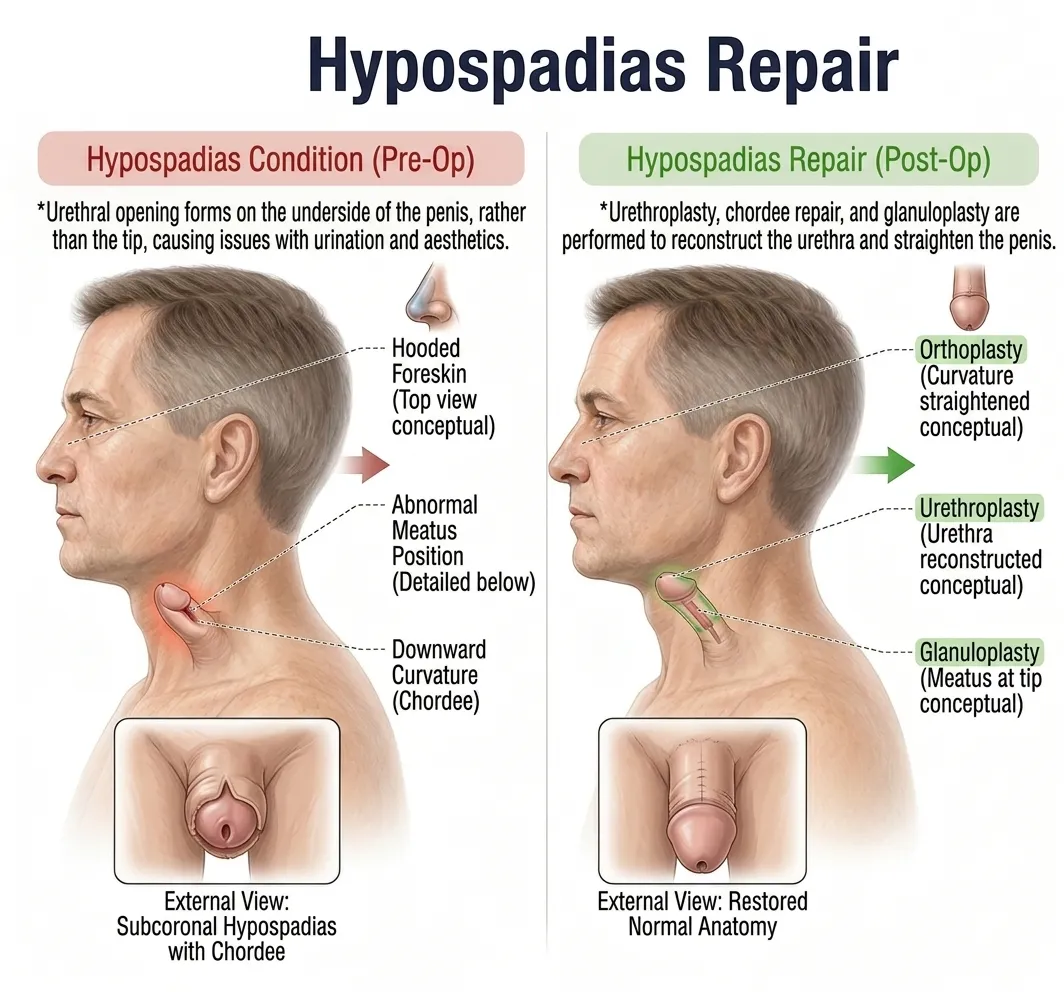
Hypospadias repair is a complex reconstructive procedure aimed at restoring normal urethral length, straightening penile curvature (chordee), and repositioning the urinary meatus to the tip of the glans penis. It is ideally performed in infancy (between 6 to 18 months) to support normal urinary control and psychological development.
Who Needs Hypospadias Repair?
Surgical correction is indicated for all male infants born with hypospadias to ensure proper standing urinary stream, cosmetic appearance, and future sexual function.
Key clinical indicators include:
- Urethral opening positioned on the underside of the glans, shaft, or near the scrotum.
- Downward curvature or bending of the penis during erection (chordee).
- Incomplete "hooded" appearance of the foreskin (dorsal hood).
- Abnormal urinary stream requiring sitting down to urinate in young boys.
Types of Hypospadias Repair
- Single-Stage Repair (e.g., TIP Procedure - Tubularized Incised Plate): Ideal for distal or mid-shaft hypospadias; completed in one operation.
- Two-Stage Reconstruction: Recommended for severe proximal hypospadias with severe chordee; involves straightening first, followed by urethral creation months later.
- Chordee Correction (Orthoplasty): Release of fibrous bands causing downward bend.
Benefits of Hypospadias Repair
- Restores ability to urinate standing up with a straight forward stream.
- Corrects downward penile curvature to allow normal growth and future erectile function.
- Achieves natural aesthetic appearance of the glans and foreskin/penile skin.
- Prevents long-term psychosexual complications.
What to Expect Before Surgery?
- Specialist Consultation: Detailed anatomical mapping by a paediatric urologist.
- Hormone Therapy (Optional): Short course of topical/injectable testosterone cream in select cases to increase tissue size prior to repair.
- General Health Clearance: Routine blood work and anaesthetic assessment.
Complete Procedure
The reconstruction encompasses several steps:
- Administration of general anaesthesia and caudal nerve block for long-lasting post-op pain management.
- Orthoplasty: Releasing tight tissue to completely straighten the penile shaft.
- Urethroplasty: Creating a new urinary channel (neourethra) using surrounding skin flaps.
- Glansplasty: Reforming the tip of the glans around the new urethral opening.
- Skin Closure: Reconstructing skin cover over the shaft.
- Catheter / Stent Placement: Inserting a soft urinary catheter to divert urine while the new urethra heals.
What to Expect During Surgery?
Surgery duration ranges from 1.5 to 3 hours depending on complexity. A urinary stent/catheter is retained post-operatively to protect the delicate reconstruction.
Distal vs Proximal Hypospadias
| Feature | Distal Hypospadias | Proximal Hypospadias |
|---|---|---|
| Defect Location | Near the tip / glans. | Near the base / scrotum. |
| Surgical Stages | Usually 1 Stage. | Often 1 or 2 Stages. |
| Catheter Duration | 5–7 days. | 7–14 days. |
| Complexity | Moderate. | High. |
Success Rate and Safety
Overall success rate for primary repairs exceeds 85–90%. Potential post-operative complications like urethrocutaneous fistula or stricture can be successfully corrected with secondary minor procedures.
Hypospadias Repair Cost Estimate
| Severity / Technique | Cost Range (INR) |
|---|---|
| Single-Stage Distal Repair | ₹60,000 - ₹1,30,000 |
| Complex / Proximal Repair (Per Stage) | ₹1,00,000 - ₹2,20,000 |
| Revision Hypospadias Surgery | ₹1,20,000 - ₹2,50,000 |
Disclaimer: Includes specialized urology care, urinary stent management, and inpatient monitoring.
Recovery Guide & Post-Operative Care
Recovery Timeline
- Days 1–3: Inpatient care; catheter care, pain management, and bed rest.
- Days 7–10: Outpatient clinic visit for urinary catheter or stent removal.
- Weeks 2–3: Soft tissue healing; regular voiding pattern established.
- Month 3–6: Final anatomical result and scar maturation evaluation.
Post-Op Precautions & Care
- Catheter Maintenance: Keep the urinary drainage bag or double-diaper setup clean and unkinked.
- Double Diapering Technique: Often used to keep the stent isolated from stool contamination.
- Activity Limit: Avoid straddle toys, tricycles, or rough physical activity for 4–6 weeks.
Frequently Asked Questions
At what age should hypospadias repair be performed?⌄
The ideal timing is between 6 and 18 months of age, before the child develops gender identity and toilet-training awareness.
Should my baby be circumcised before hypospadias repair?⌄
No! The foreskin tissue is often required by the surgeon to reconstruct the new urinary channel. Avoid routine circumcision.
How long does the catheter remain in place?⌄
The urinary catheter or stent stays in place for 5 to 10 days depending on whether it was a distal or proximal repair.
What is a fistula after hypospadias repair?⌄
A fistula is a tiny leak hole that can develop along the repair line. If it occurs, it can be easily repaired with a minor follow-up procedure.
Will my child have normal sexual function in the future?⌄
Yes, successful hypospadias repair provides normal erection, straight alignment, and unimpaired fertility/sexual function.