










What is Laparoscopic Hernia Repair?
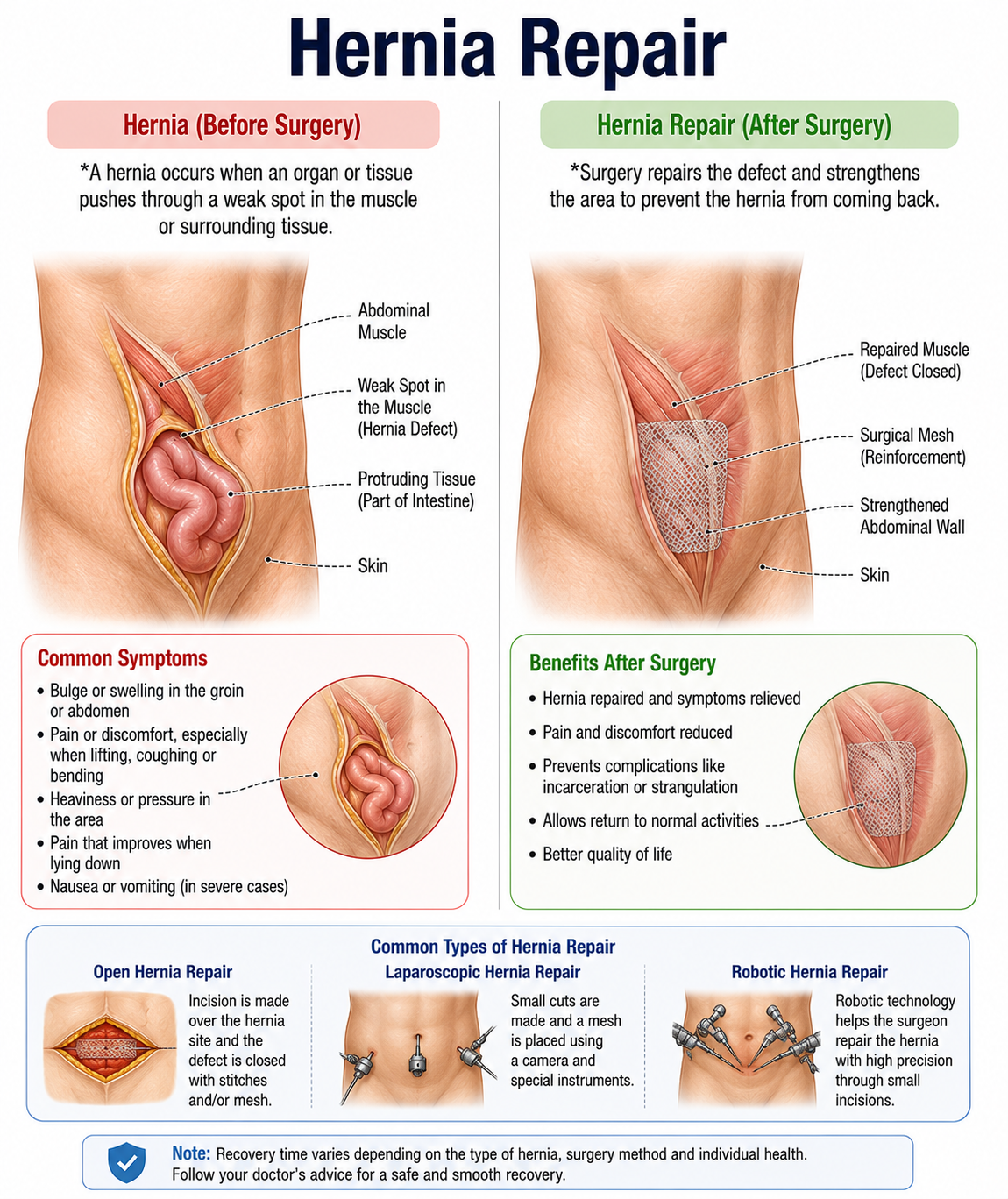
Laparoscopic Hernia Repair (Hernioplasty) is a keyhole surgical technique used to treat abdominal hernias (such as inguinal, umbilical, or incisional hernias). Through 3 tiny incisions, the herniated tissue or organ is pushed back into place, and a high-grade biocompatible mesh is anchored over the muscle defect to reinforce the weak area and prevent recurrence.
Who Needs Hernia Surgery?
Hernias do not heal on their own and tend to enlarge over time. Surgery is advised to relieve discomfort and avoid serious complications like obstruction or strangulation (loss of blood supply to the trapped tissue).
Key clinical indicators include:
- A visible or palpable bulge in the groin, belly button, or near a past surgical scar.
- Pain or dragging sensation aggravated by coughing, bending, or heavy lifting.
- Difficulty reducing (pushing back) the bulge manually.
- Severe, acute pain with redness or nausea (indicates possible strangulation requiring emergency care).
Types of Hernia Repair
- TAPP (Transabdominal Preperitoneal): The laparoscope enters the peritoneal cavity to access the preperitoneal space and place the mesh.
- TEP (Totally Extraperitoneal): The repair is performed entirely in the preperitoneal space without entering the main abdominal cavity.
- Open Hernia Repair: Traditional technique where an incision is made directly over the hernia site.
Benefits of Laparoscopic Hernia Repair
- Reduced post-operative pain and significantly lower mesh infection rates.
- Ability to repair bilateral (both sides) hernias through the same small incisions.
- Quicker return to work and routine physical activities.
- Minimal cosmetic scarring.
What to Expect Before Surgery?
- Clinical & Ultrasound Assessment: Confirming hernia size, type, and defect location.
- Anesthesia Clearance: Routine blood work, ECG, and chest X-ray for general anesthesia.
- Fasting Protocol: No food or drink for 8 hours prior to the procedure.
- Medication Adjustments: Temporarily stopping blood thinners under medical supervision.
Complete Procedure
- Administration of general anesthesia.
- Making 3 small incisions (5–10 mm) in the abdominal region.
- Inserting the laparoscopic camera and surgical instruments.
- Identifying the hernia sac and gently reducing the herniated contents back into the abdominal cavity.
- Positioning a synthetic mesh (e.g., polypropylene) across the muscular weakness.
- Securing the mesh with surgical tacks, sutures, or fibrin glue.
- Closing keyholes with sutures or surgical tape.
What to Expect During Surgery?
The surgery lasts between 45 and 90 minutes. You will be asleep under general anesthesia. Monitored continuously in the recovery unit, most patients can sit up and walk within a few hours post-surgery.
Laparoscopic vs Open Hernia Repair
| Feature | Laparoscopic Repair | Open Surgery |
|---|---|---|
| Incisional Pain | Low | Moderate to High |
| Bilateral Repair | Done via same keyholes | Requires 2 separate incisions |
| Return to Normal Activity | 7 - 10 Days | 3 - 4 Weeks |
| Recurrence Rate | Very Low (<2%) | Low (2-5%) |
Success Rate and Safety
Laparoscopic hernia repair is a highly successful intervention with a success rate exceeding 98%. Use of modern 3D meshes has reduced recurrence rates significantly.
Laparoscopic Hernia Surgery Cost Estimate
| Type of Hernia | Conventional Laparoscopic (INR) | Robotic / Premium Mesh (INR) |
|---|---|---|
| Unilateral Inguinal / Umbilical | ₹60,000 - ₹1,20,000 | ₹1,20,000 - ₹1,80,000 |
| Bilateral Inguinal Hernia | ₹90,000 - ₹1,60,000 | ₹1,60,000 - ₹2,20,000+ |
Disclaimer: Cost varies based on mesh type (standard, 3D, light-weight, absorbed) and hospital room selection.
Recovery Guide & Post-Operative Care
Recovery Timeline
- Day 1: Walking and light movement encouraged to prevent stiffness.
- Week 1: Pain subsides; resumption of light household work.
- Week 2: Normal office work and driving can be resumed.
- Month 1-2: Avoid heavy lifting (>10 kg) and intense strain to allow mesh integration.
Post-Op Precautions & Care
- Avoid Straining: Treat constipation early with fiber and stool softeners to prevent abdominal pressure.
- Support During Coughing: Press a pillow gently against the abdomen when coughing or sneezing.
- Wound Care: Keep incision sites clean and dry until sutures are removed or absorbed.
Frequently Asked Questions
Will the mesh stay in my body permanently?⌄
Yes, the surgical mesh is designed to permanently reinforce the abdominal wall and integrate safely with your body tissues.
How long do I need to avoid heavy lifting after hernia repair?⌄
You should avoid lifting objects heavier than 5–10 kg for 4 to 6 weeks to allow the mesh to settle securely.
Is laparoscopic hernia repair better than open surgery?⌄
Laparoscopic repair generally causes less post-operative pain, offers faster recovery, and is especially advantageous for recurrent or bilateral hernias.
Can a hernia come back after laparoscopic surgery?⌄
Recurrence rates with modern laparoscopic mesh techniques are very low (less than 2%).
When can I drive after hernia surgery?⌄
You can usually resume driving after 7 to 10 days, provided you can comfortably perform an emergency stop and are no longer taking prescription narcotic pain medication.