






What is Liposuction?
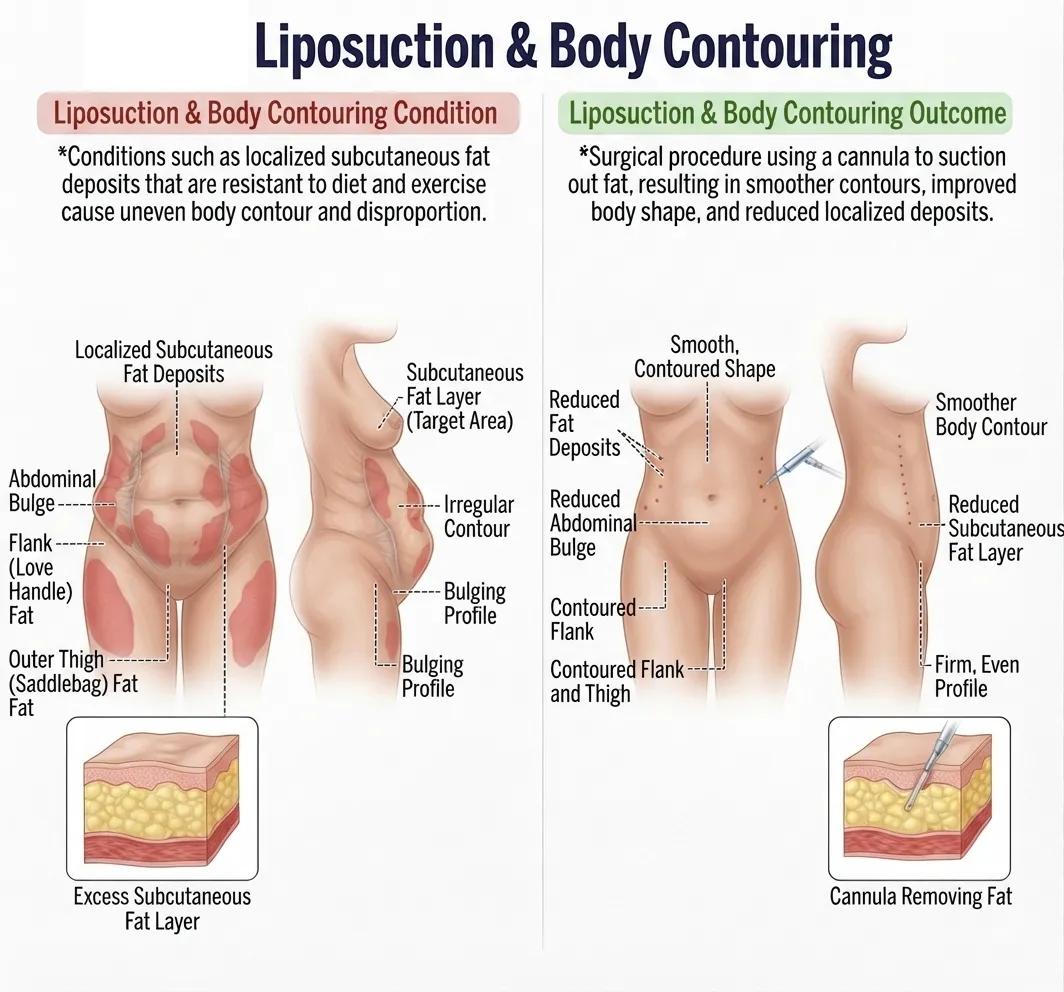
Liposuction (suction-assisted lipectomy) targets stubborn subcutaneous fat pockets unresponsive to diet and exercise. Utilizing tumescent fluid infiltration and specialized thin cannulas, surgeons suction out targeted fat cells from regions such as the abdomen, flanks, thighs, arms, chin, and male chest (gynecomastia).
Who Needs Liposuction?
Individuals at or near stable weight with good skin elasticity seeking localized body contouring refinement.
Key clinical indicators include:
- Localized lipodystrophy (fat deposits) on abdomen, love handles, thighs, or neck.
- Gynecomastia (male breast tissue enlargement - fatty component).
- Lipedema management to reduce painful limb swelling.
- High-definition body sculpting (360 abdominal etching).
Types of Liposuction Technologies
- Tumescent Liposuction: Standard technique infusing saline, lidocaine, and epinephrine to break down fat, minimize bleeding, and numb tissue.
- VASER Ultrasound-Assisted Liposuction (UAL): Employs ultrasonic sound waves to liquefy fat cells selectively before suctioning, preserving blood vessels and nerves.
- Power-Assisted Liposuction (PAL): Uses a rapidly vibrating cannula to facilitate smooth fat extraction with less manual force and trauma.
- Laser-Assisted Liposuction (SmartLipo): Uses laser energy to liquefy fat and stimulate collagen contraction for mild skin tightening.
Benefits of Liposuction
- Permanent removal of targeted subcutaneous fat cells.
- Enhanced muscle definition and streamlined body silhouette.
- Minimal tiny scar access points (<4-5mm).
- High-definition contouring options (VASER Hi-Def).
What to Expect Before Surgery?
- Body Marking & Elasticity Check: Evaluation of skin retraction capacity; marking treatment zones while standing upright.
- Lab Workup: Full blood count, coagulation profile, kidney function, and cardiac evaluation.
- Pre-Op Guidelines: Discontinue blood-thinning supplements, alcohol, and smoking 2 weeks prior.
Complete Procedure
- Administration of local with sedation or general anesthesia depending on target volume.
- Infiltration of tumescent fluid into targeted subcutaneous fat layers.
- Tiny skin incisions (3-5mm) made in hidden natural folds.
- Insertion of specialized cannula (VASER/PAL) to emulsify and suction out unwanted fat cells in a criss-cross pattern.
- Incision closure and immediate fitting of a medical-grade compression garment.
Traditional vs VASER Liposuction
| Feature | Traditional Tumescent | VASER Ultrasound-Assisted |
|---|---|---|
| Fat Emulsification | Manual mechanical breakdown | Ultrasonic wave liquefaction |
| Tissue Selectivity | Standard tissue displacement | High selectivity (spares blood vessels/nerves) |
| Skin Tightening | Dependent on natural elasticity | Mild thermal collagen contraction |
| Bruising & Recovery | Moderate bruising (7-14 days) | Reduced bruising; faster recovery |
Success Rate and Safety
Liposuction is one of the safest aesthetic procedures when adhering to standardized fluid volume guidelines (staying under 4-5 liters of fat extraction per session).
Cost Estimate
| Treatment Area / Technique | Estimated Cost (INR) |
|---|---|
| Single Zone (Double Chin / Arms) | ₹60,000 - ₹1,00,000 |
| Abdomen & Flanks (Tumescent / PAL) | ₹1,20,000 - ₹2,00,000 |
| Full 360 VASER HD Liposuction | ₹1,80,000 - ₹2,80,000 |
Disclaimer: Cost varies based on target zones count, technology choice (VASER/PAL), and fat volume extracted.
Recovery Guide & Post-Operative Care
Recovery Timeline
- Days 1-3: Tumescent fluid drainage from tiny incision sites; mild soreness similar to an intense workout.
- Week 1: Bruising peaks and begins fading; return to light desk work.
- Week 3-4: Significant swelling reduction (~70%); resumption of cardio exercise.
- Month 2-3: Final body contours emerge as tissue edema resolves completely.
Post-Op Precautions & Care
- Compression Garment: Wear custom pressure garment 24/7 for 4 weeks (except during showers) to prevent seroma formation and promote skin retraction.
- Manual Lymphatic Drainage (MLD): Post-liposuction massage starting week 2 helps speed up fluid clearance.
- Hydration & Walking: Maintain high fluid intake and light frequent walking to prevent DVT.
Frequently Asked Questions
Is the fat loss from liposuction permanent?⌄
Yes. The fat cells removed during liposuction do not regenerate. However, remaining fat cells in untreated areas can expand if significant weight is gained after surgery.
How much weight can I lose through liposuction?⌄
Liposuction is for body shaping, not weight loss. Maximum safe fat extraction in a single session is typically 4 to 5 liters (~3-4 kg).
Will I have loose skin after liposuction?⌄
If you have good baseline skin elasticity, skin retracts smoothly over new contours. For significant pre-existing skin sag, combining liposuction with skin excision (e.g., tummy tuck) may be recommended.
When can I see final results after liposuction?⌄
Initial shape changes are visible immediately, but post-operative swelling hides final definition. Final results develop between 2 and 3 months.
Why is wearing a compression garment necessary?⌄
Compression garments collapse empty subcutaneous channels, prevent fluid collection (seroma), minimize bruising, and assist skin in conforming smoothly to your new contour.