




What is Lung Transplant Surgery?
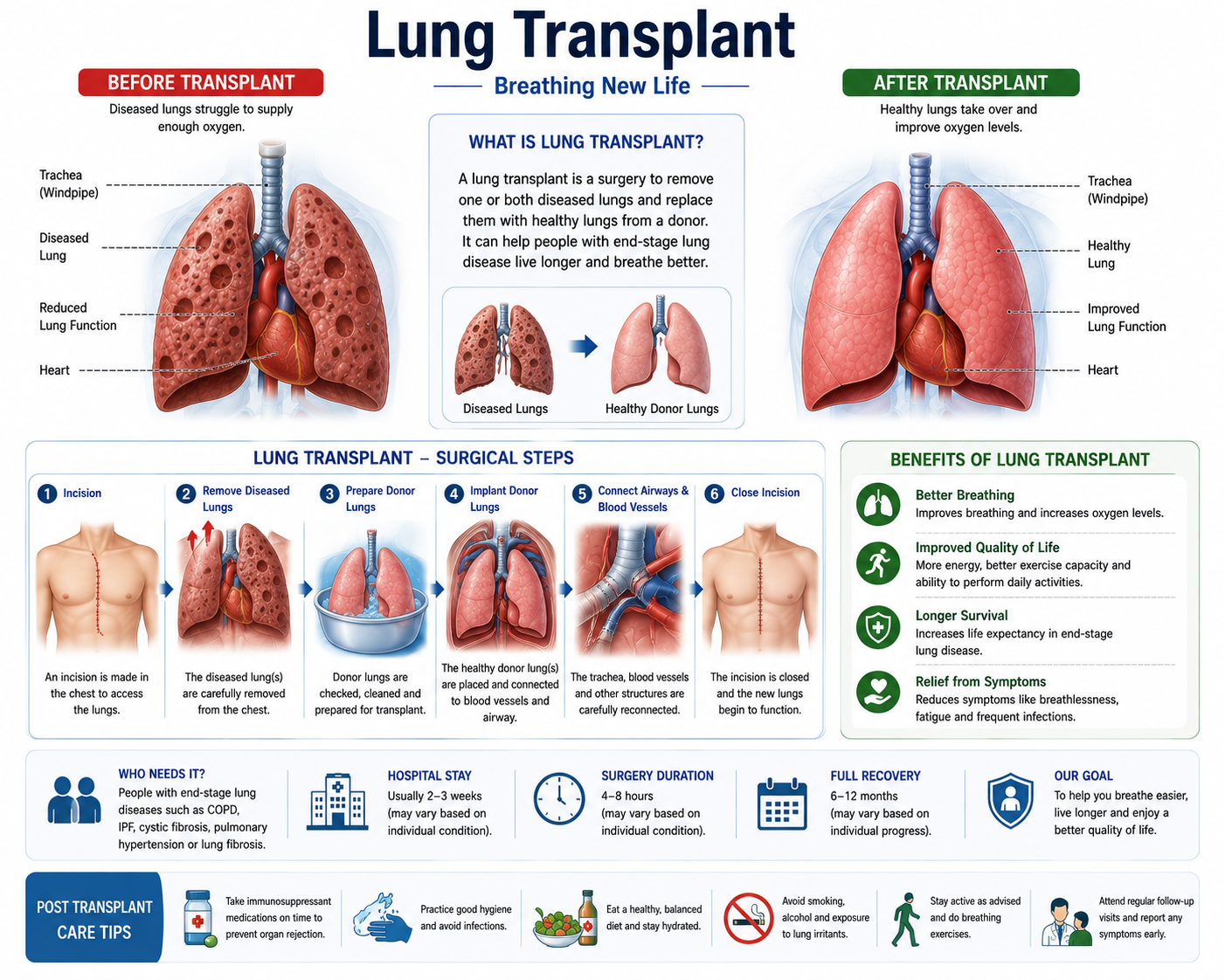
Lung transplantation is an advanced cardiothoracic surgical intervention wherein damaged lungs affected by end-stage respiratory failure are removed and replaced with healthy lungs harvested from a brain-dead organ donor. The surgery reconnects the pulmonary arteries, pulmonary veins, and main bronchi to re-establish pulmonary gas exchange.
Who Needs a Lung Transplant?
Lung transplantation is considered when medical management, pulmonary rehabilitation, and supplemental oxygen no longer maintain adequate lung function.
Key clinical indicators include:
- Severe Chronic Obstructive Pulmonary Disease (COPD) or Emphysema.
- Idiopathic Pulmonary Fibrosis (IPF) or Interstitial Lung Disease (ILD).
- Cystic Fibrosis or severe non-cystic fibrosis Bronchiectasis.
- Severe Primary Pulmonary Arterial Hypertension (PAH).
- FEV1 < 20-30% predicted or rapidly declining oxygen saturation requiring continuous oxygen therapy.
Types of Lung Transplant Surgery
- Single Lung Transplant: Replacement of one damaged lung (commonly performed for IPF or emphysema in older adults).
- Bilateral (Double) Lung Transplant: Simultaneous replacement of both lungs (essential for Cystic Fibrosis or severe pulmonary infections).
- Combined Heart-Lung Transplant: Indicated when severe irreversible heart failure coexists with end-stage lung disease.
Donor Compatibility: Donor lungs must match the recipient's ABO blood group, chest cavity size (height/predicted total lung capacity), and negative antibody crossmatch.
Benefits of Lung Transplant Surgery
- Complete freedom or dramatic reduction in dependence on external oxygen support.
- Elimination of severe breathlessness during basic activities of daily living.
- Enhanced stamina, mobility, and long-term overall survival.
- Ability to walk, travel, and participate in social activities comfortably.
What to Expect Before Surgery?
Preparing for a lung transplant requires rigorous physical and medical conditioning:
- Comprehensive Workup: High-resolution CT chest scans, ventilation-perfusion scans, coronary angiography, and psychological evaluations.
- Pulmonary Rehabilitation: Pre-transplant chest physiotherapy to maintain muscle strength while on the transplant waitlist.
- Registry Listing: Registration on the national/state organ donation network.
- Emergency Call: Patients must reach the transplant hospital within hours once a matching donor lung is harvested.
Complete Procedure
The operative steps for double lung transplantation generally follow:
- Administration of general anesthesia and insertion of a double-lumen endotracheal tube.
- Clamshell incision across the chest or bilateral anterolateral thoracotomies.
- Placement on veno-arterial Extracorporeal Membrane Oxygenation (VA-ECMO) or Cardiopulmonary Bypass if hemodynamically unstable.
- Excision of the recipient's diseased lung(s).
- Bronchial anastomosis (stitching the main donor airway to the recipient airway).
- Pulmonary artery and left atrial (pulmonary vein cuff) anastomoses.
- Inflation and ventilation of the new lung(s), chest tube placement, and layer-by-layer chest closure.
What to Expect During Surgery?
The surgical time ranges from 6 to 12 hours depending on whether it is a single or double lung transplant and whether ECMO support is required. Continuous arterial line, central venous, and pulmonary artery monitoring are maintained throughout.
Single vs Bilateral (Double) Lung Transplant
| Feature | Single Lung Transplant | Bilateral (Double) Lung Transplant |
|---|---|---|
| Surgical Complexity | Lower complexity; single incision. | Higher complexity; clamshell incision. |
| Infection Risk | Remaining native lung can harbor infection. | Both infected lungs removed; lower reinfection risk. |
| Primary Candidates | Selected IPF and emphysema patients. | Cystic Fibrosis, Bronchiectasis, Young IPF patients. |
| Procedure Duration | 4 - 6 hours | 8 - 12 hours |
Success Rate and Safety
1-year survival after lung transplantation is approximately 80-85%, with 5-year survival rates around 55-65%. Modern post-transplant ICU care and antiviral/antifungal prophylaxis have significantly improved outcomes.
Lung Transplant Surgery Cost Estimate
| Procedure Category | Estimated Cost Range (INR) |
|---|---|
| Single Lung Transplant | ₹25,000 - ₹32,000 |
| Bilateral (Double) Lung Transplant | ₹32,000 - ₹45,000 |
| Pre-transplant Rehab & ECMO Support (if needed) | ₹5,000 - ₹10,000 |
Disclaimer: Costs vary significantly based on post-operative ECMO duration, prolonged ICU mechanical ventilation, and donor organ transport expenses.
Recovery Guide & Post-Operative Care
Recovery Timeline
- Days 1-7: ICU monitoring with mechanical ventilation or ECMO weaning; intensive chest physiotherapy.
- Days 8-21: Step-down ward stay; learning incentive spirometry and walking short distances.
- Month 1-3: Outpatient clinic visits, routine spirometry testing, and surveillance bronchoscopies with transbronchial biopsy.
- Month 3-6: Full return to light activities and exercise programs.
Post-Op Precautions & Care
- Incentive Spirometry: Perform breathing exercises daily to keep new lung tissue fully expanded.
- Daily Spirometry Monitoring: Use a handheld home spirometer to check peak flow and report any drop in FEV1 immediately.
- Immunosuppressive Regimen: Strict compliance with triple-drug immunosuppressive therapy to prevent rejection.
- Avoid Environmental Hazards: Stay away from dusty environments, pet dander, mold, and tobacco smoke.
Frequently Asked Questions
How long do donor lungs last outside the human body?⌄
Donor lungs must typically be implanted within 6 to 8 hours of retrieval, although Ex-Vivo Lung Perfusion (EVLP) technology can extend this window up to 12 hours.
Will I need oxygen after a lung transplant?⌄
Most successful lung transplant recipients no longer require supplemental oxygen once fully recovered from surgery.
What is Chronic Lung Allograft Dysfunction (CLAD)?⌄
CLAD (including Bronchiolitis Obliterans Syndrome) is a long-term form of lung rejection where small airways narrow. It is managed with adjusted immunosuppressive therapy.
Can I catch chest infections more easily after transplant?⌄
Yes, because immunosuppressive medications lower your body's defenses. Patients take prophylactic antibiotics, antifungals, and antivirals to minimize infection risks.
How often will I need follow-up bronchoscopies?⌄
Routine bronchoscopies with tissue biopsy are typically scheduled at 1, 3, 6, and 12 months post-transplant or whenever lung function tests decline.