










What is Ovarian Cystectomy?
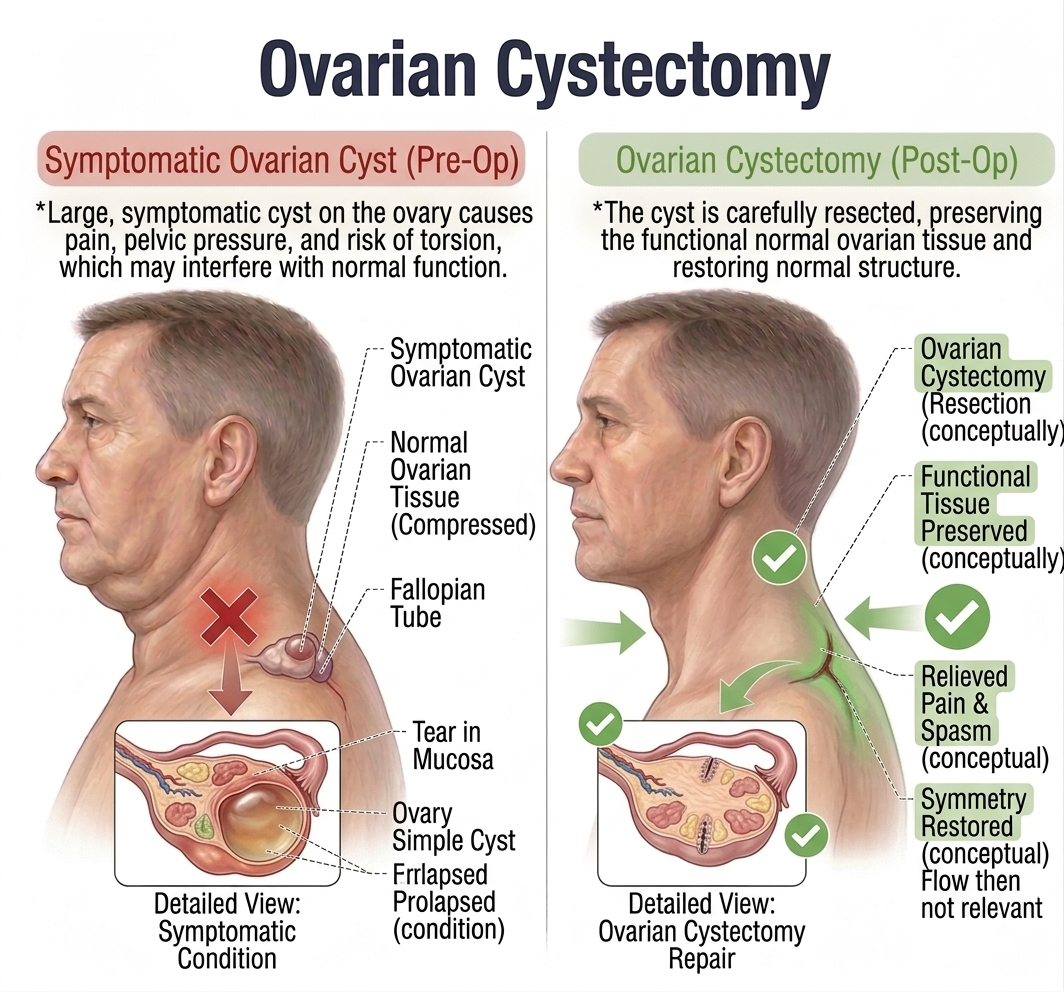
Ovarian Cystectomy is a delicate surgical procedure aimed at removing a fluid-filled or solid sac (cyst) from an ovary. Unlike an oophorectomy (removal of the entire ovary), a cystectomy meticulously peels away the cyst wall while leaving maximum healthy ovarian stroma intact.
Who Needs an Ovarian Cystectomy?
Surgery is considered when an ovarian cyst fails to resolve spontaneously, causes severe symptoms, or exhibits suspicious features on imaging.
Key clinical indicators include:
- Large cysts (>5 cm) that persist across multiple menstrual cycles.
- Endometriotic cysts (chocolate cysts) causing pain or subfertility.
- Dermoid cysts (teratomas) containing complex tissues like hair or teeth.
- Severe acute pelvic pain indicating cyst rupture or ovarian torsion (twisting).
- Cysts causing persistent pelvic pressure, pain during sex, or abdominal bloat.
Types of Ovarian Cystectomy
- Laparoscopic Ovarian Cystectomy: The preferred minimally invasive approach using 3-4 tiny abdominal keyholes.
- Robotic Ovarian Cystectomy: High-precision robotic surgery providing 3D magnification for complex or bilateral cysts.
- Laparotomy (Open Cystectomy): Performed in rare cases involving exceptionally large cysts or when malignancy is suspected.
Benefits of Ovarian Cystectomy
- Preservation of ovarian reserve, fertility, and hormonal balance.
- Immediate relief from pelvic pain, bloating, and urinary pressure.
- Prevention of life-threatening complications like ovarian torsion or rupture.
- Histopathological confirmation to rule out ovarian cancer.
What to Expect Before Surgery?
Preparation focuses on accurate diagnosis and surgical safety:
- Ultrasound / MRI Scan: Detailed evaluation of cyst dimensions, blood flow, and interior wall structure.
- Tumor Marker Blood Tests: Checking serum CA-125, HE4, ROMA index, or AFP levels to assess cancer risk.
- Pre-Anesthetic Evaluation: Routine blood tests, chest X-ray, and ECG.
- Pre-Op Fasting: Fasting for 8 hours prior to general anesthesia.
Complete Procedure
The surgical procedure follows these steps:
- Administration of general anesthesia.
- Inserting a laparoscope through a umbilical keyhole incision and inflating the abdomen with CO2 gas.
- Placing small secondary ports in the lower abdomen to introduce fine micro-instruments.
- Incising the ovarian cortex overlying the cyst wall.
- Carefully stripping the cyst capsule away from healthy ovarian tissue without rupturing it.
- Hemostasis (stopping any bleeding) using bipolar cautery or fine dissolvable sutures.
- Placing the cyst inside a retrieval bag and extracting it through a keyhole incision.
- Sending the removed tissue for histopathology (biopsy) testing.
What to Expect During Surgery?
The surgery usually takes 45 to 90 minutes. Surgeons prioritize preserving the healthy ovarian cortex and egg reserve.
Laparoscopic vs Open Cystectomy
| Feature | Laparoscopic Cystectomy | Open Abdominal Cystectomy |
|---|---|---|
| Incisional Trauma | Minimal (0.5 - 1 cm keyholes). | Larger lower abdominal scar. |
| Hospital Stay | Same-day discharge or 1 Day. | 2 to 3 Days. |
| Recovery Period | 1 to 2 Weeks. | 4 to 6 Weeks. |
| Adhesion Risk | Low. | Moderate. |
Success Rate and Safety
Laparoscopic cystectomy has a success rate over 95%. Complication rates are extremely low, and egg reserve preservation techniques are standard in modern gynaecological practice.
Ovarian Cystectomy Cost Estimate
| Procedure Type | Estimated Cost Range (INR) |
|---|---|
| Unilateral Laparoscopic Ovarian Cystectomy | ₹80,000 - ₹1,60,000 |
| Bilateral (Both Ovaries) Laparoscopic Cystectomy | ₹1,20,000 - ₹2,20,000 |
| Robotic-Assisted Ovarian Cystectomy | ₹1,80,000 - ₹2,80,000 |
Disclaimer: Final costs depend on whether one or both ovaries are operated upon, cyst size, and pathology evaluation.
Recovery Guide & Post-Operative Care
Recovery Timeline
- Day 0-1: Discharge home within 24 hours; mild shoulder tip pain due to laparoscopic gas.
- Week 1: Rest at home; resume light household walking and basic tasks.
- Week 2: Return to desk job, light driving, and regular daily walking.
- Week 4: Full resumption of strenuous physical activity and exercise.
Post-Op Precautions & Care
- Suture Care: Keep keyhole wound dressings clean and dry.
- Watch for Warning Signs: Contact your doctor if you experience fever, heavy bleeding, or severe abdominal pain.
- Follow-Up: Review biopsy report with your gynaecologist at 7-10 days post-op.
Frequently Asked Questions
Will removing an ovarian cyst lower my fertility?⌄
Skilled surgeons use egg-sparing techniques to preserve healthy ovarian tissue. In most cases, removing a symptomatic or endometriotic cyst actually improves fertility potential.
Can ovarian cysts recur after surgery?⌄
Functional cysts can occasionally form in subsequent cycles. Endometriotic cysts have a recurrence risk, which can be minimized with post-operative hormonal medical therapy.
How soon can I return to work after laparoscopic cystectomy?⌄
Most patients return to office jobs within 7 to 10 days post-surgery.
Is shoulder pain normal after laparoscopic cystectomy?⌄
Yes. Mild shoulder pain is common for 24-48 hours due to residual carbon dioxide gas used to expand the abdomen during surgery. It resolves on its own.