









What is Pacemaker / ICD Implantation?
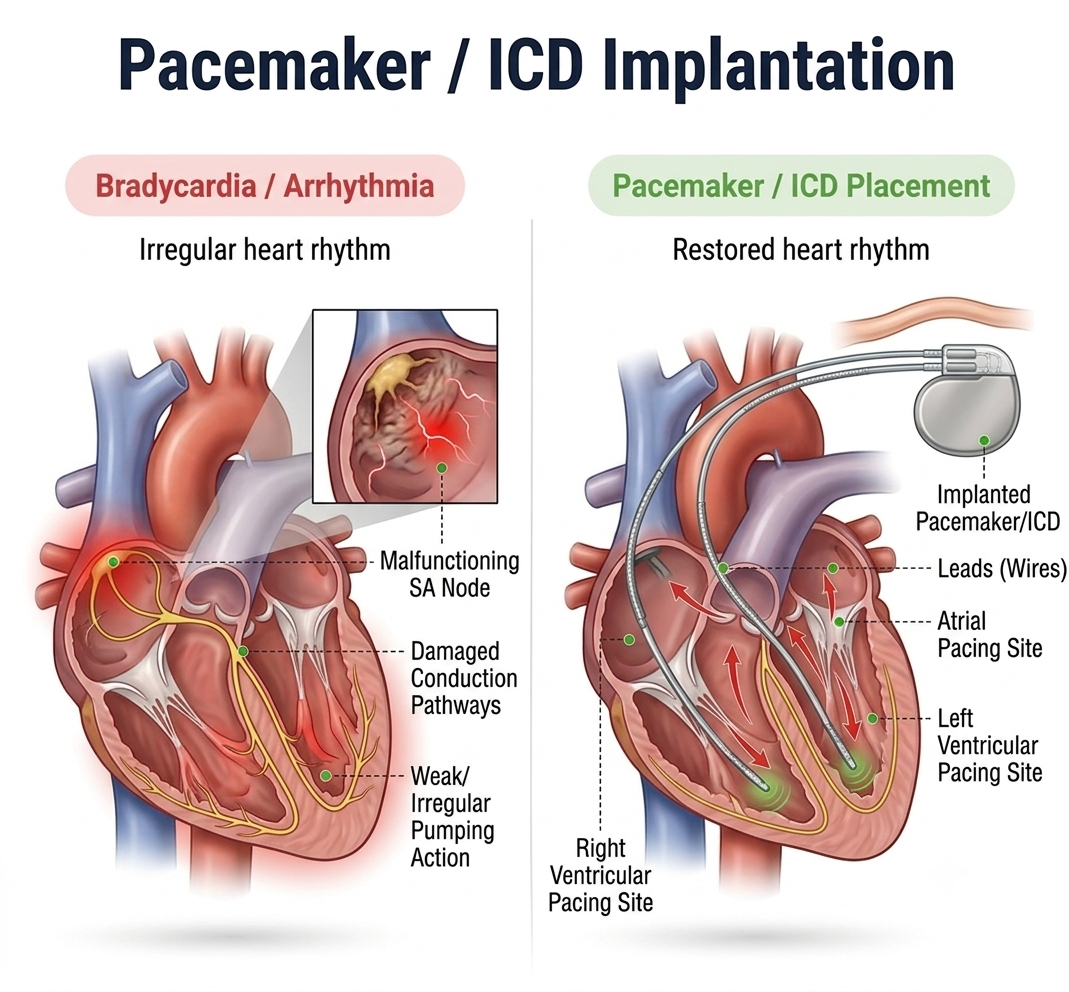
A pacemaker is a tiny electro-therapeutic device implanted beneath the collarbone to send painless electrical pulses to the heart muscle whenever it beats too slowly (bradycardia). An Implantable Cardioverter Defibrillator (ICD) is a specialized device that performs pacemaker functions while also delivering an immediate life-saving internal electrical shock if it senses a lethal, abnormally rapid heart rhythm (ventricular fibrillation or tachycardia).
Who Needs a Pacemaker or ICD?
Implantation is vital for patients with severe heart conduction blocks or high risk of sudden cardiac death.
Key clinical indicators include:
- Complete Heart Block (3rd Degree AV Block) or symptomatic Mobitz Type II AV block.
- Sick Sinus Syndrome causing severe fatigue, dizziness, or blackouts (syncope).
- Heart failure with low Left Ventricular Ejection Fraction (LVEF ≤ 35%) requiring Cardiac Resynchronization Therapy (CRT).
- Survivors of sudden cardiac arrest or patients with dangerous ventricular arrhythmias.
- Inherited channelopathies (Long QT syndrome, Brugada syndrome, Hypertrophic Cardiomyopathy).
Types of Implants & Devices
- Single-Chamber Pacemaker: Uses one wire (lead) attached to either the right atrium or right ventricle.
- Dual-Chamber Pacemaker: Uses two leads attached to both the right atrium and right ventricle to coordinate natural pumping rhythm.
- Biventricular Pacemaker (CRT-P / CRT-D): Uses three leads to synchronize both left and right ventricles in advanced heart failure patients.
- Implantable Cardioverter Defibrillator (ICD): Monitors for fatal electrical spikes and delivers pacing or defibrillation shocks instantly.
- Leadless Pacemaker: A tiny self-contained capsule (e.g., Micra) implanted directly inside the right ventricle via a femoral catheter without chest leads.
Benefits of Pacemaker / ICD Implantation
- Prevention of sudden cardiac arrest and life-threatening electrical collapse.
- Complete elimination of blackout spells, fainting, dizziness, and chronic fatigue.
- Restoration of normal active daily physical energy and stamina.
- Continuous 24/7 automated heart rhythm monitoring and emergency therapy delivery.
What to Expect Before Surgery?
Pre-procedure preparation focuses on electrophysiological evaluation:
- Diagnostic Workup: 24-48 hour Holter monitoring, electrophysiology (EP) study, and echocardiogram.
- Infection Screening: Skin check over upper chest area; blood tests for infection parameters.
- Medication Adjustments: Anticoagulant blood thinners are managed according to electrophysiologist instructions.
- Fasting Requirement: 6 hours of fasting prior to procedure under local anesthesia.
Complete Procedure
The step-by-step implantation process involves:
- Local anesthesia administration and mild sedation in the EP cath lab.
- Making a 3-5 cm horizontal skin incision just below the left collarbone (clavicle).
- Creating a small subcutaneous pocket under the skin or muscle layer.
- Accessing the subclavian or cephalic vein and threading insulated leads into the heart under fluoroscopic X-ray guidance.
- Testing lead thresholds, sensing parameters, and impedance using an external programmer computer.
- Connecting lead terminals tightly to the generator unit and inserting it into the skin pocket.
- Closing the incision with absorbable sutures, applying sterile pressure dressings, and verifying device telemetry.
What to Expect During Surgery?
The surgery takes approximately 45 to 90 minutes (1.5 to 2.5 hours for CRT/ICD devices). Performed under local anesthesia, the patient remains resting comfortably. You will feel pressure during pocket creation, but no pain.
Standard Pacemaker vs Implantable Defibrillator (ICD)
| Feature | Standard Pacemaker | Implantable Cardioverter Defibrillator (ICD) |
|---|---|---|
| Primary Function | Treats abnormally slow heart rates (bradycardia). | Treats dangerously fast, lethal rhythms (tachycardia/VF) & slow rates. |
| Emergency Shock | Cannot deliver defibrillation shocks. | Delivers immediate internal cardioversion/defibrillation shock. |
| Device Size | Compact, slim generator. | Slightly larger generator due to high-voltage capacitor. |
| Indication | AV blocks, Sick Sinus Syndrome. | Heart failure (EF ≤ 35%), cardiac arrest survival, lethal arrhythmias. |
Success Rate and Safety
Pacemaker and ICD implantation carries a procedural success rate exceeding 99%. Modern lithium-hybrid batteries provide a device lifespan of 8 to 15 years before a simple generator change is required.
Pacemaker / ICD Cost Estimate
| Device Category | Single Chamber (INR) | Dual Chamber / CRT / ICD (INR) |
|---|---|---|
| Single Chamber Pacemaker | ₹1,80,000 - ₹2,80,000 | N/A |
| Dual Chamber Pacemaker | N/A | ₹2,80,000 - ₹4,20,000 |
| Single / Dual Chamber ICD | N/A | ₹4,50,000 - ₹6,50,000 |
| Biventricular CRT-P / CRT-D | N/A | ₹6,00,000 - ₹9,50,000+ |
Disclaimer: Device costs vary depending on brand (Medtronic, Abbott, Boston Scientific, Biotronik), MRI-compatibility features, and battery longevity ratings.
Recovery Guide & Post-Operative Care
Recovery Timeline
- Hour 0-24: Bed rest, arm immobilization on device side, overnight telemetry monitoring.
- Day 1: Chest X-ray to confirm lead position and rule out pneumothorax; home discharge.
- Week 1-2: Keep surgical pocket clean and dry; avoid raising the left arm above shoulder height.
- Week 4: First pacemaker clinic check for wireless telemetry programming and interrogation.
- Month 2: Complete wound healing and full return to unrestricted upper body arm movements.
Post-Op Precautions & Care
- Arm Elevation Restriction: Avoid raising the arm on the implanted side above 90 degrees for 3-4 weeks to allow leads to anchor firmly in heart tissue.
- Electromagnetic Interference (EMI): Keep cell phones at least 6 inches away from the device pocket. Avoid metal detectors and industrial high-voltage magnetic fields.
- MRI Safety: Ensure your device is MRI-conditional before undergoing magnetic resonance imaging.
- ID Card Carrying: Always carry your official Pacemaker/ICD Patient Identification Card in your wallet.
Frequently Asked Questions
How long does a pacemaker battery last?⌄
Modern pacemaker batteries typically last between 8 to 12 years (and ICDs 7 to 10 years). Replacing the battery involves a simple minor procedure to swap the generator unit.
Does getting an electrical shock from an ICD hurt?⌄
An ICD shock feels like a sudden, forceful thud in the chest lasting a fraction of a second. While startling, it is a life-saving therapy that resets dangerous cardiac rhythms.
Can I use household appliances like microwaves with a pacemaker?⌄
Yes, modern pacemakers are shielded against common household appliances including microwaves, refrigerators, televisions, and computers.
Will airport security metal detectors affect my pacemaker?⌄
Airport metal detectors will not damage your pacemaker, but the device's metal case may trigger the security alarm. Show your Pacemaker ID card to security personnel for a manual wand check.
What is a leadless pacemaker?⌄
A leadless pacemaker (e.g., Micra) is a tiny device 90% smaller than a traditional pacemaker, placed directly inside the heart through a leg vein without surgical chest cuts or wires.