

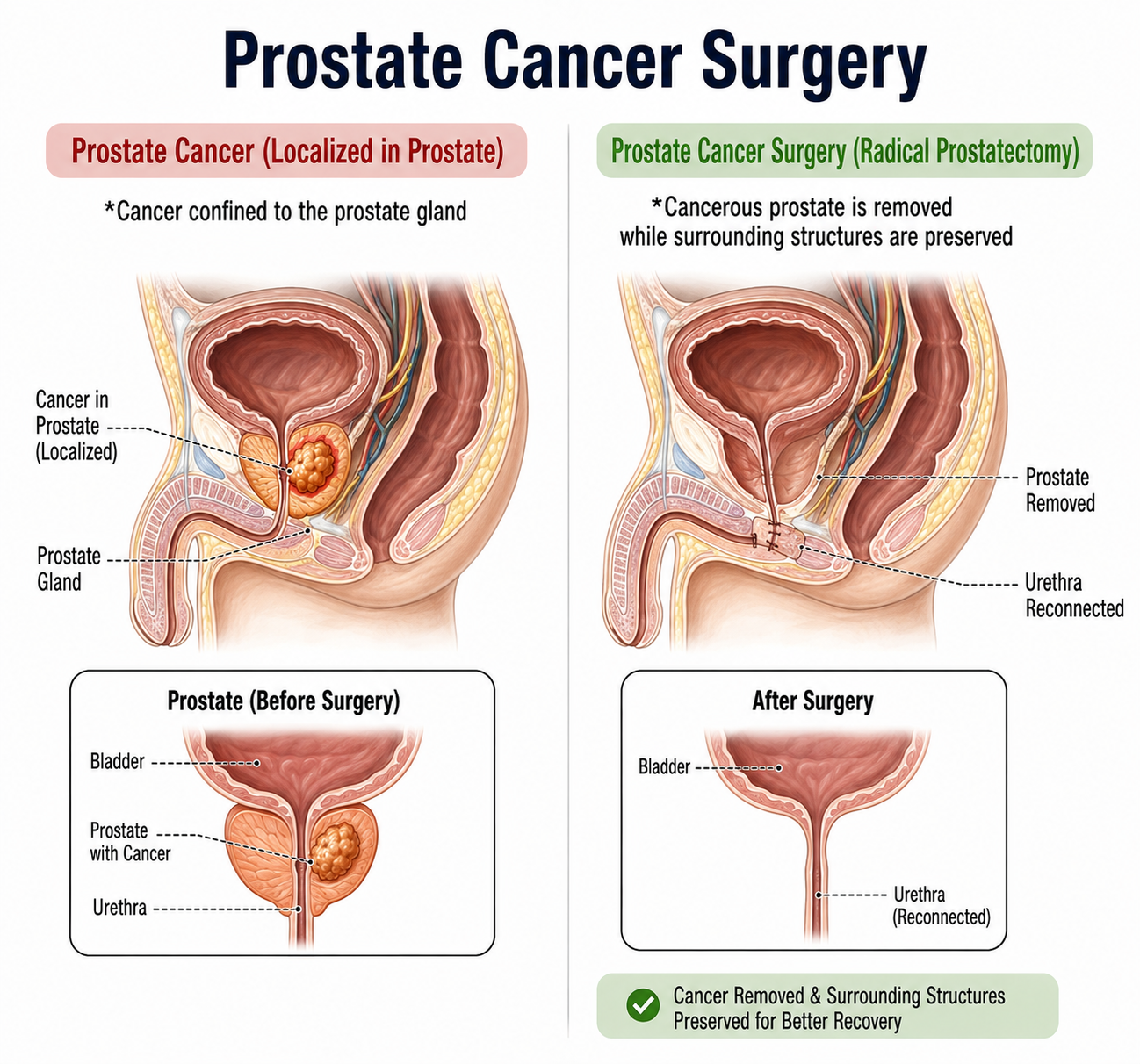









What is Prostate Cancer Surgery?
Radical Prostatectomy is the surgical excision of the prostate gland, ampullae of the vas deferens, and seminal vesicles, followed by joining the bladder neck directly to the urethra (vesicourethral anastomosis). Robotic-Assisted Radical Prostatectomy (RARP) using the da Vinci system is the gold standard, providing 3D magnification and wristed instrumentation that allows precise nerve-sparing dissection to preserve urinary continence and erectile function.
Who Needs Prostate Cancer Surgery?
Surgery is indicated for men with localized or locally advanced prostate cancer (Gleason score 6 to 9, Stage T1-T3) who have a life expectancy greater than 10 years.
Key clinical indicators include:
- Elevated Prostate-Specific Antigen (PSA) and multiparametric MRI (mpMRI) identifying suspicious lesions.
- Prostate biopsy confirming adenocarcinoma (Gleason score / ISUP Grade Group).
- PSMA PET-CT scan confirming disease localized to the prostate and regional pelvis.
- Patient preference for surgical cure over radiation or active surveillance.
Types of Prostate Cancer Surgery
- Robotic-Assisted Radical Prostatectomy (RARP): Minimally invasive robotic approach; offers optimal nerve preservation and minimal blood loss.
- Nerve-Sparing Radical Prostatectomy: Unilateral or bilateral preservation of the neurovascular bundles responsible for erections.
- Laparoscopic Radical Prostatectomy: Keyhole surgery without robotic assistance.
- Open Retropubic Radical Prostatectomy: Traditional lower abdominal incision approach; used in complex or salvage cases.
- Pelvic Lymph Node Dissection (PLND): Staging removal of pelvic lymph nodes for intermediate and high-risk disease.
Benefits of Prostate Cancer Surgery
- Complete removal of primary prostate tumor with definitive pathological staging.
- Immediate drop in serum PSA levels to undetectable levels (<0.1 ng/mL).
- Avoids long-term radiation complications such as radiation cystitis or proctitis.
- High rates of long-term cancer control and biochemical disease-free survival.
What to Expect Before Surgery?
- Multiparametric MRI & PSMA PET Scan: Accurate mapping of tumor extent and pelvic lymph nodes.
- Pelvic Floor (Kegel) Exercises: Pre-operative pelvic floor physical therapy to speed up post-catheter urinary control.
- Cardiac & Anesthesia Fitness: Routine blood work, EKG, and medical optimization.
- Bowel Preparation: Light diet and enema the evening prior to surgery.
Complete Procedure
- General anesthesia administration.
- Placement of 5 to 6 keyhole port incisions across the abdomen for robotic arms.
- Development of the preperitoneal space and bladder mobilization.
- Dissection of the prostate gland and preservation of neurovascular bundles (if oncologically safe).
- Excision of the prostate and seminal vesicles en-bloc.
- Pelvic lymph node dissection (if indicated).
- Reconstruction of the vesicourethral anastomosis over a Foley urinary catheter.
- Water-tight testing of the anastomosis and wound closure.
What to Expect During Surgery?
Robotic prostatectomy typically takes 2 to 3.5 hours. Intraoperative blood loss is minimal (<100-150 mL), and patients are mobilized on the evening of surgery.
Robotic (RARP) vs Open Prostatectomy
| Feature | Open Retropubic Surgery | Robotic-Assisted (RARP) |
|---|---|---|
| Magnification | 1x (naked eye with loupes). | 10x High-Definition 3D Vision. |
| Blood Loss | Moderate to high (often requires transfusion). | Minimal (<100 mL). |
| Catheter Duration | 10 - 14 Days. | 6 - 9 Days. |
| Continence Recovery | Faster with robotic nerve-sparing precision. | Gradual over months. |
Success Rate and Safety
In localized prostate cancer, radical prostatectomy achieves 10-year cancer-specific survival rates of 95%+. With robotic techniques, >90% of men regain complete urinary continence within 3 to 6 months.
Prostate Cancer Surgery Cost Estimate
| Procedure Type | Open Surgery (INR) | Robotic-Assisted RARP (INR) |
|---|---|---|
| Radical Prostatectomy | ₹2,50,000 - ₹4,20,000 | ₹4,20,000 - ₹7,00,000 |
| Radical Prostatectomy + Extended PLND | ₹3,00,000 - ₹4,80,000 | ₹5,00,000 - ₹8,00,000+ |
Disclaimer: Final costs depend on hospital stay, robotic technology fees, and catheter care kit inclusions.
Recovery Guide & Post-Operative Care
Recovery Timeline
- Day 0-1: Early walking; starting clear fluids; drain removal if output is low.
- Day 2-3: Discharge home with urinary catheter in place.
- Day 6-9: Outpatient cystogram / trial of void; urinary catheter removal.
- Week 2-6: Pelvic floor muscle rehabilitation; gradual return to non-strenuous daily activities.
- Month 2-3: First post-operative PSA blood test (target: undetectable <0.01-0.04 ng/mL).
Post-Op Precautions & Care
- Catheter Hygiene: Clean the catheter insertion site daily; keep urine drainage bag below bladder level.
- Pelvic Floor Exercises: Continue Kegel exercises 3 times daily to strengthen urinary sphincter muscles.
- Activity Restrictions: No heavy lifting (>5 kg), straining, or bicycle riding for 6 weeks post-surgery.
Frequently Asked Questions
How long will I need to wear a catheter after prostate surgery?⌄
With robotic surgery, the urinary catheter is typically removed within 6 to 9 days post-surgery after verifying proper healing of the bladder-urethra connection.
Will I be incontinent after prostate cancer surgery?⌄
Temporary urinary leakage is common after catheter removal. With pelvic floor (Kegel) exercises, over 90% of men regain full urinary control within 3 to 6 months.
What is nerve-sparing prostatectomy?⌄
It is a precise technique where the delicate neurovascular bundles adjacent to the prostate are preserved. This helps protect the patient's ability to achieve erections after recovery.
When will I know if the cancer is completely removed?⌄
Your surgeon will review the pathology report within 1 week to check surgical margins and lymph nodes. Your first PSA test at 6-8 weeks should drop to undetectable levels.
Why is robotic surgery preferred for prostate cancer?⌄
Robotic systems provide 3D magnification and 360-degree instrument rotation in the deep pelvis, leading to significantly less blood loss, faster catheter removal, and better nerve preservation.