








What is Rectal Prolapse Repair Surgery?
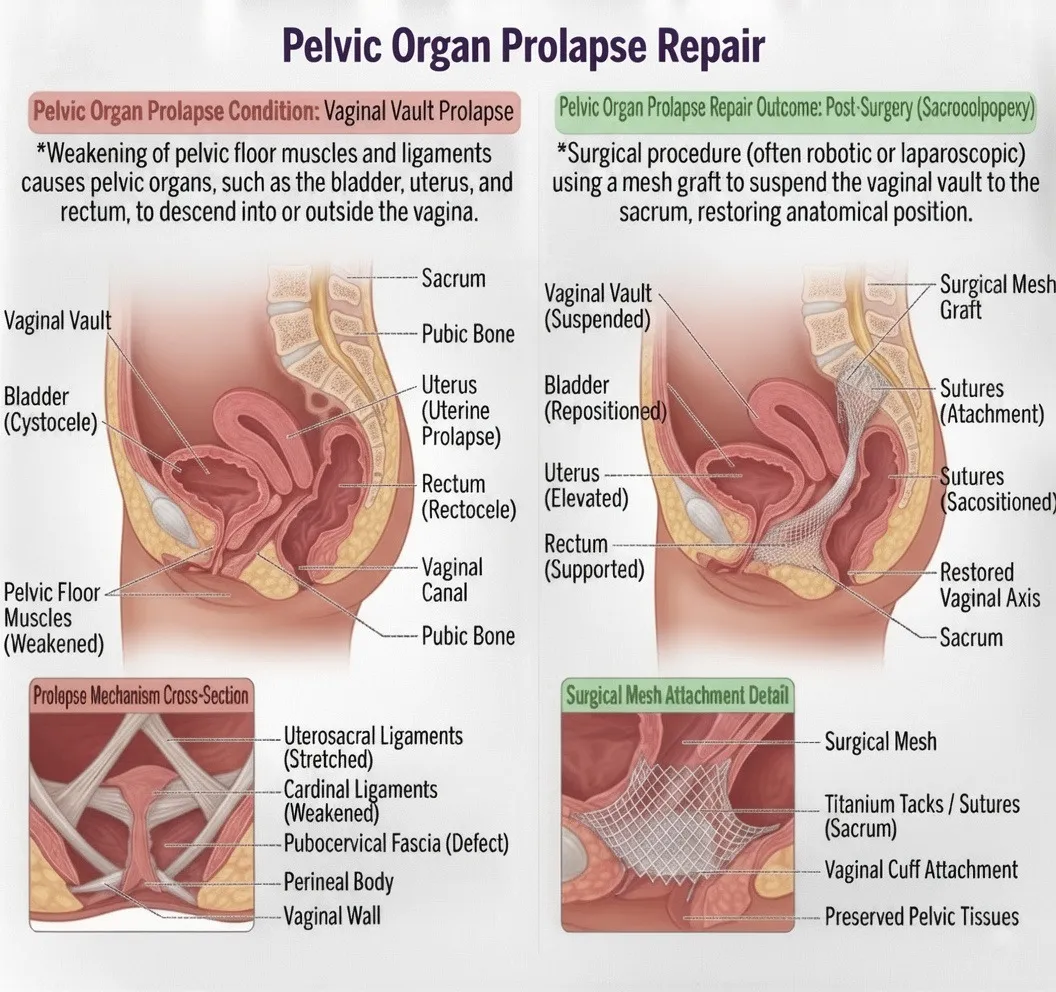
Rectal prolapse occurs when the full thickness of the wall of the rectum slides out of its normal pelvic attachments and protrudes through the anal opening. Surgical repair (rectopexy) lifts the prolapsed rectum and anchors it securely to the sacral bone within the pelvis, often reinforced with a biocompatible mesh or suture repair.
Who Needs Rectal Prolapse Repair?
Surgery is required for full-thickness rectal prolapse because non-surgical treatments cannot correct the anatomical structural failure.
Key clinical indicators include:
- Visible red tissue mass protruding through the anus during coughing or bowel movements.
- Progression from self-reducing prolapse to permanently externalized rectal tissue.
- Chronic mucous discharge, rectal bleeding, and tissue ulceration.
- Fecal incontinence or severe chronic constipation due to pelvic floor dysfunction.
Types of Rectal Prolapse Repair
- Laparoscopic / Robotic Ventral Mesh Rectopexy (Abdominal Approach): Minimally invasive abdominal repair where the rectum is mobilized and suspended to the sacrum using a mesh. Preferred for fit patients.
- Resection Rectopexy (Frykman-Goldberg): Combines rectal fixation with sigmoid colon resection for patients with severe concomitant constipation.
- Perineal Approaches (Altemeier / Delorme Procedure): Performed through the anus/perineum without opening the abdomen. Ideal for elderly, high-risk patients unsuitable for general anesthesia.
Benefits of Rectal Prolapse Repair
- Permanent structural correction of external tissue protrusion.
- Significant improvement in bowel control and reduction in fecal incontinence.
- Prevention of rectal tissue strangulation, ulceration, and gangrene.
- Minimal scarring and rapid recovery with laparoscopic/robotic approaches.
What to Expect Before Surgery?
- Diagnostic Evaluation: MRI Defecography, Colonoscopy, and Anorectal Manometry to evaluate pelvic floor physiology.
- Bowel Preparation: Full mechanical bowel cleansing administered 24 hours prior.
- Anesthesia clearance: Standard pre-op evaluations for abdominal or regional anesthesia.
Complete Procedure
The Laparoscopic Ventral Mesh Rectopexy follows these steps:
- Administration of general anesthesia.
- Keyhole incisions (3-4 small 5-10 mm ports) made in the abdomen.
- Dissection and mobilization of the anterior wall of the rectum away from the vagina/bladder.
- A biological or synthetic mesh strip is sutured to the lower rectal wall.
- The upper end of the mesh is anchored securely to the sacral promontory bone, pulling the rectum up into its correct place.
- Inspection of pelvic anatomy, closure of peritoneum over the mesh, and port site closure.
What to Expect During Surgery?
The laparoscopic procedure takes approximately 90 to 150 minutes under general anesthesia. It causes minimal blood loss and leaves negligible abdominal scarring.
Abdominal (Laparoscopic) vs Perineal Approach
| Feature | Laparoscopic Abdominal Rectopexy | Perineal Repair (Altemeier/Delorme) |
|---|---|---|
| Surgical Route | Abdominal keyhole ports | Directly through the anal region |
| Recurrence Rate | Low (2% - 5%) | Higher (10% - 20%) |
| Ideal Candidate | Young, fit, active patients | Elderly, frail, high-risk cardiac patients |
| Anesthesia | General Anesthesia | Spinal / Regional Anesthesia |
Success Rate and Safety
Laparoscopic rectopexy has a high success rate (>95%) with low long-term recurrence rates (2-5%).
Rectal Prolapse Repair Cost Estimate
| Surgical Technique | Estimated Cost (INR) |
|---|---|
| Perineal Repair (Delorme / Altemeier) | ₹1,20,000 - ₹1,80,000 |
| Laparoscopic Mesh Rectopexy | ₹1,50,000 - ₹2,50,000 |
| Robotic-Assisted Ventral Rectopexy | ₹2,20,000 - ₹3,50,000 |
Disclaimer: Costs vary depending on mesh material (biologic vs synthetic), robotic assistance, and hospital stay duration.
Recovery Guide & Post-Operative Care
Recovery Timeline
- Days 1-2: In-hospital mobilization, liquid to soft diet transition.
- Days 3-5: Catheter removal, normal bowel movement, discharge.
- Weeks 2-4: Gradual resumption of light daily activities.
- Weeks 6-8: Full recovery; clearance for physical exercise.
Post-Op Precautions & Care
- Prevent Straining: Take daily stool softeners to ensure smooth, effortless defecation.
- Avoid Heavy Lifting: Refrain from lifting >5 kg for 6 to 8 weeks to protect pelvic mesh anchors.
- Pelvic Floor Physiotherapy: Perform guided Kegel exercises to rebuild pelvic floor muscle strength.
Frequently Asked Questions
What is the difference between piles and rectal prolapse?⌄
Piles are swollen blood vessels inside the anus, whereas rectal prolapse is the complete structural sliding out of the entire rectal muscular wall.
Can rectal prolapse be cured without surgery?⌄
No. While mild mucosal prolapse in children can sometimes be managed conservatively, full-thickness rectal prolapse in adults requires surgical repair.
Is laparoscopic rectopexy safe for older adults?⌄
Yes, laparoscopic rectopexy is safe and well-tolerated. For extremely frail patients, perineal approaches under spinal anesthesia are offered.
Will my bowel control improve after surgery?⌄
Yes. Most patients experience significant improvement in sphincter tone and fecal continence over 3 to 6 months post-surgery.
How long does the mesh last?⌄
The surgical mesh used in rectopexy is permanent and designed to provide lifelong structural support to the pelvic organs.