









What is Shoulder Replacement Surgery?
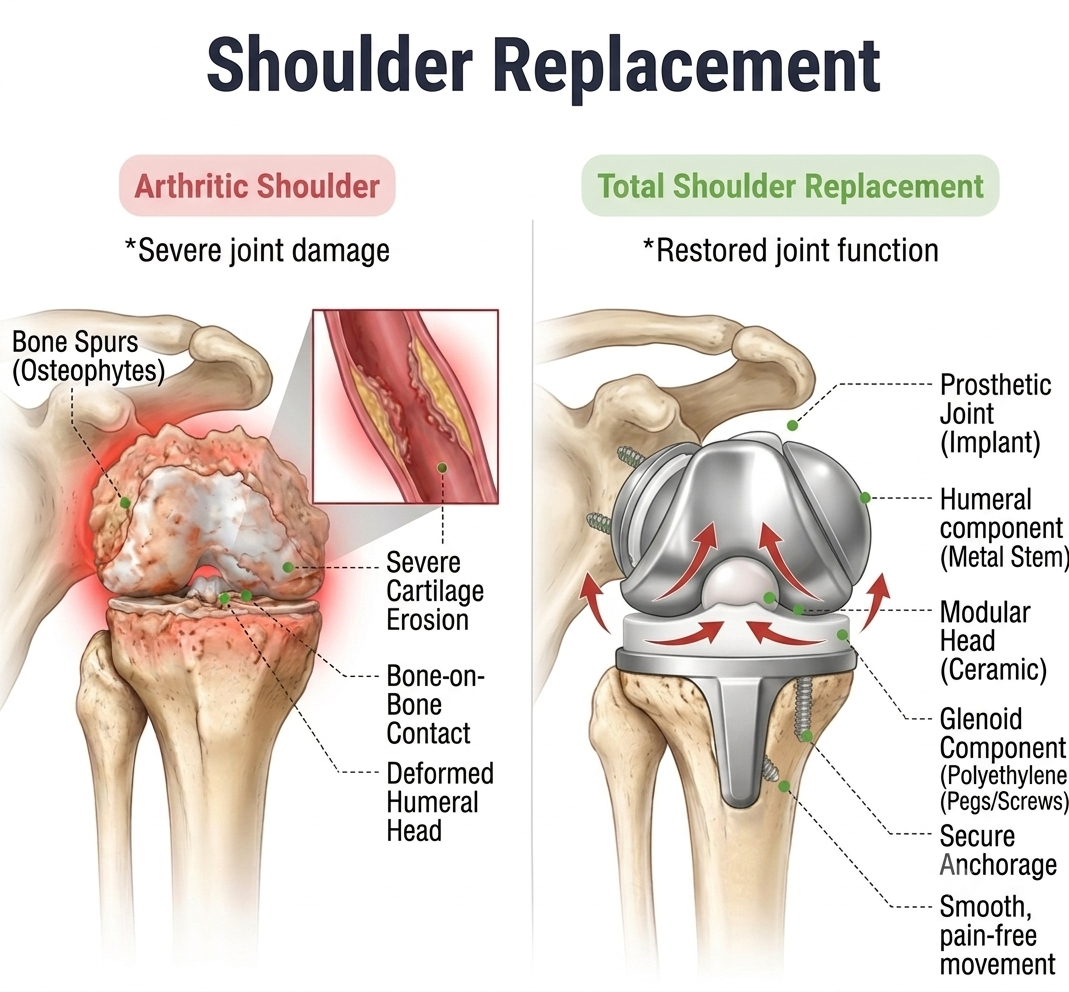
Shoulder arthroplasty is a procedure used to replace damaged bone and cartilage in the glenohumeral (shoulder) joint. The ball (humeral head) and socket (glenoid) are replaced with synthetic implant components to restore smooth, pain-free articulation.
Who Needs Shoulder Replacement Surgery?
Recommended for individuals experiencing severe shoulder pain and dysfunction caused by advanced joint destruction that has failed to improve with conservative care.
Key clinical indicators include:
- Severe shoulder pain that interferes with daily tasks like reaching overhead, combing hair, or dressing.
- Persistent shoulder pain while resting or trying to sleep at night.
- Moderate to severe loss of motion or weakness in the arm and shoulder.
- Radiographic signs of advanced shoulder osteoarthritis, rotator cuff tear arthropathy, or rheumatoid arthritis.
- Complex or non-union fractures of the upper arm bone (humerus).
Types of Shoulder Replacement Surgery
- Anatomic Total Shoulder Replacement: Replaces the ball and socket with implants that recreate natural anatomy; requires a functional rotator cuff.
- Reverse Total Shoulder Replacement: Swaps the positions of the ball and socket, allowing the deltoid muscle to power the arm when the rotator cuff is irreparably torn.
- Partial Shoulder Replacement (Hemiarthroplasty): Replaces only the humeral ball, preserving the natural glenoid socket.
Note on Modality: Patient-Specific 3D Surgical Guides and Navigation can be used to ensure precise placement of the glenoid component in complex bone deformities.
Benefits of Shoulder Replacement Surgery
- Profound reduction in chronic shoulder and arm pain.
- Restored ability to perform overhead tasks and daily activities.
- Improved muscle function and joint stability.
- High rate of long-term patient satisfaction.
What to Expect Before Surgery?
- Diagnostic Evaluation: X-rays, MRI, or CT scans to assess bone stock and rotator cuff integrity.
- Medical Screening: Evaluation for anesthesia and general health clearance.
- Pre-Op Exercises: Gentle strengthening and conditioning under physical therapy guidance.
- Home Adjustments: Organizing items at waist level to avoid post-op overhead reaching.
Complete Procedure
- Administration of general anesthesia combined with a regional nerve block for pain control.
- Incision made across the front of the shoulder joint.
- Exposure of the shoulder ball and socket.
- Removal of the damaged humeral head and preparation of the humeral canal.
- Preparation of the glenoid socket surface.
- Implantation of the humeral stem/ball and socket components.
- Closure of soft tissues, rotator cuff tendons (if applicable), and skin incision.
What to Expect During Surgery?
The surgery takes approximately 1.5 to 2.5 hours. Post-operatively, your arm will be supported in a protective sling before you move to the hospital ward.
Anatomic vs Reverse Replacement
| Feature | Anatomic Shoulder Replacement | Reverse Shoulder Replacement |
|---|---|---|
| Joint Anatomy | Mimics natural ball-and-socket anatomy. | Reverses ball and socket orientation. |
| Rotator Cuff | Requires an intact, healthy rotator cuff. | Ideal for massive, irreparable rotator cuff tears. |
| Primary Muscle | Uses rotator cuff muscles for motion. | Uses the deltoid muscle to lift the arm. |
| Indication | Primary Osteoarthritis. | Rotator Cuff Arthropathy / Complex Fractures. |
Success Rate and Safety
Shoulder replacement is highly effective, yielding significant pain relief in over 90% of patients. Implants typically last 15-20 years.
Shoulder Replacement Surgery Cost Estimate
| Type of Procedure | Conventional Surgery (INR) | Advanced / Navigated Surgery (INR) |
|---|---|---|
| Anatomic Total Shoulder Replacement | ₹2,00,000 - ₹4,50,000 | ₹3,50,000 - ₹6,00,000 |
| Reverse Total Shoulder Replacement | ₹2,80,000 - ₹5,50,000 | ₹4,50,000 - ₹7,50,000 |
| Shoulder Hemiarthroplasty | ₹1,50,000 - ₹3,50,000 | ₹2,50,000 - ₹4,50,000 |
Disclaimer: Costs depend on implant material, length of hospital stay, and surgical approach.
Recovery Guide & Post-Operative Care
Recovery Timeline
- Week 1-2: Arm supported in a sling; gentle wrist, hand, and passive shoulder pendulum exercises.
- Week 3-6: Active-assisted physical therapy; gradual discontinuation of the sling.
- Month 2-3: Progressive strengthening exercises; light daily use of the arm.
- Month 4-6: Advanced rehabilitation and near-full functional recovery.
Post-Op Precautions & Care
- Sling Adherence: Wear your sling strictly as advised to allow soft tissues to heal.
- Weight Limitations: Do not lift heavy objects (>2-3 kg) with the operative arm for the first 3 months.
- Avoid Extreme Rotation: Do not force the arm into extreme external rotation or behind your back early in recovery.
Frequently Asked Questions
What is the difference between anatomic and reverse shoulder replacement?⌄
Anatomic replacement retains natural joint positioning and relies on a healthy rotator cuff. Reverse replacement reverses the ball and socket positions, allowing the deltoid muscle to move the arm when rotator cuff tendons are torn.
How long will I need to wear a sling after shoulder surgery?⌄
Most patients wear a protective shoulder sling for 4 to 6 weeks to protect healing tissues and implants.
Can I drive after a shoulder replacement?⌄
You can usually resume driving 6 to 8 weeks after surgery, provided you are out of the sling, off narcotic pain medications, and have sufficient arm control.
When can I reach overhead again?⌄
Light overhead reaching is gradually reintroduced in physical therapy between weeks 6 and 12, depending on your healing progress.
Is shoulder replacement surgery painful?⌄
Post-operative pain is effectively managed using nerve blocks and medications. Pain reduces significantly over the first few weeks compared to pre-surgery pain.