

What is Skin Grafting?
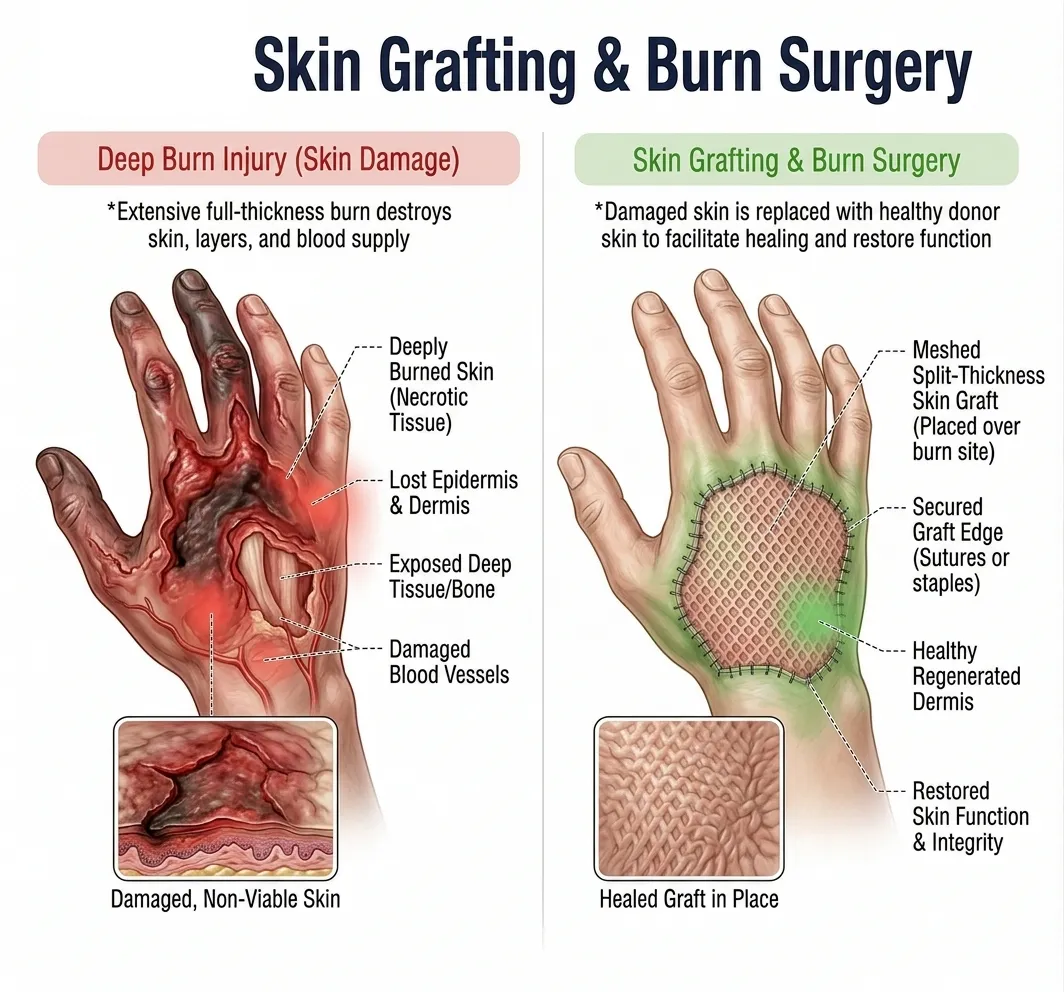
Skin grafting involves removing skin from a healthy area (donor site) and securing it over an open wound lacking skin cover (recipient site). Depending on wound depth, surgeons use Split-Thickness Skin Grafts (STSG) or Full-Thickness Skin Grafts (FTSG) to restore barrier function, prevent infection, and minimize contractures.
Who Needs Skin Grafting?
Patients with extensive skin loss where primary closure or secondary healing is clinically inadequate.
Key clinical indicators include:
- Second-degree deep partial-thickness and third-degree full-thickness burns.
- Non-healing diabetic foot ulcers, venous stasis ulcers, or pressure sores.
- Large surgical defect post-skin cancer resection or necrotizing fasciitis.
- Post-traumatic avulsion injuries or degloving trauma.
Types of Skin Grafts
- Split-Thickness Skin Graft (STSG): Contains epidermis and a portion of dermis; harvested using a dermatome. Heals rapidly and covers large surface areas.
- Full-Thickness Skin Graft (FTSG): Contains complete epidermis and dermis; harvested via scalpel from groin/clavicle. Provides better cosmetic matching and texture.
- Local / Distal Flaps: Tissue transfer maintaining its own intact blood supply, reserved for deep wounds exposing bone or tendon.
Benefits of Skin Grafting
- Rapid wound closure preventing severe systemic infection and fluid loss.
- Accelerated healing of non-healing chronic diabetic/venous ulcers.
- Functional reconstruction over joints to mitigate burn contractures.
- Long-term structural protection for underlying vulnerable tissues.
What to Expect Before Surgery?
- Wound Bed Preparation (Debridement): Complete removal of necrotic tissue, infection control, and establishing a healthy vascular granulation bed.
- Donor Site Selection: Choosing hidden donor zones (thigh, buttock for STSG; groin/supraclavicular for FTSG).
- Medical Optimization: Nutritional optimization (high protein intake) and glycemic control in diabetic patients.
Complete Procedure
- Administration of regional, spinal, or general anesthesia.
- Surgical excision / debridement of recipient wound bed until healthy bleeding tissue is exposed.
- Harvesting donor graft using a precision dermatome (STSG) or scalpel (FTSG).
- Graft meshing (optional) to expand surface area and allow fluid drainage.
- Securing graft to wound bed with staples, fine sutures, and Negative Pressure Wound Therapy (NPWT/VAC dressing).
Split-Thickness vs Full-Thickness Graft
| Feature | Split-Thickness (STSG) | Full-Thickness (FTSG) |
|---|---|---|
| Layer Harvested | Epidermis + Partial Dermis | Epidermis + Entire Dermis |
| Donor Healing | Heals spontaneously (7-14 days) | Requires primary suture closure |
| Contraction Risk | Higher secondary graft contraction | Minimal contraction; superior match |
| Best Used For | Extensive burns & large ulcers | Face, hands, and joint surfaces |
Success Rate and Safety
Graft "take" success depends on recipient blood supply, absence of infection, and immobility during the first 48-72 hours (plasmatic imbibition and inosculation phases). Success rates exceed 85-90% in clean wound beds.
Cost Estimate
| Complexity / Surface Area | Estimated Cost (INR) |
|---|---|
| Minor Grafting (<5% Body Surface Area) | ₹40,000 - ₹90,000 |
| Moderate Burn Reconstruction / Flap | ₹90,000 - ₹1,80,000 |
| Major Extensive Grafting + VAC Therapy | ₹1,80,000 - ₹3,50,000+ |
Disclaimer: Final pricing depends heavily on wound area, specialized VAC dressing requirements, and length of hospital stay.
Recovery Guide & Post-Operative Care
Recovery Timeline
- Days 1-5: Strict immobility of recipient limb; tie-over bolster or VAC dressing remains intact.
- Day 5-7: First dressing change to assess graft "take" and vascularization.
- Week 2-3: Donor site re-epithelialization complete; light mobilization.
- Month 2-6: Custom pressure garments worn to manage scar hypertrophy.
Post-Op Precautions & Care
- Immobilization: Keep the grafted extremity strictly immobilized for 5-7 days to prevent shearing forces.
- Donor Site Hygiene: Keep donor site dry; allow specialized non-adherent dressing to peel off naturally.
- Scar Management: Apply silicone sheets, pressure garments, and moisturizing creams once fully healed.
Frequently Asked Questions
What does graft 'take' mean?⌄
Graft 'take' refers to the process where new blood vessels grow from the recipient wound bed into the transplanted graft tissue, successfully nourishing it within 3-5 days.
How does the donor site heal?⌄
For split-thickness grafts, the donor site heals spontaneously from deep skin appendages within 10-14 days, similar to a scrape or abrasion.
Is skin grafting painful?⌄
The recipient site has minimal sensation initially. Donor sites can feel similar to a sun burn for a few days, which is managed with prescribed oral pain relievers.
Why is meshing done on skin grafts?⌄
Meshing cuts tiny slits into the graft, allowing it to stretch over larger wound areas and allowing fluid/blood to drain through, preventing graft detachment.
Will the grafted skin look identical to surrounding skin?⌄
Initial color and texture differences are common. Over 12-18 months, the graft matures, blends better in color, though mild texture variations may persist.