








What is Spinal Fusion Surgery?
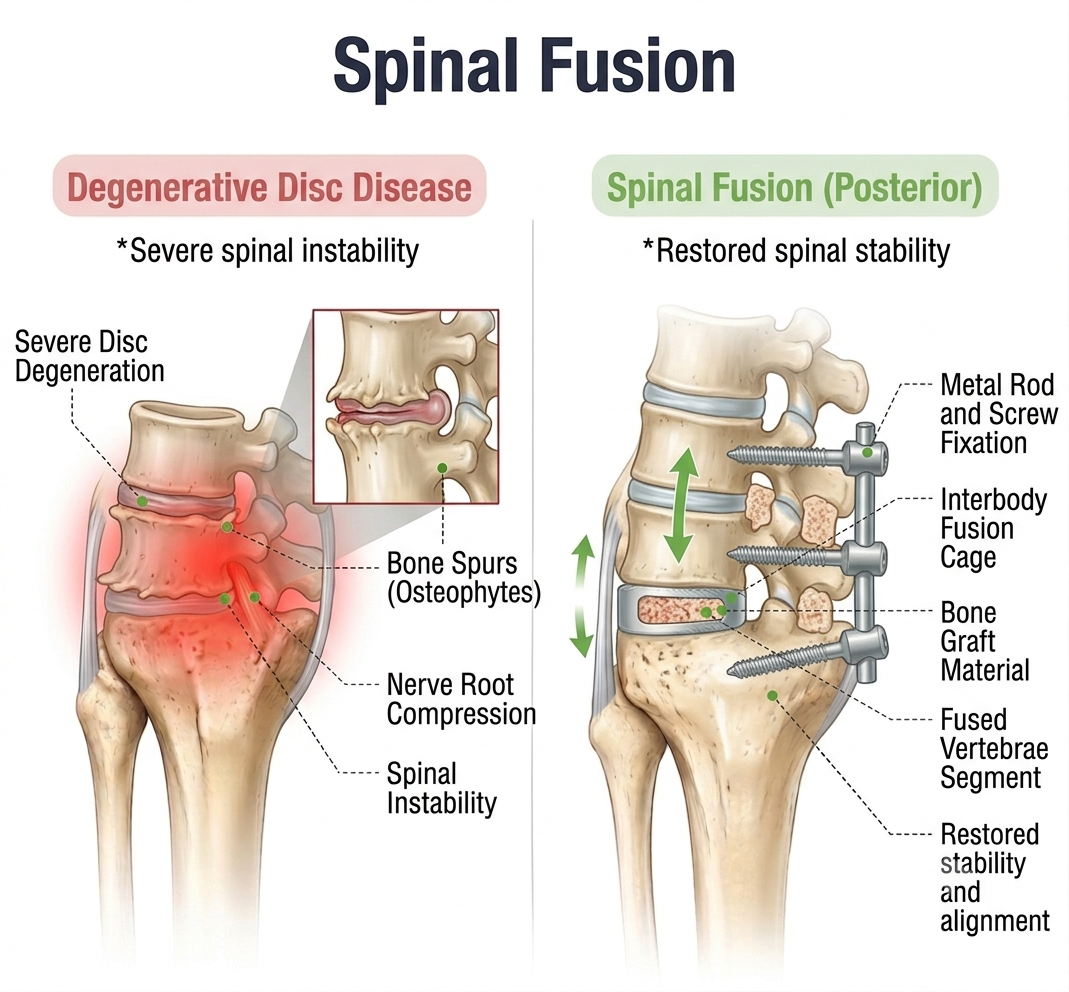
Spinal fusion is a major surgical procedure where two or more vertebral bones in the cervical (neck) or lumbar (lower back) spine are welded together using bone grafts, metal screws, rods, or cages. By eliminating motion between unstable vertebrae, spinal fusion reduces chronic localized back pain and protects adjacent spinal nerves.
Who Needs Spinal Fusion Surgery?
Spinal fusion is indicated when chronic back or neck instability causes severe functional impairment that fails to respond to non-surgical treatment like physiotherapy and epidural injections.
Key clinical indicators include:
- Spondylolisthesis (slipping of one vertebra over another).
- Severe spinal instability caused by degenerative disc disease or spinal stenosis.
- Spinal deformities such as scoliosis or kyphosis.
- Spinal fractures or dislocations caused by trauma.
- Recurrent herniated discs with chronic instability.
Types of Spinal Fusion Surgery
- Lumbar Spinal Fusion (TLIF / PLIF / ALIF): Fusion performed in the lower back through transforaminal, posterior, or anterior surgical approaches.
- Cervical Spinal Fusion (ACDF): Anterior Cervical Discectomy and Fusion to relieve neck pain and arm nerve compression.
- Minimally Invasive Spine Surgery (MISS) Fusion: Utilizes tubular retractors and intraoperative navigation to minimize muscle damage.
- Deformity Correction Fusion: Multi-level fusion for structural scoliosis or kyphosis.
Note on Modality: O-arm 3D intraoperative CT navigation and robotic assistance provide real-time guidance for pedicle screw placement near delicate spinal cord structures.
Benefits of Spinal Fusion Surgery
- Permanent elimination of painful segment motion in the spine.
- Realignment and stabilization of spinal deformities.
- Decompression and long-term protection of spinal nerves and spinal cord.
- Substantial reduction in radiating leg pain (sciatica) or arm pain.
What to Expect Before Surgery?
- Advanced Imaging: High-resolution MRI, CT scans, and dynamic flex-ext X-rays.
- Neurological & Anesthesia Evaluation: Comprehensive baseline nerve function testing.
- Smoking Cessation: Nicotine severely inhibits bone graft fusion and must be stopped completely several weeks prior to surgery.
Complete Procedure
- Administration of general anesthesia.
- Accessing the spinal column through posterior, anterior, or lateral incision.
- Decompressing pinched nerves by removing pressing bone spurs or disc material.
- Preparing the vertebral bone surfaces for bone grafting.
- Inserting interbody cages packed with bone graft (autograft, allograft, or synthetic bone morphogenetic protein) into the disc space.
- Securing the vertebrae with titanium pedicle screws and connecting rods for immediate internal stability.
- Intraoperative X-ray / CT verification and multi-layer incision closure.
What to Expect During Surgery?
Surgery time ranges from 2 to 5 hours depending on the number of spinal levels fused. Neuromonitoring continuously tracks nerve electrical activity during the operation.
MISS vs Open Spinal Fusion
| Feature | Traditional Open Fusion | Minimally Invasive (MISS) Fusion |
|---|---|---|
| Incision & Muscle Impact | Long incision; muscle stripping from bone. | Small targeted incisions; muscle dilation. |
| Blood Loss | Moderate to significant. | Minimal blood loss. |
| Hospital Stay | 5 to 7 Days. | 2 to 4 Days. |
| Post-Op Pain | Higher early post-op pain. | Lower muscular pain and faster recovery. |
Success Rate and Safety
Solid bone fusion is achieved in 85-95% of patients. Clinical success and pain reduction correlate strongly with strict post-operative rehab and smoking avoidance.
Spinal Fusion Surgery Cost Estimate
| Procedure Complexity | Open Surgery (INR) | MIS / Robotic / Multi-Level (INR) |
|---|---|---|
| Single-Level Fusion (ACDF / TLIF) | ₹2,50,000 - ₹4,80,000 | ₹3,80,000 - ₹6,50,000 |
| Two-Level Spinal Fusion | ₹3,50,000 - ₹6,00,000 | ₹5,00,000 - ₹8,50,000 |
| Complex Deformity / Scoliosis Fusion | ₹5,50,000 - ₹9,50,000 | ₹7,50,000 - ₹14,00,000+ |
Disclaimer: Implant hardware quality (imported titanium/PEEK cages), number of fused levels, and ICU stay significantly influence total cost.
Recovery Guide & Post-Operative Care
Recovery Timeline
- Day 1-3: Supported standing and short steps with a rigid lumbar corset or cervical collar.
- Week 2-6: Wound healing; gradual walking increase; avoiding twisting, bending, or heavy lifting (BLT precautions).
- Month 2-3: Outpatient physical therapy and core stabilization exercises.
- Month 6-12: Full biological bone fusion solidifies on follow-up CT/X-rays.
Post-Op Precautions & Care
- No Bending, Lifting, Twisting (BLT): Strictly avoid bending at the waist or lifting objects >3-5 kg for the first 3 months.
- Wear Spinal Brace: Use prescribed back brace or neck collar whenever out of bed.
- Bone Healing Boosters: Maintain adequate calcium, vitamin D intake, and avoid all tobacco/nicotine products.
Frequently Asked Questions
How long does bone take to fuse after spinal fusion surgery?⌄
Initial solid bone fusion takes 3 to 6 months, while full biological consolidation continues for up to 12 months.
Will spinal fusion restrict my ability to bend?⌄
Fusing 1 or 2 spinal levels causes minimal loss of overall spinal flexibility because adjacent unfused levels compensate. Bending is mostly preserved.
Why is smoking prohibited before and after spinal fusion?⌄
Nicotine constricts blood vessels and directly inhibits bone cell growth, increasing the risk of non-union (failure of bone to fuse) by up to 50%.
How long will I need to wear a back brace after spinal fusion?⌄
Most patients wear a custom rigid back brace or cervical collar for 6 to 12 weeks post-surgery when standing or walking.
When can I go back to work after spine fusion?⌄
Sedentary desk job workers can often return in 4 to 6 weeks. Jobs requiring physical labor may require 3 to 6 months.