





What is Thyroid Cancer Surgery?
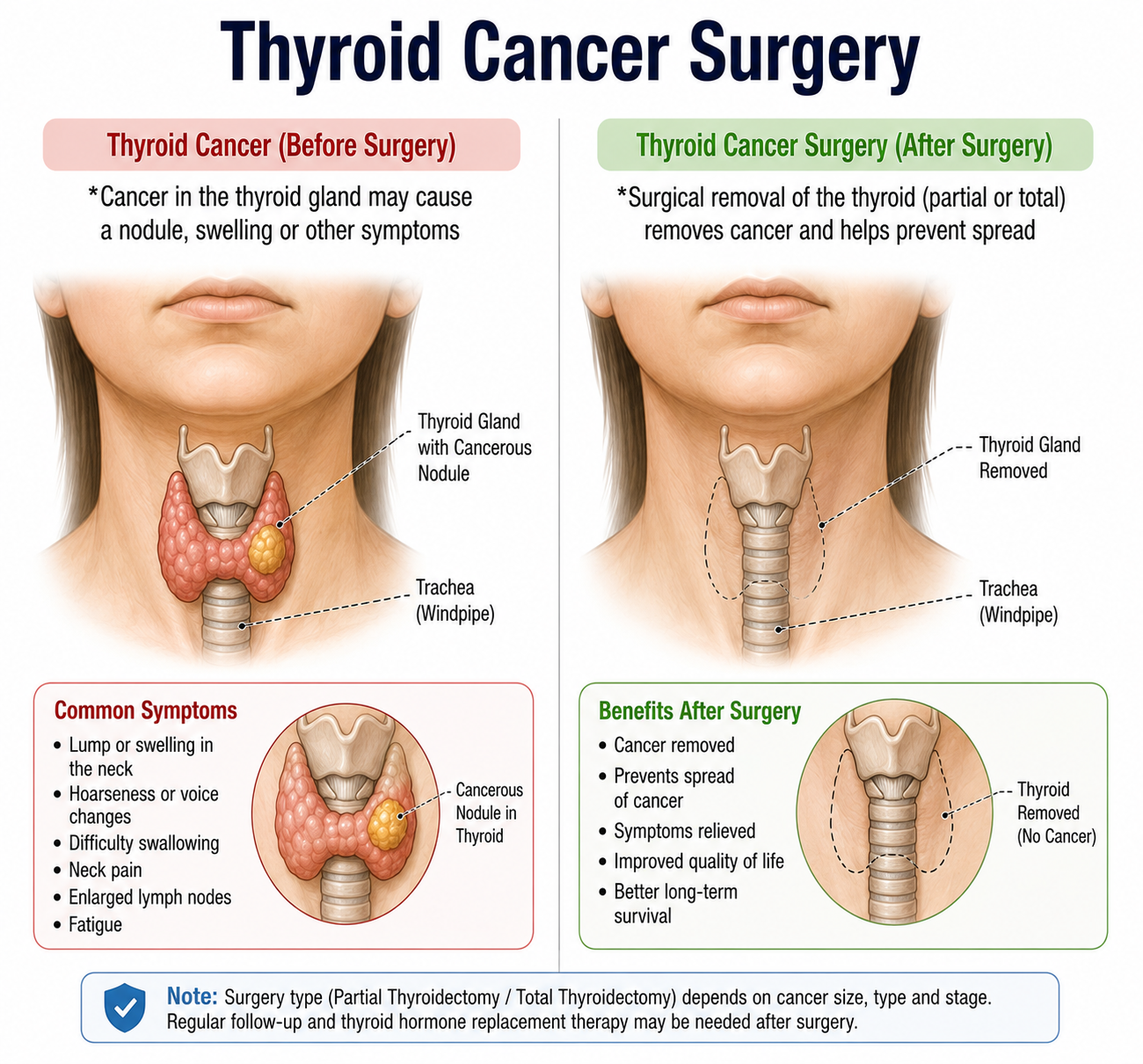
Thyroid Cancer Surgery involves the surgical removal of the butterfly-shaped thyroid gland located at the base of the neck. Depending on tumor size, histological subtype (papillary, follicular, medullary, or anaplastic), and lymph node involvement, the surgeon performs a thyroid lobectomy (hemithyroidectomy) or total thyroidectomy. Meticulous preservation of the recurrent laryngeal nerves (which control voice) and parathyroid glands (which regulate calcium) is critical.
Who Needs Thyroid Cancer Surgery?
Surgery is the primary cure for confirmed thyroid carcinoma and indeterminate thyroid nodules with high suspicious risk features.
Key clinical indicators include:
- Fine-needle aspiration cytology (FNAC) confirming papillary, follicular, medullary, or anaplastic carcinoma.
- Rapidly enlarging neck mass with compression symptoms (dysphagia, hoarseness, dyspnea).
- Ultrasound-detected cervical lymph node metastasis associated with thyroid nodules.
- Genetic risk factors such as RET proto-oncogene mutation (Medullary Thyroid Cancer).
Types of Thyroid Cancer Surgery
- Thyroid Lobectomy / Hemithyroidectomy: Removal of one lobe and the connecting isthmus; suitable for small, low-risk papillary carcinomas (<1-2 cm).
- Total Thyroidectomy: Removal of the entire thyroid gland; standard for larger tumors, bilateral disease, or high-risk features.
- Central Neck Dissection (Level VI): Excision of lymph nodes immediately surrounding the thyroid gland.
- Lateral Neck Dissection (Levels II-V): Removal of lymph nodes along the major neck vessels when preoperative imaging shows lateral nodal spread.
- Scarless / Endoscopic / Robotic Thyroidectomy: Transoral (TOETVA) or axillary approaches that avoid a visible collar incision in the neck.
Benefits of Thyroid Cancer Surgery
- Complete removal of primary thyroid malignancy.
- Prepares the patient for subsequent Radioactive Iodine (RAI) ablation therapy if total thyroidectomy is performed.
- Facilitates long-term surveillance using serum Thyroglobulin (Tg) tumor markers.
- Relieves airway or esophageal compression.
What to Expect Before Surgery?
- Vocal Cord Inspection: Pre-operative indirect laryngoscopy to document baseline vocal cord mobility.
- Neck Ultrasound & CT: High-resolution mapping of thyroid nodules and regional neck lymph nodes.
- Serum Calcium & PTH Levels: Baseline measurement of parathyroid function.
- Medication Adjustments: Ceasing anti-platelet drugs as instructed.
Complete Procedure
- General anesthesia administration.
- Low transverse neck incision placed in a natural skin crease (or transoral/axillary keyhole access).
- Division of strap muscles and exposure of the thyroid gland.
- Intraoperative Nerve Monitoring (IONM) setup to locate and preserve the recurrent laryngeal nerve.
- Identification and preservation of superior and inferior parathyroid glands with their blood supply.
- Resection of the thyroid gland (lobectomy or total) and indicated lymph node stations.
- Hemostasis verification and placement of a small suction drain if necessary.
- Meticulous cosmetic skin closure using plastic surgical technique.
What to Expect During Surgery?
Procedure length is generally 1.5 to 3 hours for total thyroidectomy, extending to 4-5 hours if comprehensive lateral neck dissection is required.
Scarless / Robotic vs Conventional Open Surgery
| Feature | Conventional Open Surgery | Transoral / Robotic (TOETVA) |
|---|---|---|
| Scar Location | 4 - 6 cm skin fold scar on anterior neck. | Hidden inside lower lip or axilla (no neck scar). |
| Cosmetic Appeal | Visible collar scar. | Excellent (zero neck marks). |
| Recovery Time | 1 - 2 Weeks. | 3 - 5 Days. |
| Incision Pain | Mild neck tightness. | Mild lip/chin numbness or swelling initially. |
Success Rate and Safety
Papillary and follicular thyroid cancers have an exceptional prognosis, with 10-year survival rates exceeding 95%. Complication rates (permanent nerve injury or hypoparathyroidism) are under 1-2% in expert high-volume surgical hands.
Thyroid Cancer Surgery Cost Estimate
| Procedure Type | Open Surgery (INR) | Robotic / Scarless TOETVA (INR) |
|---|---|---|
| Thyroid Lobectomy | ₹1,20,000 - ₹2,20,000 | ₹2,20,000 - ₹3,50,000 |
| Total Thyroidectomy | ₹1,60,000 - ₹3,00,000 | ₹2,80,000 - ₹4,50,000 |
| Total Thyroidectomy + Neck Dissection | ₹2,50,000 - ₹4,50,000 | ₹3,80,000 - ₹6,00,000+ |
Disclaimer: Costs depend on nerve monitoring technology, intraoperative frozen section usage, and hospital bed category.
Recovery Guide & Post-Operative Care
Recovery Timeline
- Day 0-1: Monitoring in ward; checking serum calcium levels; soft diet re-introduction.
- Day 2: Discharge home after drain removal (if placed) and confirmation of stable calcium levels.
- Week 1-2: Normal light activity; initiation of daily Levothyroxine (thyroid hormone replacement) if total thyroidectomy was performed.
- Month 1-2: Post-op pathology review; assessment for Radioactive Iodine (RAI) therapy scan.
Post-Op Precautions & Care
- Calcium Monitoring: Watch for symptoms of low calcium (tingling in fingers/lips, muscle cramps); take prescribed calcium and Vitamin D supplements.
- Voice Rest: Avoid shouting or straining the voice for the first 1-2 weeks.
- Wound Protection: Apply sunscreen or scar gel to the neck incision after stitches dissolve/are removed to ensure optimal cosmetic healing.
Frequently Asked Questions
Will my voice change after thyroid cancer surgery?⌄
Temporary hoarseness or fatigue in the voice can occur due to tissue inflammation near the recurrent laryngeal nerve. Permanent voice changes are rare (<1%) when performed by experienced surgeons using nerve monitoring.
Will I have to take thyroid pills for the rest of my life?⌄
If you undergo total thyroidectomy, you will need daily thyroid hormone replacement pills (Levothyroxine) for life. If only one lobe is removed, the remaining lobe may produce enough hormone naturally.
What are the signs of low calcium after surgery?⌄
Symptoms include tingling around the mouth or in fingertips and toes, muscle cramps, or facial twitching. It is easily treated with oral calcium and Vitamin D supplements.
Can thyroid surgery be done without leaving a scar on the neck?⌄
Yes. Transoral Endoscopic Thyroidectomy (TOETVA) and robotic axillary approaches enter through the inside of the lower lip or underarm, leaving no visible neck scar.
When will I know if I need Radioactive Iodine (RAI) treatment?⌄
Final pathology results—including tumor size, capsular invasion, and lymph node status—are reviewed 1 to 2 weeks after surgery to determine if RAI ablation is recommended.