









What is a Thyroidectomy?
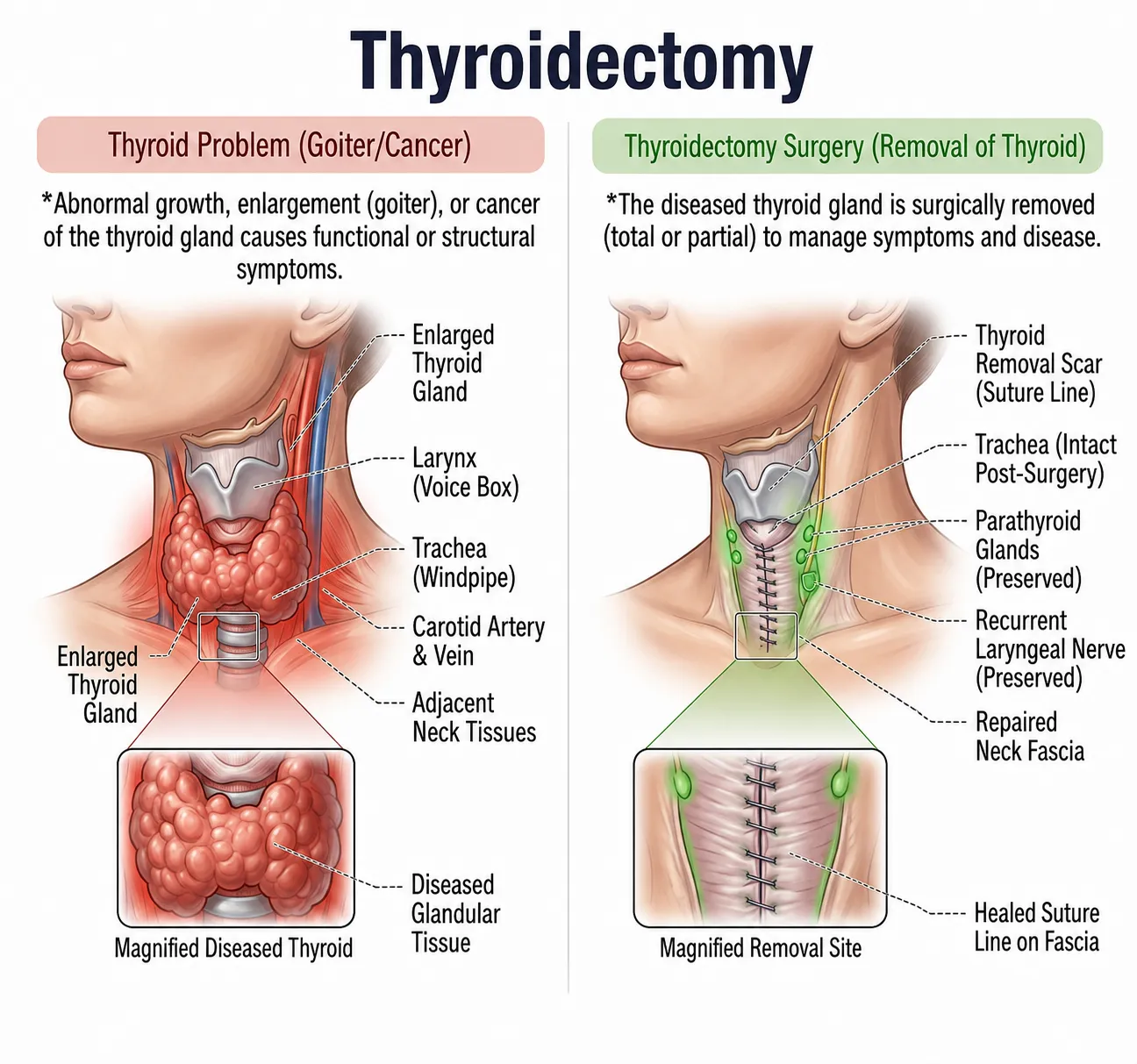
A Thyroidectomy is the surgical removal of all (Total Thyroidectomy) or part (Hemithyroidectomy / Partial Thyroidectomy) of the butterfly-shaped thyroid gland located at the base of the neck. The procedure is performed to treat thyroid cancer, symptomatic non-cancerous goitres, toxic thyroid nodules, or hyperthyroidism refractory to medication.
Who Needs a Thyroidectomy?
Thyroid surgery is performed when conservative medical management or radioactive iodine is insufficient or contraindicated.
Key clinical indicators include:
- Thyroid nodules suspicious for or confirmed as thyroid malignancy on Fine Needle Aspiration Cytology (FNAC).
- Large goitres causing compressive symptoms (difficulty swallowing, breathing difficulty, or hoarseness).
- Hyperthyroidism (Graves' disease or toxic nodule) unresponsive to anti-thyroid drugs.
- Cosmetic discomfort from prominent neck swellings.
Types of Thyroidectomy
- Total Thyroidectomy: Complete removal of the entire thyroid gland.
- Hemithyroidectomy / Lobectomy: Removal of one lobe (half) of the thyroid, preserving the other half.
- Near-Total Thyroidectomy: Removal of almost all gland tissue while leaving a minimal strip to protect parathyroid glands and nerves.
- Scarless / Endoscopic / Robotic Thyroidectomy: Transoral or axillary approach eliminating visible neck scars.
Benefits of Thyroidectomy
- Definitive treatment and cure for thyroid malignancies.
- Immediate relief from neck pressure, choking sensations, and swallowing difficulties.
- Curative management for severe, drug-resistant hyperthyroidism.
- Excellent cosmetic outcomes with fine-line natural crease incisions.
What to Expect Before Surgery?
- Thyroid Function Tests (TFTs): Ensuring euthyroid state (normal thyroid hormone levels) prior to surgery.
- Ultrasound & FNAC: Detailed mapping of nodules and biopsy evaluation.
- Vocal Cord Evaluation: Laryngoscopy to verify baseline vocal cord mobility.
Complete Procedure
- General anesthesia is administered.
- A low collar incision is made along a natural skin fold in the lower neck.
- Neck muscles are retracted to expose the thyroid gland.
- Careful identification and preservation of the recurrent laryngeal nerves (controlling voice) and parathyroid glands (regulating calcium).
- The targeted lobe or whole gland is excised.
- Hemostasis is verified, and a small drain may be placed temporarily.
- Muscles and skin are closed using fine cosmetic subcuticular sutures.
What to Expect During Surgery?
Surgery lasts 90 to 150 minutes. Special nerve-monitoring technology is often used during surgery to safeguard the vocal cords. Monitored post-op in recovery, swallowing and voice clarity are tested early.
Traditional vs Scarless (Transoral/Robotic) Thyroidectomy
| Feature | Conventional Open Surgery | Transoral / Robotic Approach |
|---|---|---|
| Incision Location | Lower neck crease | Inside lower lip / Armpit |
| Visible Neck Scar | Small fine line | Completely Scarless on neck |
| Nerve Monitoring | Standard / Optional | Integrated HD 3D vision |
| Cost | Baseline | Premium cost |
Success Rate and Safety
Thyroidectomy is safe when performed by experienced endocrine or ENT surgeons. Complication rates regarding voice changes or low calcium are under 1-2% in specialist hands.
Thyroidectomy Cost Estimate
| Procedure Type | Standard Package (INR) | Premium / Robotic (INR) |
|---|---|---|
| Hemithyroidectomy / Lobectomy | ₹80,000 - ₹1,30,000 | ₹1,40,000 - ₹1,90,000 |
| Total Thyroidectomy | ₹1,10,000 - ₹1,70,000 | ₹1,80,000 - ₹2,50,000+ |
Disclaimer: Includes surgeon fee, nerve monitor usage (if opted), histopathology, and room stay.
Recovery Guide & Post-Operative Care
Recovery Timeline
- Day 1: Soft diet, neck exercises, calcium level check.
- Day 2-3: Drain removal (if placed) and hospital discharge.
- Week 1-2: Resume light activities; neck stiffness gradually dissipates.
- Month 1: Final histopathology review and hormone replacement stabilization.
Post-Op Precautions & Care
- Hormone Therapy: Lifetime Levothyroxine (Thyrox) replacement required following Total Thyroidectomy.
- Calcium Monitoring: Watch for tingling in fingertips/lips or muscle cramps (signs of transient low calcium).
- Scar Care: Apply sunscreen and silicone gels after wound closure to minimize scar prominence.
Frequently Asked Questions
Will I need to take thyroid medicine for life?⌄
If you have a Total Thyroidectomy, you will need daily thyroid hormone replacement pills for life. If only half the gland is removed (Hemithyroidectomy), medication may not be needed.
Will my voice change after thyroid surgery?⌄
Temporary hoarseness or voice weakness can occur in a small percentage of patients but usually resolves within weeks. Permanent voice changes are rare (<1%) with nerve monitoring.
How noticeable will the neck scar be?⌄
Surgeons place the incision in a natural neck crease, making the scar faint and barely noticeable over time.
How long is the hospital stay after thyroidectomy?⌄
Most patients stay in the hospital for 1 to 2 days.
What are symptoms of low calcium after surgery?⌄
Tingling around the lips, numbness in fingers or toes, and muscle cramps are signs of low calcium, which can be easily treated with oral calcium supplements.