










What is Heart Valve Repair?
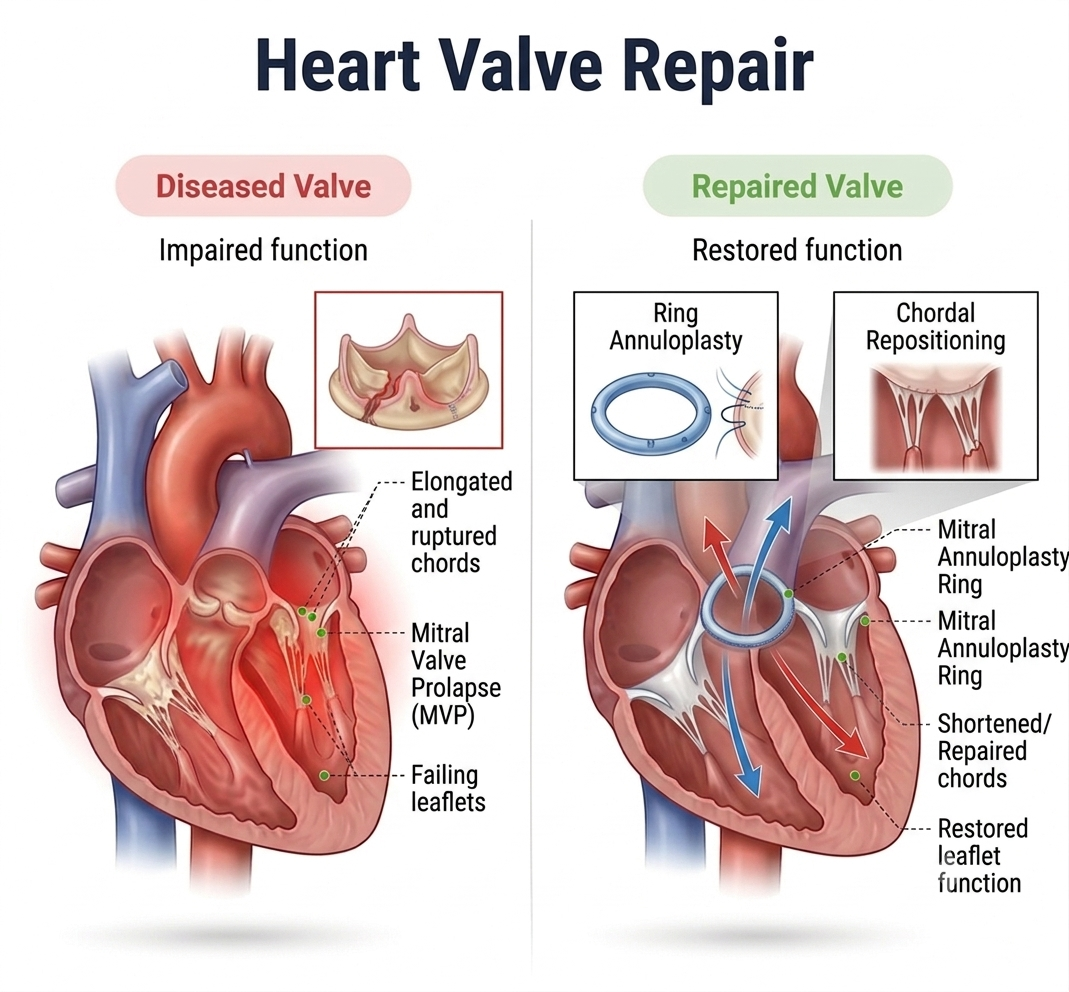
Heart Valve Repair is the gold-standard surgical approach for addressable valve lesions, particularly Mitral Valve Prolapse and Regurgitation. Rather than removing the native valve and inserting an artificial prosthesis, the cardiac surgeon reconstructs damaged valve leaflets, reshapes stretched valve rings, or attaches artificial GORE-TEX chords. Preserving the patient's own valve maintains natural ventricular function and eliminates the need for lifelong blood thinner medications.
Who Needs Heart Valve Repair?
Valve repair is preferred over replacement whenever technically feasible, especially in degenerative valve conditions.
Key clinical indicators include:
- Severe degenerative Mitral Valve Regurgitation (Myxomatous/Barlow's disease or Flail Leaflet).
- Moderate-to-severe Tricuspid Valve Regurgitation secondary to left-sided heart disease.
- Congenital valve defects (e.g., bicuspid aortic valve amenable to repair).
- Ring dilation or localized leaflet perforation from successfully treated endocarditis.
Types of Valve Repair Techniques
- Annuloplasty: Suturing a rigid or semi-flexible artificial ring around the outer circumference of the valve to tighten a dilated opening.
- Leaflet Resection & Reconstruction: Trimming excess, floppy, or prolapsed leaflet tissue and re-stitching healthy edges together.
- Neochord Implantation: Replacing broken or stretched natural chordae tendineae with synthetic PTFE (polytetrafluoroethylene) sutures.
- Percutaneous Edge-to-Edge Repair (MitraClip): A minimally invasive catheter procedure that clips floppy mitral valve leaflets together.
Benefits of Heart Valve Repair
- Superior long-term survival rates compared to prosthetic valve replacement.
- No requirement for lifelong Warfarin blood thinner treatment or routine needle pricks.
- Better preservation of native left ventricular muscular function and geometry.
- Significantly lower long-term risk of stroke and post-operative endocarditis.
What to Expect Before Surgery?
Pre-operative planning focuses on high-resolution 3D anatomical imaging:
- 3D Transesophageal Echocardiography (3D-TEE): Creating real-time spatial maps of specific valve segments (P1, P2, P3, A1, A2, A3).
- Cardiac CT Angiogram: Evaluating femoral access and chest anatomy for minimally invasive suitability.
- Coronary Angiography: Ruling out underlying coronary artery stenosis.
- Functional Assessment: Evaluating pulmonary arterial pressures and right ventricular strain.
Complete Procedure
The surgical repair steps include:
- Anesthesia, TEE monitoring, and sternotomy or right mini-thoracotomy incision.
- Initiating cardiopulmonary bypass and securing cardiac arrest with cardioplegia.
- Accessing the left atrium to clearly expose the mitral or tricuspid valve apparatus.
- Testing valve competency with saline injection to identify precise leakage points.
- Reconstructing leaflets (triangular/quadrangular resection) and placing artificial chords.
- Sizing and suturing an annuloplasty ring to reinforce the valve base.
- Closing atrial walls, re-warming, and assessing repair quality under high blood pressure conditions using intra-operative 3D-TEE.
What to Expect During Surgery?
The procedure takes 3 to 4.5 hours. Intra-operative 3D-TEE is critical: if the repair shows residual leakage on testing, the surgeon can refine the repair immediately before concluding the operation.
Valve Repair vs Valve Replacement
| Feature | Valve Repair | Valve Replacement |
|---|---|---|
| Native Tissue | Fully preserved. | Removed and replaced with artificial prosthetic. |
| Lifelong Blood Thinners | Not required (unless AFib is present). | Mandatory for mechanical valves. |
| Operative Complexity | Technically demanding; requires specialized surgeon skill. | Standardized technique. |
| Ventricular Function | Superior preservation of cardiac pump efficiency. | Good, but loss of natural subvalvular apparatus continuity can occur. |
Success Rate and Safety
Mitral valve repair carries a procedural success rate exceeding 97-99% in specialized heart centers. Over 90-95% of patients remain free from re-operation at 15-20 years post-repair.
Heart Valve Repair Cost Estimate
| Procedure Type | Standard Surgical Repair (INR) | Minimally Invasive / MitraClip (INR) |
|---|---|---|
| Open Mitral / Tricuspid Valve Repair | ₹3,00,000 - ₹5,00,000 | ₹4,50,000 - ₹6,50,000 |
| Complex Multi-Valve Repair | ₹4,00,000 - ₹6,50,000 | ₹6,00,000 - ₹8,00,000 |
| Transcatheter MitraClip Procedure | N/A | ₹18,00,000 - ₹28,00,000+ |
Disclaimer: Final pricing depends on annuloplasty ring selection, usage of 3D intra-operative TEE, and choice of surgical approach (open vs mini-thoracotomy).
Recovery Guide & Post-Operative Care
Recovery Timeline
- Day 0-1: Intensive care recovery, early extubation within 6-8 hours.
- Day 2-4: Transition to ward, removal of chest drains, initiation of room walking.
- Week 2-4: Convalescence at home; light routine walking and pulmonary rehab exercises.
- Week 6: Complete sternal or mini-thoracotomy wound healing.
- Month 2-3: Full physical recovery and clearance for unrestricted activity.
Post-Op Precautions & Care
- Follow-Up Echocardiogram: Performed at 1 month, 6 months, and annually to confirm valve stability.
- Temporary Medication: Short-term aspirin or blood thinners prescribed for 2-3 months while the annuloplasty ring endothelializes.
- Blood Pressure Management: Strict control of blood pressure to reduce stress on the repaired valve.
- Infection Protection: Good dental hygiene and timely antibiotic prophylaxis prior to dental procedures.
Frequently Asked Questions
Is valve repair always possible instead of replacement?⌄
Repair is possible in over 90-95% of degenerative mitral regurgitation cases, but severe calcification or rheumatic disease may necessitate valve replacement.
Will I need blood thinners after heart valve repair?⌄
Unlike mechanical valve replacement, valve repair typically requires blood thinners for only 2 to 3 months, after which they are safely discontinued.
How long does a heart valve repair last?⌄
A successful mitral valve repair is extremely durable and often lasts a lifetime, with over 90% of patients free from re-operation after 20 years.
What is a keyhole or minimally invasive valve repair?⌄
Keyhole repair is performed through a 4 to 5 cm incision on the right side of the chest between the ribs, avoiding breastbone cleavage and enabling faster wound recovery.
How soon can I return to sports or heavy exercise after repair?⌄
Most patients can return to low-impact sports within 6 to 8 weeks, and full high-grade recreational exercise by 3 months following cardiologist clearance.